proomt

Search

Search posts, papers, and topics

All posts

Hugging Face Daily PapersAmir Taubenfeld, Zorik Gekhman, Avigail Grinstein-Dabush1 min readpaperadvanced

Verifiable Social Reasoning for LLM Assistants

Summary

The paper introduces Fuse, a multi‑agent simulation that gives LLM assistants a verifiable ground‑truth task for social reasoning by hiding a target agent’s motive and letting a user‑mediated conversation infer it. Experiments on 12 LLMs show user mediation makes reasoning harder, models are biased by user framing, need more detail than humans, and longer chats don’t always help.

  • Fuse creates a controlled social‑reasoning benchmark where the target’s hidden motive provides ground truth by construction.
  • A human study with 24 k annotations confirms the simulation’s fidelity to real‑world social inference.
  • Evaluating 12 LLMs reveals (i) user mediation amplifies difficulty, (ii) models are sensitive to biased user framing, (iii) they often need more detail than humans to succeed, and (iv) longer dialogues don’t guarantee b…
  • The authors release the Fuse framework and a 21 k‑example dataset for reproducible research.

Anyone building or evaluating LLM assistants for advice or social interaction needs a reliable, verifiable testbed for social reasoning.

7/10
Related reading

  1. Mind2Dialogue: Training Human-Aware Language Models by Simulating User Mental States

    Mind2Dialogue introduces a psychology‑guided simulator that generates user mental states and uses privileged distillation to train LLM assistants on Oracle responses that know those states. The resulting models improve personalization and theory‑of‑mind metrics by up to 41 percentage points versus standard instruction‑tuned baselines.

    Hugging Face Daily Papersarxiv.org2 minpaper
  2. Do LLMs Have the Memory of a Goldfish?

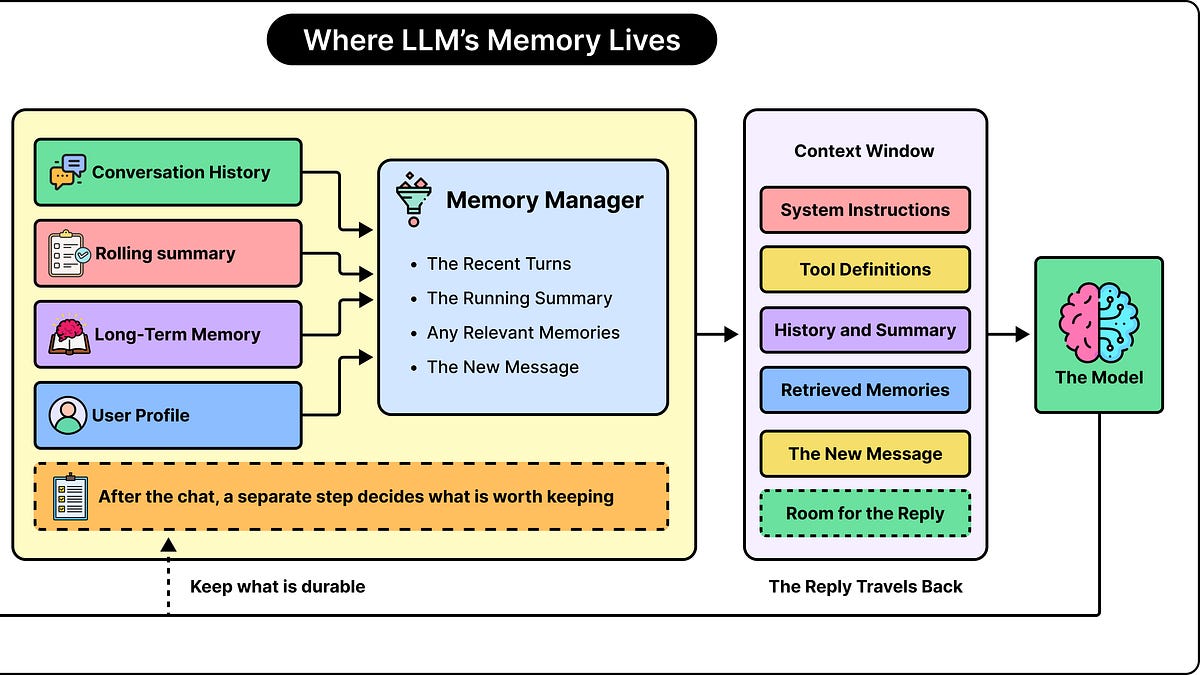
    The article explains that LLMs don’t have persistent personal memory; all “memory” is supplied by the surrounding application via the context window, summaries, or external storage. It outlines the distinction between trained weights, working‑memory (token context), and persistent application memory, shows how to construct API calls to preserve conversation state, and discusses the cost and laten…

    ByteByteGobytebytego.com12 min
  3. Presentation: Context Engineering at LinkedIn: How We Built an Organizational Context Layer for AI Agents with MCP

    LinkedIn built a “Contextual Agent Playbooks and Tools” layer that wraps internal services (code search, docs, feature flags, etc.) behind the open‑source Model Context Protocol (MCP). By feeding LLM‑powered coding agents the exact internal artifacts they need, the agents can diagnose incidents, generate PRs, and update incident tickets in minutes, delivering a reported 20 % productivity gain wit…

    InfoQinfoq.com28 mintalk