proomt

Search

Search posts, papers, and topics

All posts

TwilioJesse Sumrak12 min readintermediate

How to handle real-time interruptions in your AI voice agent

Summary

Twilio’s blog explains how to manage barge‑in, backchannels, and noisy speech in AI voice agents using Conversation Relay settings and Deepgram Flux turn‑detection, and shows how to keep LLM context in sync after an interruption.

  • Configure Conversation Relay attributes (interruptible, ignoreBackchannel, eotThreshold, speechTimeout) to handle barge‑in, backchannels, and background noise without writing new code.
  • Deepgram Flux fuses transcription and turn detection, reducing false interruptions by ~30% and cutting latency by 200‑600 ms compared to Nova‑3.
  • When an interruption occurs, use the WebSocket interrupt message (utteranceUntilInterrupt) to trim the LLM’s conversation history so the model only sees what the caller actually heard.
  • Adjust interruptSensitivity and eotThreshold (0.5‑0.9) to balance responsiveness against false positives in noisy environments.

Voice‑AI engineers and contact‑center developers need these knobs to make agents robust in real‑world, noisy calls and to keep LLM responses coherent after interruptions.

6/10


Related reading

  1. 9 top conversational AI platforms in 2026

    Twilio’s blog lists the nine leading conversational‑AI platforms for 2026, highlighting how the market consolidated and what capabilities matter when choosing a vendor. It details Twilio’s own infrastructure tools—ConversationRelay, Agent Connect, Orchestrator, and Memory—showing sub‑second latency and full‑stack reliability for voice and messaging.

    Twiliotwilio.com12 min
  2. On-Demand Masked Sessions with Twilio Proxy, Voice and Serverless

    A step‑by‑step tutorial showing how to build a Just‑in‑Time masked‑call workflow with Twilio Voice, Proxy, and Sync, using a two‑bounce out‑of‑session pattern to collect a tracking code via IVR, resolve the counterpart’s number, stash it in Sync, and auto‑create a Proxy session on the fly—all deployed as Twilio Serverless Functions.

    Twiliotwilio.com18 min
  3. How OpenAI Built GPT-Live

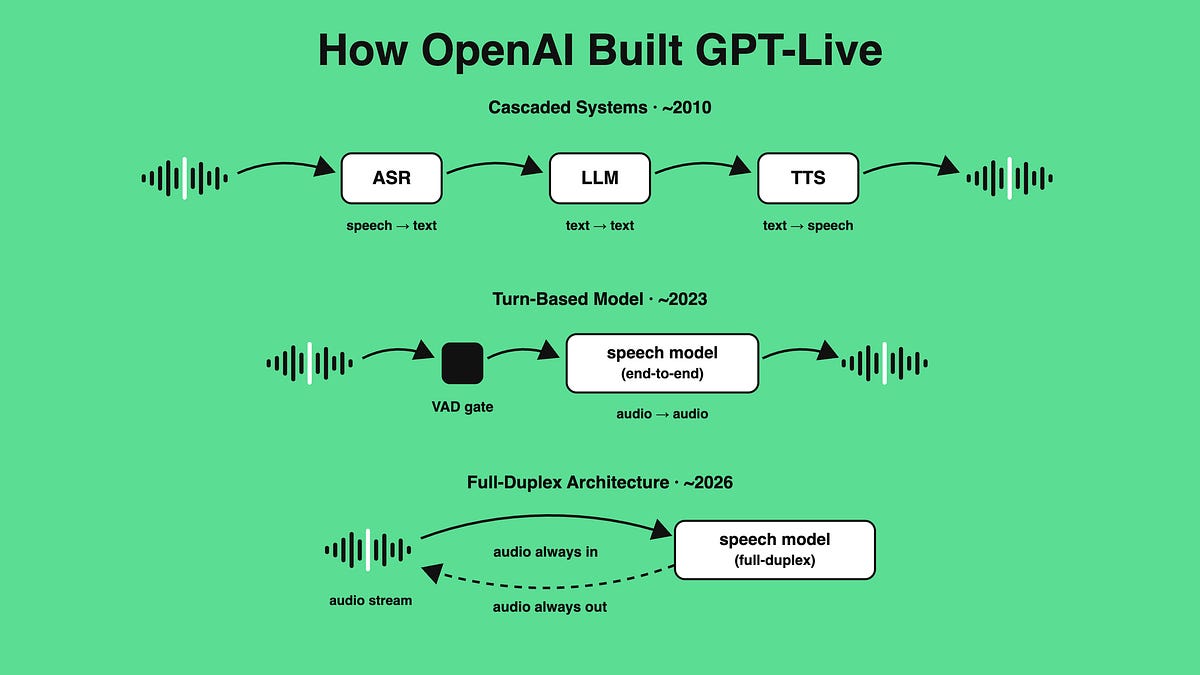
    OpenAI’s GPT‑Live‑1 is a full‑duplex voice model that can listen and speak simultaneously by tokenizing audio (including silence) and emitting tokens on an ~80 ms clock. By keeping the model small and fast and delegating heavy reasoning to a separate LLM, OpenAI solves the turn‑detector problem of earlier cascaded and turn‑based systems while meeting sub‑100 ms latency requirements. The post walk…

    ByteByteGobytebytego.com14 min
  4. What is AI agent orchestration? How it works in 2026

    AI agent orchestration is the coordination layer that routes requests, shares state, resolves conflicts, and escalates to humans across multiple AI agents. Twilio’s Conversation Orchestrator and Agent Connect implement these functions with rule‑based routing, semantic memory recall, and sub‑second handoff latency.

    Twiliotwilio.com10 min