proomt

Search

Search posts, papers, and topics

All posts

Hugging Face Daily PapersXingxuan Zhang, Gang Ren, Hao Yuan2 min readpaperadvanced

LimiX-2: A Contextual Mechanism Network Towards General Structured-Data Intelligence

Summary

LimiX-2 is a new tabular foundation model that replaces the usual target‑centric in‑context learning objective with a joint‑distribution objective via Contextual Mechanism Networks (CMNs). Trained on synthetic causal graphs using Context‑Conditional Masked Modeling, it outperforms prior tabular PFNs on TabArena, TALENT, and BCCO and can recover causal skeletons from attention patterns.

  • CMNs shift the learning goal from p(y|x,context) to p(x,y|context), enabling the model to capture underlying generative mechanisms.
  • Pre‑training uses large‑scale synthetic datasets generated from diverse structural causal models, following scaling laws derived in earlier LimiX work.
  • Evaluation shows state‑of‑the‑art predictive performance on several tabular benchmarks and emergent causal‑awareness (attention aligns with direct causal edges).

Tabular data is ubiquitous in industry, yet most models treat it as a pure prediction problem. By learning the joint distribution conditioned on context, LimiX‑2 can both predict and expose causal structure, opening pathways for more reliable decision‑support systems and for downstream tasks like c…

8/10
Related reading

  1. Presentation: Context Engineering at LinkedIn: How We Built an Organizational Context Layer for AI Agents with MCP

    LinkedIn built a “Contextual Agent Playbooks and Tools” layer that wraps internal services (code search, docs, feature flags, etc.) behind the open‑source Model Context Protocol (MCP). By feeding LLM‑powered coding agents the exact internal artifacts they need, the agents can diagnose incidents, generate PRs, and update incident tickets in minutes, delivering a reported 20 % productivity gain wit…

    InfoQinfoq.com28 mintalk
  2. Convergent Emergence of In-Context Learning Across Modalities

    The paper proposes the Convergent Emergence Hypothesis that few‑shot in‑context learning (ICL) shares a common difficulty profile across domains. Using a unified task suite, the authors evaluate ICL on six modalities—language, genome, integer sequences, time‑series, images, and proteins—showing that paired‑mapping ICL emerges in all and that per‑task benefits correlate across five modalities, sup…

    Hugging Face Daily Papersarxiv.org1 minpaper
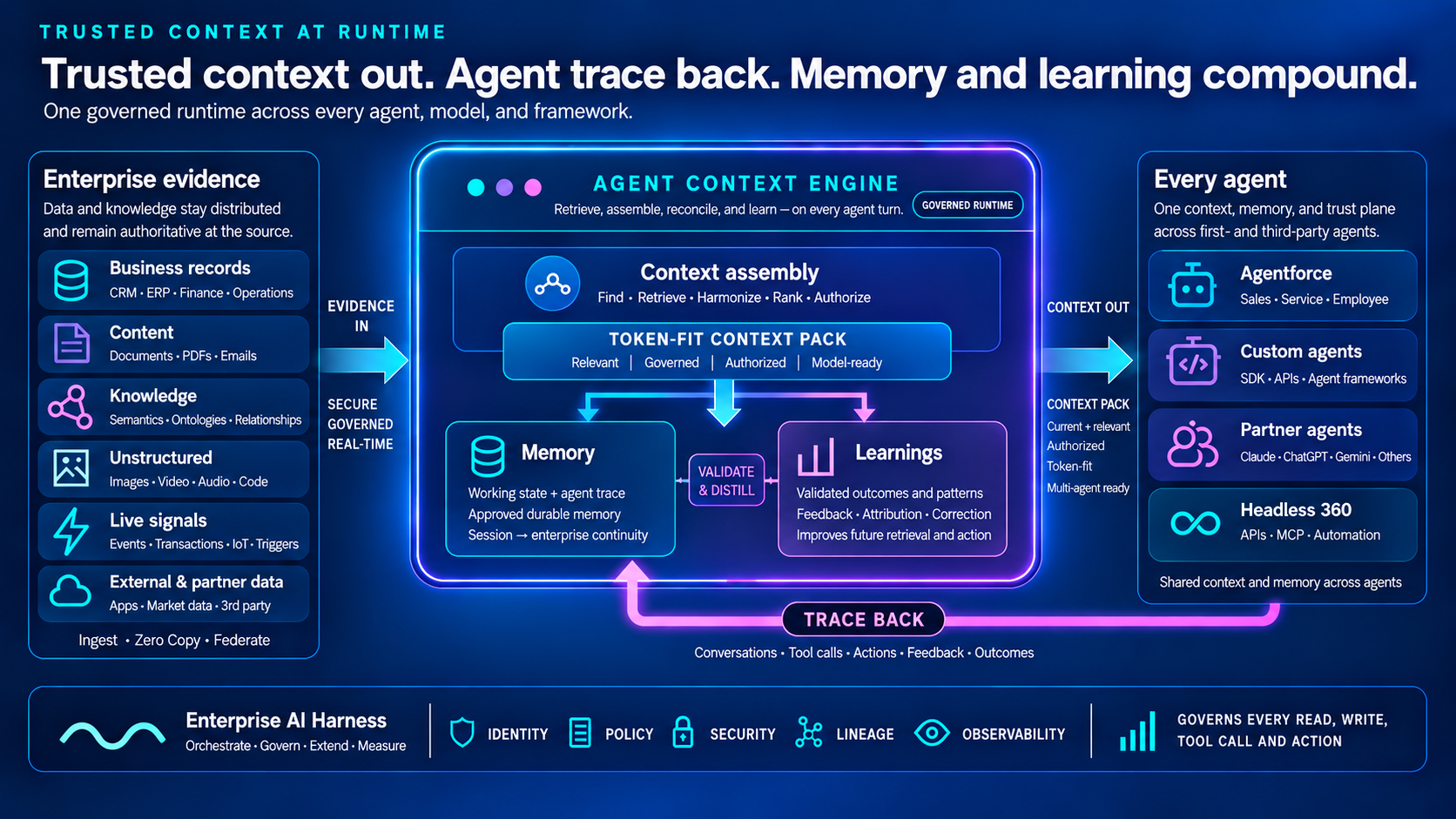
  3. How Data 360 Builds Trusted Context: The Enduring Layer for Enterprise AI

    Salesforce’s Data 360 provides a shared runtime that assembles the minimal, authorized slice of enterprise data (“Trusted Context”) for each AI‑agent turn. A six‑stage Agent Context Engine (Resolve, Plan, Reconcile, Govern, Compile, Learn) pulls data from structured, unstructured, and streaming sources across Salesforce, Snowflake, Databricks, etc., applies fine‑grained policy, and returns a toke…

    Salesforce Engineeringsalesforce.com11 min
  4. SpectralShift: Effective Context Window Extension of Gated DeltaNet via Spectral Reparameterization

    This paper introduces SpectralShift, a spectral reparameterization method for extending the context window of Gated DeltaNet (GDN) linear attention models. It reconfigures the decay spectrum by enhancing slow propagation and preserving fast-decaying modes, consistently improving long-context capabilities during continual pretraining.

    Hugging Face Daily Papersarxiv.org1 minpaper
  5. Breaking the Vision-Action Shortcut: Latent Interface Training for Generalizable Robotics Foundation Models

    Latent Interface Training (LIT) first learns a goal‑conditioned action prior without visual input, then adds a pose‑supervised latent interface as the only visual conditioning path. Applied to several vision‑language‑action models, LIT cuts vision‑action shortcuts and lifts LIBERO‑Plus success by 3.9–10.7 points and real‑world task success by 13.3–16.7 points under distribution shifts.

    Hugging Face Daily Papersarxiv.org1 minpaper
  6. Infinite-Parameter LLMs: Generating and Adapting Weights from Live Data

    The paper presents Infinite-Parameter LLMs, where a compact hypernetwork creates feed‑forward weights from live user data and updates a Bayesian latent code online, keeping the stored model size constant while effectively having infinite parameters. This design aims to improve over standard in‑context learning and retrieval by persisting knowledge in weights and freeing context space.

    Hacker News front pagearxiv.org2 minpaperHN15743