proomt

Search

Search posts, papers, and topics

All posts

arXiv cs.NI (Networking)

Quantum computers will not be that different: A blueprint for quantum computer architecture at scale

From the article

arXiv:2609.19639v1 Announce Type: cross Abstract: Quantum computers are technologically novel and unusual, but at system scale they should be engineered using many of the same principles that govern classical heterogeneous accelerators. This paper argues that utility-scale quantum architecture is primarily a cost-performance problem across a coupled quantum-classical system, leading to a blueprint for scalable quantum processing unit (QPU) design. Our architecture blueprint is organized around clean logical abstractions, hiding details and complexity of physical qubit modalities below the instruction set architecture (ISA) boundary, and specializes recurring functions aggressively to minimize the cost for utility scale quantum computations. Its low-level implementation through specialized local hardware for control, readout, and quantum error correction (QEC) closely resembles the architecture of high-performance network stacks. One of our main insights is that the design principles and the resulting architecture closely follow established practice from classical computing and networking

Related reading

  1. From error mitigation to fault-tolerant quantum computing

    IBM’s blog outlines a practical continuum from quantum error mitigation to fault‑tolerant error correction, highlighting hybrid spacetime codes that achieve ~10× effective error‑rate reduction (64 logical qubits on 76 physical qubits) and a 63× sampling‑overhead cut versus pure mitigation. It describes how post‑selected QEC combined with probabilistic error cancellation, dynamic circuits, and a n…

    IBM Researchibm.com10 min
  2. A theoretical separation between quantum computers & LLMs

    The IBM research blog explains two new theoretical results that prove shallow constant‑depth quantum circuits can outperform decoder‑only transformers on a functional task (iterated index) and diffusion language models on a sampling task (parity‑sampling). The proofs give asymptotic separations but are not yet practical.

    IBM Researchibm.com6 min
  3. Shapelearn Qwen 3.8 27B (13.1 GB VRAM)

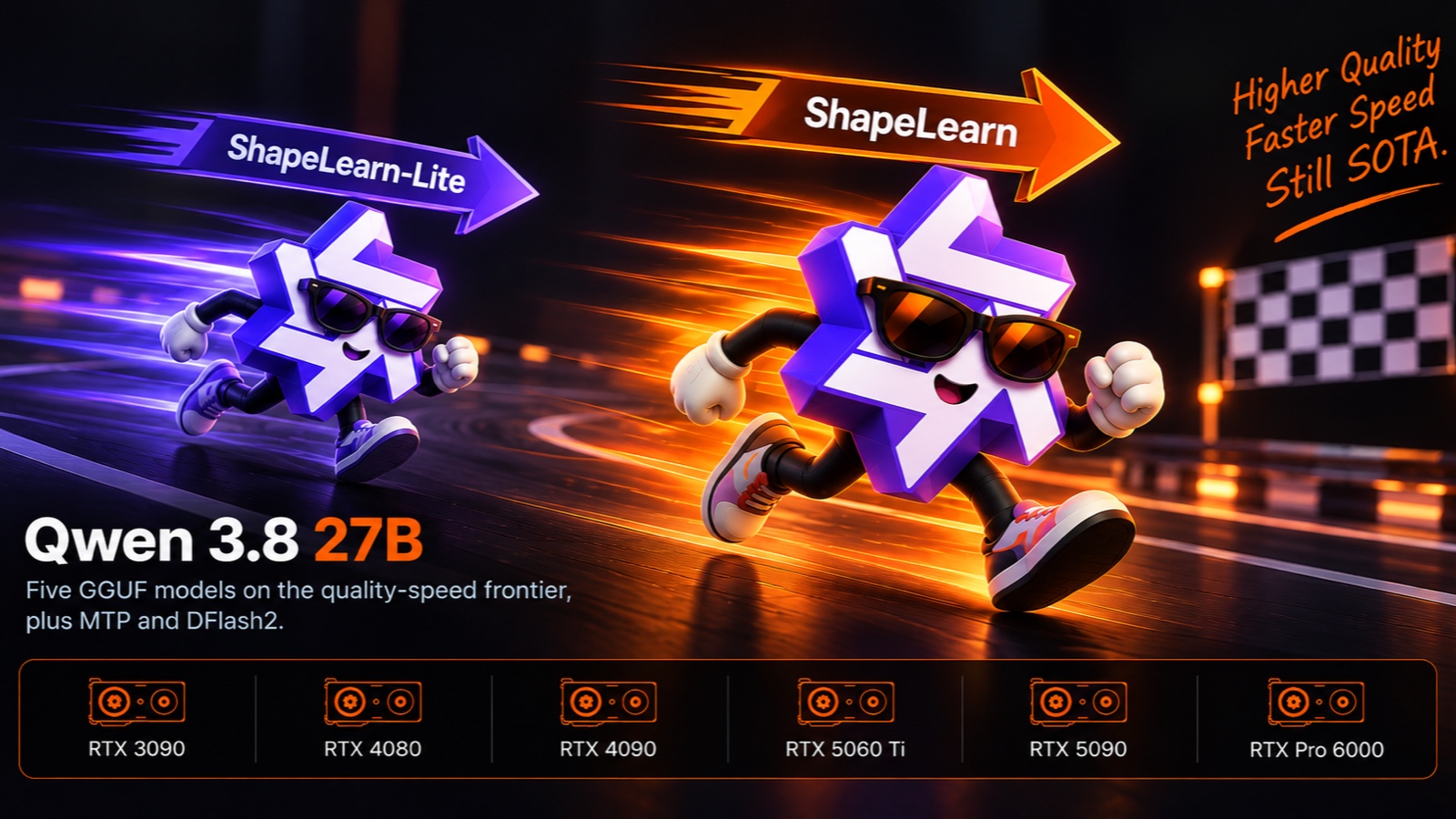
    ByteShape releases full ShapeLearn quantizations for Qwen 3.8 27B, showing that their GPU‑specific GGUFs (GPU‑1…GPU‑5) dominate the quality‑throughput frontier across six GPUs, with GPU‑5 hitting 99.63 % of BF16 accuracy at 90 TPS on a 13.1 GB model. Speculative decoding (MTP, DFlash2) further boosts throughput, and the Lite set remains competitive.

    Hacker News front pagebyteshape.com17 minHN10439
  4. Java 27 Delivers Post-Quantum Cryptography, Future Language Innovation, Helidon 27, JavaFX 27

    Java 27 ships with nine JEPs—G1 as the default GC, post‑quantum TLS 1.3, lazy constants, primitive‑type patterns, structured concurrency, compact object headers, JFR redaction, Vector API incubator, and PEM encoding preview—plus the first Java Verified Portfolio releases (Helidon 27, JavaFX 27, Jipher 20). The release is a security‑focused, non‑LTS update that paves the way for Project Valhalla f…

    InfoQinfoq.com5 min
  5. Frontier AI on Your Own Hardware

    Tim Dettmers’ lab releases an open‑source stack that lets a single‑GPU desktop run 125‑B‑parameter LLMs (Qwen 3.8 Flash Next) and even a 550‑B model (DeepSeek V4.1) with 1.5‑bit quantisation, 450 t/s token throughput, and an auto‑compaction system (CliffCompaction) that halves inference cost and enables multi‑million‑token agent sessions. The stack combines an agent harness, a fast inference fram…

    Hacker News front pagetimdettmers.com17 minHN11660