proomt

Search

Search posts, papers, and topics

All posts

Hacker News front pageByteShape17 min readintermediate
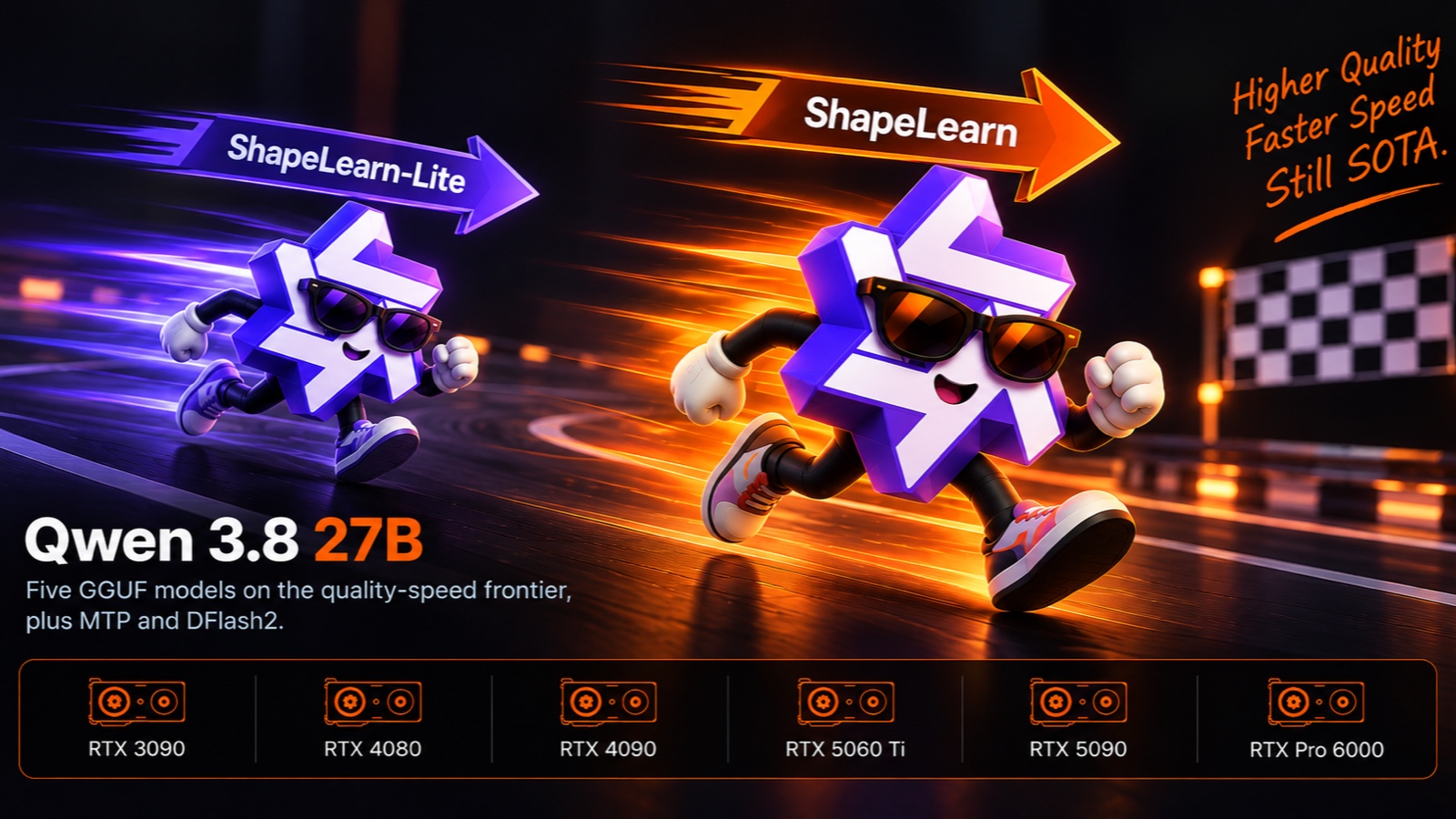
Shapelearn Qwen 3.8 27B (13.1 GB VRAM)

Summary

ByteShape releases full ShapeLearn quantizations for Qwen 3.8 27B, showing that their GPU‑specific GGUFs (GPU‑1…GPU‑5) dominate the quality‑throughput frontier across six GPUs, with GPU‑5 hitting 99.63 % of BF16 accuracy at 90 TPS on a 13.1 GB model. Speculative decoding (MTP, DFlash2) further boosts throughput, and the Lite set remains competitive.

  • ShapeLearn‑Lite (quick‑turn quantization) holds up well; the full ShapeLearn run improves both accuracy and speed for all five model sizes.
  • GPU‑5 (IQ4_XS, 3.84 bpw, 13.1 GB) is the default recommendation, achieving 99.63 % of BF16 aggregate score; GPU‑4 offers a smaller 11 GB variant with 98.72 % of BF16.
  • Speculative decoding with MTP (multimodal‑capable) or DFlash2 (text‑only, faster) consistently raises tokens‑per‑second on every GPU tested.
  • Across RTX Pro 6000 (96 GB) and RTX 5090 (32 GB) GPUs, ShapeLearn models sit on the measured quality‑throughput frontier, outperforming competing quantizations from Unsloth, ISTA‑DASLab, AtomicChat, and others.

Quantized LLMs are the only way to run 27 B‑parameter models on consumer‑grade GPUs. ByteShape’s ShapeLearn quantizations demonstrate that careful, GPU‑aware PTQ can approach full‑precision quality while fitting into 11‑13 GB VRAM, making high‑quality inference accessible without expensive hardware…

6/10

Related reading

  1. Fathom: Per-Query Read Depth for Sparse Decoding over Offloaded KV Caches

    Fathom introduces a per-query read depth mechanism for sparse decoding over offloaded KV caches, allowing each query to adaptively decide how many bits of each key channel to read. This method significantly speeds up decoding for large language models with long contexts by reducing host memory traffic, achieving 1.67x faster GPU decoding on Qwen3-8B at one million tokens.

    Hugging Face Daily Papersarxiv.org1 minpaper
  2. SiliconBench: Speed, Memory, and Fidelity for LLM Serving on Unified-Memory Desktops

    SiliconBench benchmarks nine Apple‑Silicon LLM serving engines on unified‑memory desktops, measuring speed, memory usage, and output fidelity across Qwen3, Qwen3.5, and Gemma‑4 models. It finds vllm‑metal doubles throughput at modest concurrency, memory budgets often fail to preserve headroom, and only three stacks satisfy all fidelity and model‑coverage requirements, with tensor‑parallel scaling…

    Hugging Face Daily Papersarxiv.org1 minpaper
  3. Bonsai 2 27B: Near-Lossless Compression in a 9x Smaller Footprint

    Ternary Bonsai 2 27B is a new multimodal LLM based on Qwen3.8 27B, utilizing ternary weights for a 5.9GB model footprint. It achieves over 9x compression while retaining 98.2% of the full-precision model's aggregate benchmark performance across various tasks. This enables highly capable 27B-class models to run efficiently on local devices.

    Hacker News front pageprismml.com5 minreleaseHN579198lobste.rs12
  4. Qwen 3.8 Max now available on Vercel AI Gateway

    Vercel AI Gateway now offers Qwen 3.8 Max, a 2.4 T‑parameter multimodal LLM with up to 1 M token context. It can be invoked via the standard `streamText` API or through Vercel’s coding agents, with no extra platform fees and full control over usage and security.

    Vercelvercel.com1 minrelease
  5. M5 Ultra Mac Studio Review

    The M5 Ultra Mac Studio (256 GB RAM) uses a quad‑die M5 Max architecture with an 80‑core GPU and 1.2 TB/s memory bandwidth, delivering ~70 % faster prompt‑to‑first‑token and token‑generation rates than the M3 Ultra. In the author’s tests Qwen3.8‑Flash‑Next hits 100 tokens/s on short prompts and 60‑85 tokens/s with 64‑256 KB context, making local AI agents (Open Minis, Hermes, Codex) feel snappy a…

    Hacker News front pagemacstories.net39 minHN191174