proomt

Search

Search posts, papers, and topics

All posts

Hacker News front pageDaniel Gultsch1 min readintro
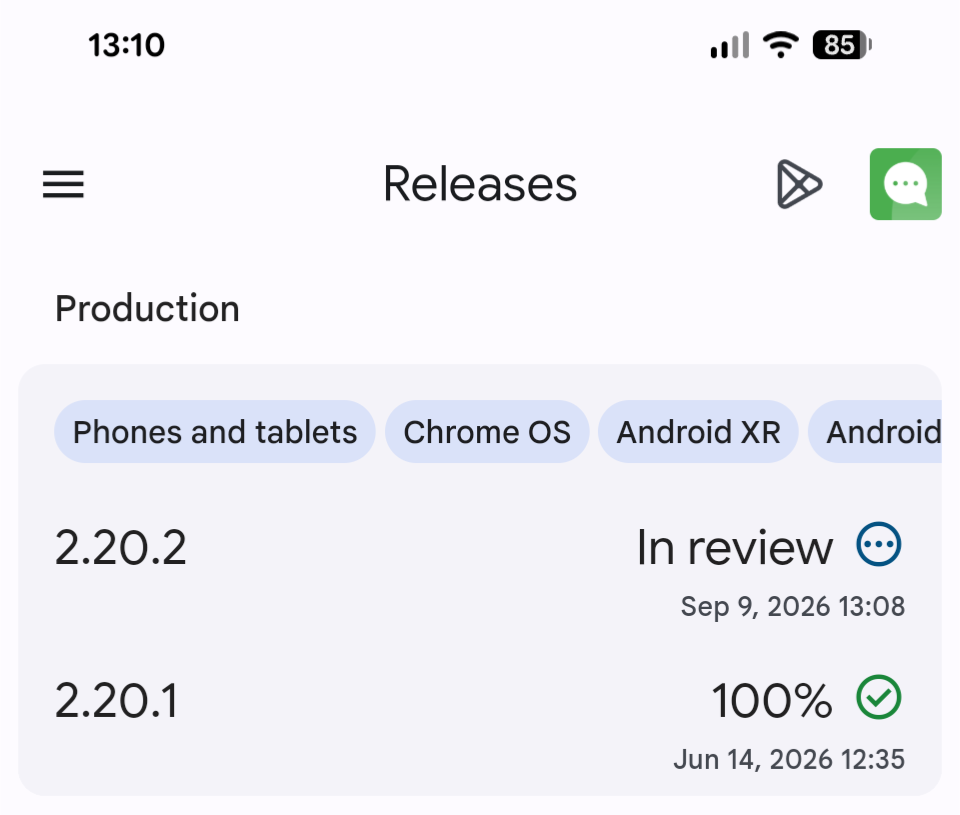
The Google Play app review process now regularly takes longer than a week

Summary

A short opinion piece complaining that Google Play’s app review now often exceeds a week, blaming AI‑generated submissions and urging Google to prioritize long‑standing Android apps.

  • The author observes review times >7 days for updates.
  • Attributes slowdown to “AI slop” in the submission pipeline.
  • Calls for Google to prioritize mature Android apps and limit update frequency.

Long review delays can stall critical bug fixes and security patches for Android developers, affecting user experience and trust in the platform.

2/10

Related reading

  1. Android Bench 2.0: Pushing the frontier with challenging long-horizon tasks

    Android Bench 2.0 adds a set of long‑horizon tasks (multi‑day Android development problems) and introduces agent‑based evaluation. Scoring is now continuous, with the best model achieving a 28 % pass rate on these tasks, far lower than the ~91 % on earlier short tasks. The post lists new models on the leaderboard and points to updated methodology and GitHub repo.

    Androidgoogleblog.com4 minHN2
  2. Changing the game: How Google uses agentic AI to secure hundreds of millions of lines of code

    Google’s AI & Infrastructure team built an agentic pipeline (Mantis) that runs pre‑submit AI‑driven scans on every code check‑in, validates findings with a fast triage agent (AST + call‑graph analysis) achieving >92% precision in <1 min, then auto‑generates fixes via a bug‑fix agent. Localized threat models and a two‑step scan cut false‑positives to ~3% and prevent hundreds of vulnerabilities eac…

    Google Cloud Bloggoogle.com4 min
  3. AI Changed How Spotify Builds. What We Learned (and Fixed) About Quality at Higher Velocity

    Spotify’s AI‑assisted development doubled change volume, exposing gaps in alerting, capacity planning, fleet‑update safety, and mobile quality signals. The team added end‑to‑end monitoring, priority‑based tiering, stronger rollback/observability, and expanded edge capacity. Data shows AI‑generated code isn’t a direct incident cause, but verification pipelines must scale with velocity.

    Spotifyatspotify.com7 minpostmortemHN52
  4. When AI Reviews Train AI Reviewers: Scientific-Judgment Collapse and Mitigation

    The authors show that training LLM reviewers on synthetic reviews leads to a compression of rating distributions and loss of semantic diversity, a phenomenon they call scientific-judgment collapse. They mitigate it with TrustReviewer, which uses curated training data and activation steering to preserve judgment diversity.

    Hugging Face Daily Papersarxiv.org1 minpaper
  5. I expected better from Google

    The authors of the open‑source project mobile‑use discovered that Google’s Artemis repository contains large blocks of identical Python code, examples, and even the same agent name without any attribution. They document the exact file diffs, the removal of their names via a force‑push, and the omission of their benchmark results from a public leaderboard. The post argues that this violates Apache…

    Lobstersminitap.ai6 minHN18032lobste.rs87