proomt

Search

Search posts, papers, and topics

All posts

Hugging Face Daily PapersYilei Tu, Zihao Li, Shaoxiong Ji1 min readpaperadvanced

Training Specialist Models without Reasoning Trajectories for Domain Expert Distillation

Summary

The paper shows that when specialist LLMs are trained only on QA pairs (no explicit reasoning supervision), their optimization implicitly selects a latent distribution of reasoning trajectories. By treating the distilled student as an agnostic probe—since it inherits only the sampled trajectories—the authors empirically demonstrate a strong correlation (across 27 specialist‑student pairs) between…

  • Specialist models trained without gold reasoning still encode a latent trajectory distribution that can be observed via downstream distillation.
  • Student models act as a clean probe of this latent distribution, inheriting only the teacher’s sampled reasoning paths.
  • Across 27 teacher‑student pairings, specialization‑generalization metrics are tightly correlated, indicating the teacher’s implicit supervision governs student behavior.
  • Explicitly adjusting the specialist’s optimization (distributional drift) yields a predictable shift in the precision‑generality balance for both teacher and student.

Understanding the hidden supervision signal in specialist‑only‑QA training lets practitioners steer the trade‑off between domain expertise and general capability without needing gold‑standard reasoning data, simplifying the pipeline for building high‑performing, domain‑adapted LLMs.

8/10

Related reading

  1. Drift-Constrained Optimization: Only Direction Matters in Fine-Tuning Instruct Models

    The paper reframes fine‑tuning of instruction‑tuned LLMs as a direction‑selection problem under a fixed behavioral‑drift budget, showing that the update direction, not magnitude, determines trade‑offs between target performance and capability preservation. In QA‑only fine‑tuning of Qwen‑3 models, layer‑selective probing finds effective directions that boost scientific reasoning and multilingual t…

    Hugging Face Daily Papersarxiv.org1 minpaper
  2. Trajectory as the Teacher: Few-Step Discrete Flow Matching via Energy-Navigated Distillation

    Apple researchers propose Trajectory‑Shaped Discrete Flow Matching (TS‑DFM), a training‑time distillation method that replaces blind stochastic jumps in discrete flow‑matching with an energy‑based compass to select higher‑quality intermediate tokens. On a 170 M‑parameter language model, the 8‑step student outperforms the 1 024‑step teacher by 32 % perplexity while being 128× faster, beating basel…

    Apple Machine Learning Researchapple.com1 minpaper
  3. Online Learning with LLM Experts from Limited Feedback

    The paper models prompt routing to multiple LLM experts as a bandit problem with limited feedback and proposes algorithms that achieve sublinear regret in both full‑information and bandit settings. Experiments demonstrate that the methods learn effective routing strategies across diverse LLMs using only a small feedback budget.

    Hugging Face Daily Papersarxiv.org2 minpaper
  4. Why I'm still bearish on LLMs after Navier-Stokes

    The author argues that despite headline successes (e.g., Navier‑Stokes proof, security exploits), current frontier LLMs still require heavy human oversight and rigorous specifications that are costly to produce. Reward‑hacking, narrow generalization, and the need for domain‑expert spec writing limit autonomous deployment to only a few niche domains (high‑failure‑cost work, tightly defined tasks,…

    Hacker News front pagedank.systems5 minHN487644lobste.rs49
  5. Verifiable Social Reasoning for LLM Assistants

    The paper introduces Fuse, a multi‑agent simulation that gives LLM assistants a verifiable ground‑truth task for social reasoning by hiding a target agent’s motive and letting a user‑mediated conversation infer it. Experiments on 12 LLMs show user mediation makes reasoning harder, models are biased by user framing, need more detail than humans, and longer chats don’t always help.

    Hugging Face Daily Papersarxiv.org1 minpaper
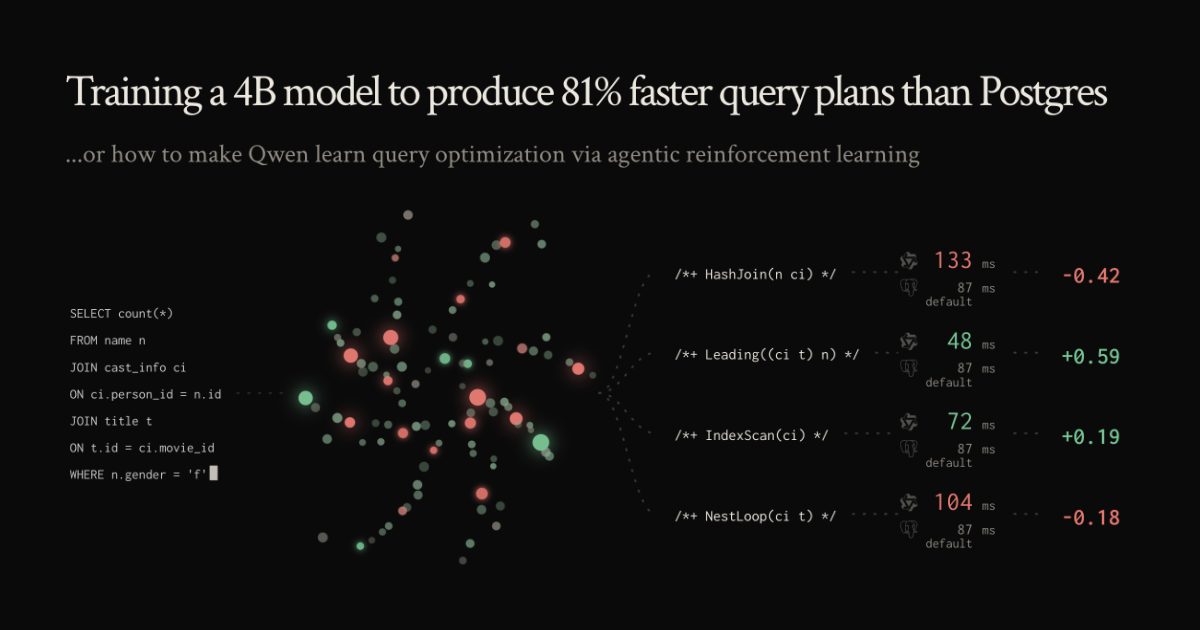
  6. Training a 4B model to produce 81% faster query plans than Postgres

    A 4‑billion‑parameter open‑weight LLM, fine‑tuned with supervised learning and a custom RL loop, learns to emit PostgreSQL join plans that cut query latency by 44.7 % on a 113‑query benchmark. The author built a low‑noise measurement harness, a GRPO‑style reward function, and ran off‑policy distillation from ~500 GPT‑6‑style trajectories, demonstrating that a modest model can outperform Postgres’…

    Hacker News front pagerohanbansal.com51 minHN692143