proomt

Search

Search posts, papers, and topics

All posts

HostingerLarassatti D.10 min readintermediate
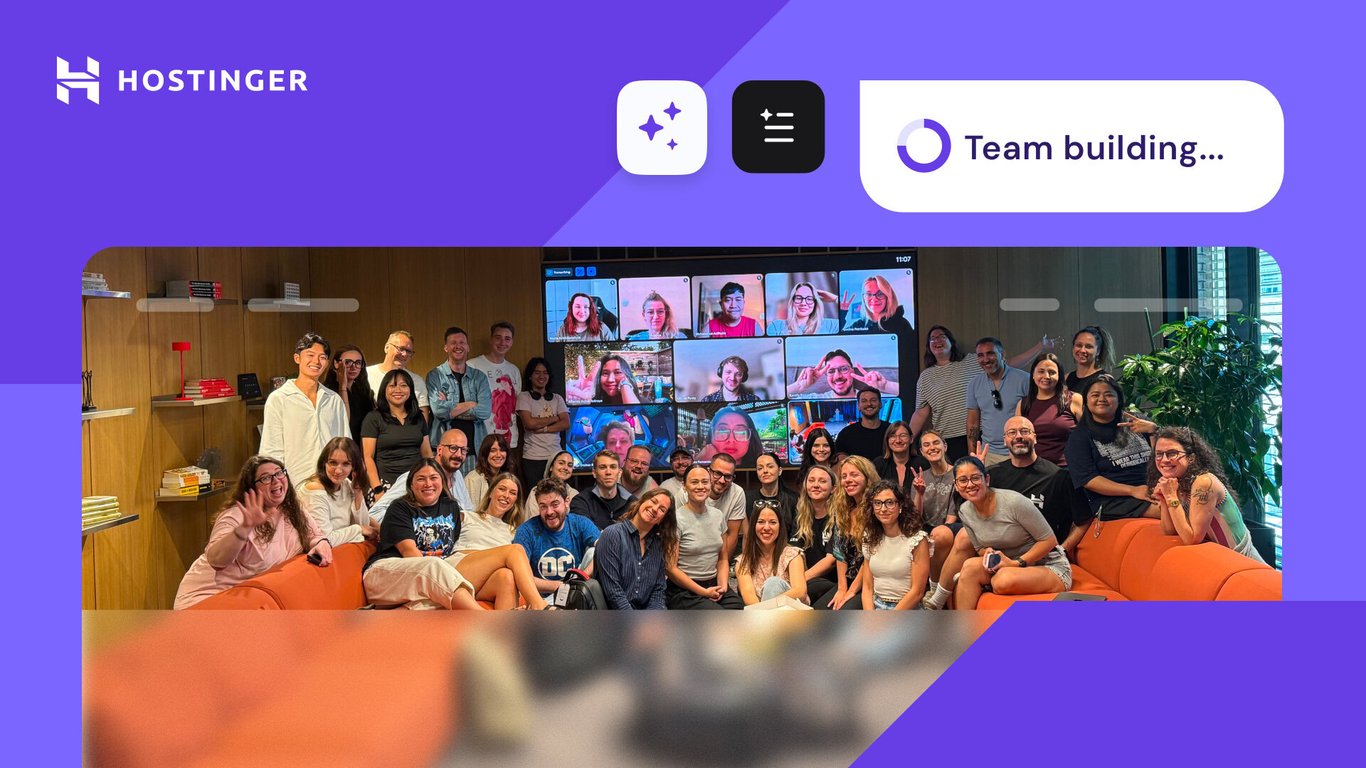
Two busy people turned team building for 42 teammates into a memorable adventure

Summary

Two Hostinger staff built a custom scavenger‑hunt web app with AI Builder to run a two‑hour, 42‑person team‑building game in Vilnius, using live scoring, photo submissions, and hidden leaderboard tricks to boost engagement.

  • A custom scavenger‑hunt web app can be built in a few hours using Hostinger AI Builder, driven by a clear PRD and 34 prompt iterations.
  • Designing for low‑bandwidth, phone‑first use requires device‑based team IDs, a timer to avoid clock drift, and a locking system to prevent duplicate review.
  • Real‑time scoring and hidden leaderboard mechanics (blitz rounds, final hide) increase engagement without needing a dedicated backend service.
  • Splitting 42 participants into mixed teams and offering a high‑stakes prize (hot‑air balloon) creates memorable bonding in a short, two‑hour window.

Engineers interested in rapid internal tool creation and AI‑assisted development will see practical patterns for low‑overhead, high‑engagement event apps.

5/10
Related reading

  1. How to upskill enterprise AI builders by using daily micro habits

    Google Cloud Consulting proposes a four‑pillar micro‑learning framework for enterprise AI upskilling: 5‑minute browser‑based exercises, pre‑configured sandboxes, daily streaks, and delivering runnable code each session. A pilot (Advent of Agents) showed >150k participants, 859k code runs, and a 31% daily return rate, suggesting short, frictionless tasks improve engagement versus traditional bootc…

    Google Cloud Bloggoogle.com3 min
  2. The DevFest Community Workshop Experience: Building Real Agents Together

    Google’s DevFest Community Workshop introduced a “Workbench” format that emphasizes architectural mental models over copy‑paste code, guiding engineers to build long‑running, self‑evolving multi‑agent systems with the Agent Development Kit and Gemini Enterprise platforms. Attendees learned state‑separation, workflow pausing, and self‑patching pipelines, and the series will continue in five more c…

    Google Cloud Bloggoogle.com2 min
  3. AI for Games in the Foundation Model Era

    The paper surveys how foundation models are used across six roles in the game development lifecycle—from playing agents to design assistance and runtime adaptation. It highlights limited transferability due to game-specific interfaces and notes that evaluation is mature for bounded play but weak for adaptive and testing scenarios.

    Hugging Face Daily Papersarxiv.org1 minpaper
  4. RecreationWorld: Scalable and Verifiable Environments for Hybrid Computer-Use Agents

    The paper presents RecreationWorld, a five‑platform framework that lets hybrid computer‑use agents learn by recreating the behavior of a running reference, and introduces RecreationBench, a 250‑task benchmark with programmatic and visual assertions. Experiments show GPT‑6 Astra reaches 58.1% overall but struggles with deeper programmatic tests, highlighting gaps in current agents.

    Hugging Face Daily Papersarxiv.org2 minpaper
  5. Android Bench 2.0: Pushing the frontier with challenging long-horizon tasks

    Android Bench 2.0 adds a set of long‑horizon tasks (multi‑day Android development problems) and introduces agent‑based evaluation. Scoring is now continuous, with the best model achieving a 28 % pass rate on these tasks, far lower than the ~91 % on earlier short tasks. The post lists new models on the leaderboard and points to updated methodology and GitHub repo.

    Androidgoogleblog.com4 minHN2