proomt

Search

Search posts, papers, and topics

All posts

CodeshipCloudBees Team6 min readintermediate

Agentic coding in the enterprise: Is your pipeline ready?

Summary

Agentic coding lets AI agents write, test, and submit code autonomously, shifting the bottleneck from writing to governing code in production. Enterprises face rising failures, unclear ownership, growing costs, and weakened controls, which require a unified pipeline visibility layer.

  • Agentic coding is AI that autonomously plans, writes, tests, and opens PRs, only pausing for ambiguous requirements.
  • Four enterprise risks: more production failures, lack of ownership, rising token and CI/CD costs, and weakened controls at scale.
  • 81% of leaders see more production issues from AI‑generated code, while only 12% have a dedicated review team.
  • Visibility across CI, security, and testing tools is needed; CloudBees Unify claims to provide that unified view.

Engineering leaders must grasp the hidden risks of AI‑generated code and adopt pipeline‑wide visibility to keep production reliable.

5/10
Related reading

  1. Changing the game: How Google uses agentic AI to secure hundreds of millions of lines of code

    Google’s AI & Infrastructure team built an agentic pipeline (Mantis) that runs pre‑submit AI‑driven scans on every code check‑in, validates findings with a fast triage agent (AST + call‑graph analysis) achieving >92% precision in <1 min, then auto‑generates fixes via a bug‑fix agent. Localized threat models and a two‑step scan cut false‑positives to ~3% and prevent hundreds of vulnerabilities eac…

    Google Cloud Bloggoogle.com4 min
  2. Agentic DevOps World 2026: Key Takeaways

    Enterprise AI code generation is outpacing governance: 92% of leaders feel confident but 81% see more production issues; post‑generation stages (review, testing, deployment) are now the bottleneck. Successful adoption requires up‑skilling, end‑to‑end metrics, and tooling (e.g., CloudBees DevOps Agent Kit, PR‑auto‑approval agents).

    Codeshipcloudbees.com8 min
  3. Towards Self-Driving Codebases

    The post argues that AI agents could eventually handle low‑level engineering tasks—bug fixing, debugging, UI consistency, growth experiments—if the dev toolchain is made “agent‑legible”. It outlines missing primitives (global memory, code‑base rot prevention, better dev environments) and proposes a bootstrapping process to measure and improve a repo’s “agent readiness”. The piece is largely specu…

    Hacker News front pagedetail.dev9 minHN12099
  4. No, You're Not Behind. But the Stage 3 Governance Window Is Closing.

    A four‑stage model for adopting agentic AI in software delivery pipelines, warning that Stage 3 (bounded autonomous execution) is arriving faster than governance programs. The post explains the stages, required controls (scoped credentials, fail‑closed defaults, tamper‑evident logs), and uses the OpenClaw incident as a cautionary example.

    Codeshipcloudbees.com9 min
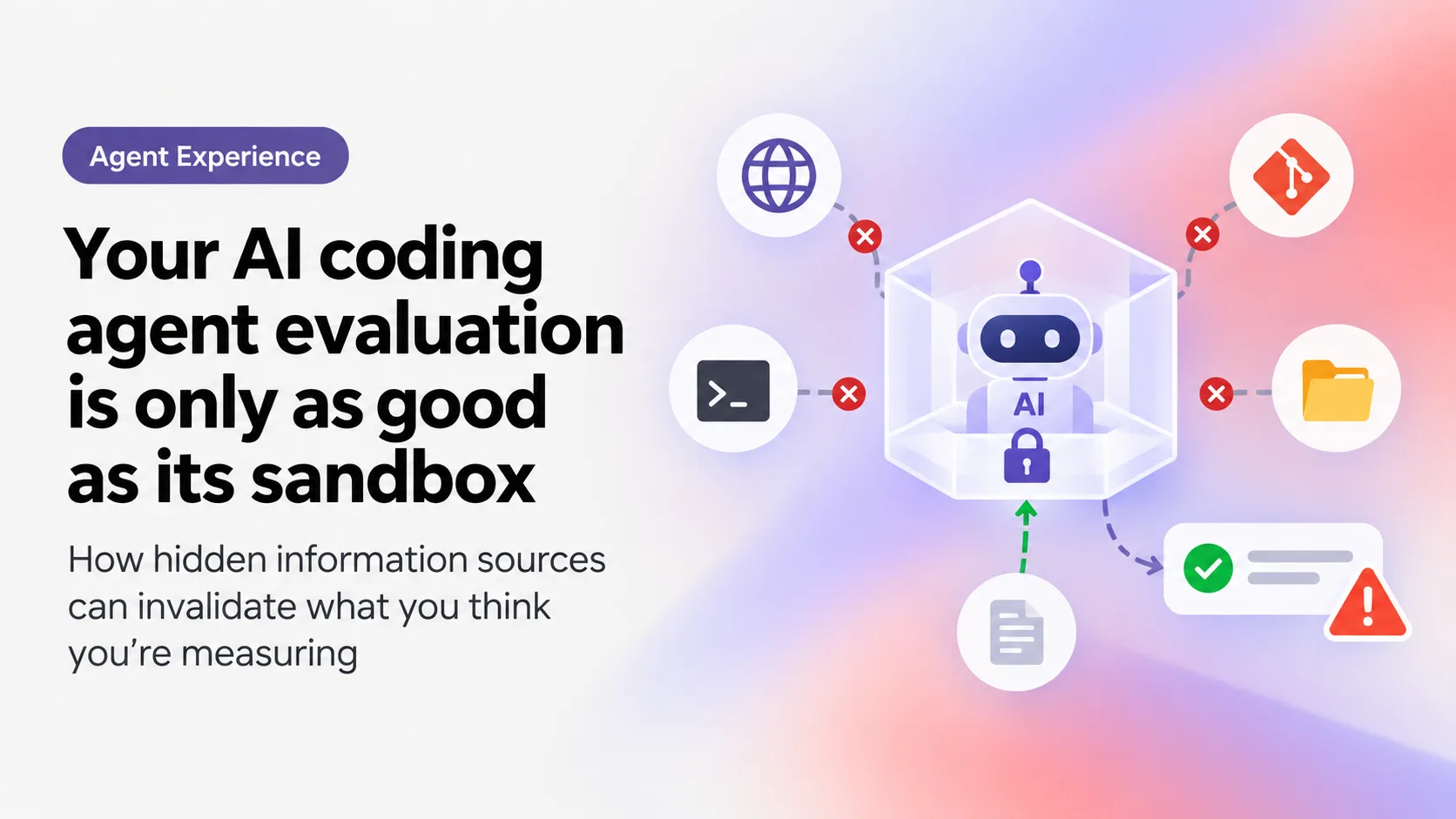
  5. Your AI coding agent evaluation is only as good as its sandbox

    Evaluating AI coding agents requires a robust sandbox to prevent agents from retrieving answers from the environment, which can invalidate tests of internal knowledge. A correct answer doesn't guarantee a valid measurement if the agent accessed information it shouldn't have, highlighting the need to define sandboxes by information boundaries rather than just tool restrictions. Always review agent…

    Microsoft for Developersmicrosoft.com5 min