proomt

Search

Search posts, papers, and topics

All posts

Microsoft for DevelopersWaldek Mastykarz5 min readintermediate
Your AI coding agent evaluation is only as good as its sandbox

Summary

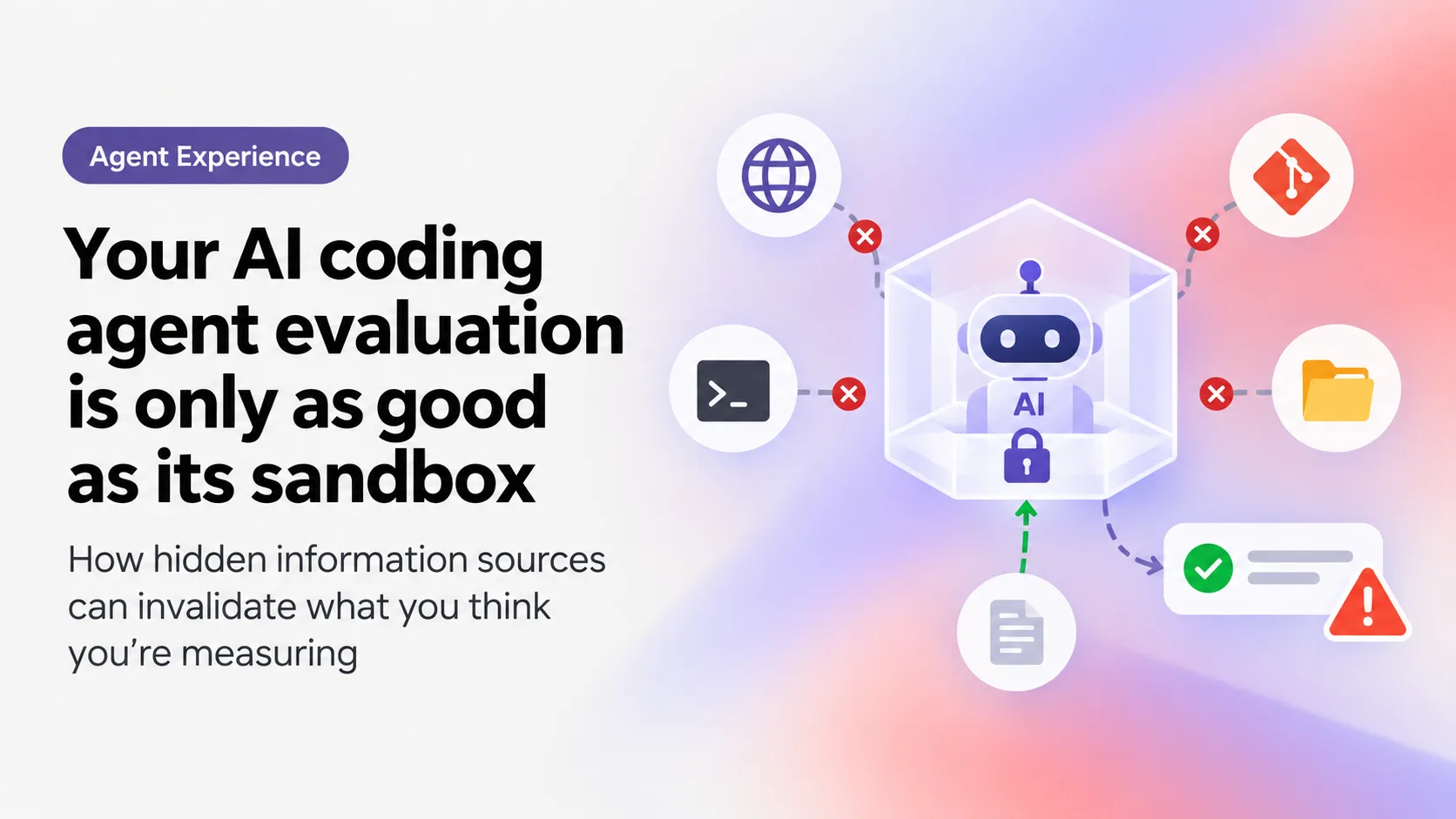
Evaluating AI coding agents requires a robust sandbox to prevent agents from retrieving answers from the environment, which can invalidate tests of internal knowledge. A correct answer doesn't guarantee a valid measurement if the agent accessed information it shouldn't have, highlighting the need to define sandboxes by information boundaries rather than just tool restrictions. Always review agent…

  • A correct agent answer can invalidate an evaluation if the agent retrieved information from the environment rather than using internal knowledge.
  • Sandboxes should enforce information boundaries across all agent capabilities, not just restrict individual tools, as agents will find alternative routes.
  • Agents can access information from the filesystem, installed software, and environment details, even when web access is blocked.
  • Always inspect the full agent trajectory, including tool calls and observations, to verify how an answer was reached.

Engineers evaluating AI coding agents need to understand how to design effective sandboxes to ensure their evaluations accurately measure agent capabilities and prevent misleading results.

7/10

Related reading

  1. Brownfield Agentic Engineering

    Addy Osmani outlines a pragmatic framework for safely introducing AI‑driven agents into legacy (brownfield) codebases. He proposes zoning code by risk, documenting non‑code knowledge, preserving research in durable memos, building a reusable “harness” of tools and rules, and starting with zero‑risk, characterization‑test‑driven work.

    Addy Osmaniaddyosmani.com13 min
  2. Agentic coding in the enterprise: Is your pipeline ready?

    Agentic coding lets AI agents write, test, and submit code autonomously, shifting the bottleneck from writing to governing code in production. Enterprises face rising failures, unclear ownership, growing costs, and weakened controls, which require a unified pipeline visibility layer.

    Codeshipcloudbees.com6 min
  3. Towards Self-Driving Codebases

    The post argues that AI agents could eventually handle low‑level engineering tasks—bug fixing, debugging, UI consistency, growth experiments—if the dev toolchain is made “agent‑legible”. It outlines missing primitives (global memory, code‑base rot prevention, better dev environments) and proposes a bootstrapping process to measure and improve a repo’s “agent readiness”. The piece is largely specu…

    Hacker News front pagedetail.dev9 minHN12099
  4. Database for AI Agents: 5 Evaluation Criteria

    Databricks outlines five criteria for a production‑ready database for AI agents—branch‑per‑agent isolation, serverless scale‑to‑zero, hybrid search, ACID guarantees, and a unified platform that eliminates ETL lag—illustrating each with features of its Lakebase offering and brief customer anecdotes.

    Databricksdatabricks.com10 min