proomt

Search

Search posts, papers, and topics

Hall of Fame

Hall of FameRoy T. Fielding200031 min readpaperintermediate

Architectural Styles and the Design of Network-based Software Architectures, Chapter 5: REST

Summary

Fielding’s dissertation chapter defines the REST architectural style by layering constraints—client‑server, stateless, cache, uniform interface, and layered system—onto a null style. It explains the trade‑offs each constraint introduces and why they matter for scalable web architectures.

  • REST is derived by incrementally adding constraints (client‑server, stateless, cache, uniform interface, layered) to a null style, each shaping system properties
  • Statelessness improves visibility, reliability, and scalability but increases per‑request overhead and shifts state to the client
  • The uniform interface decouples clients and servers via resource identification, representations, self‑descriptive messages, and hypermedia‑driven state
  • Layered systems enable intermediaries (proxies, caches) and security boundaries, at the cost of added latency

Engineers building HTTP APIs or distributed web services need to understand REST’s constraints to make informed trade‑offs about scalability, reliability, and evolvability.

8/10

Related reading

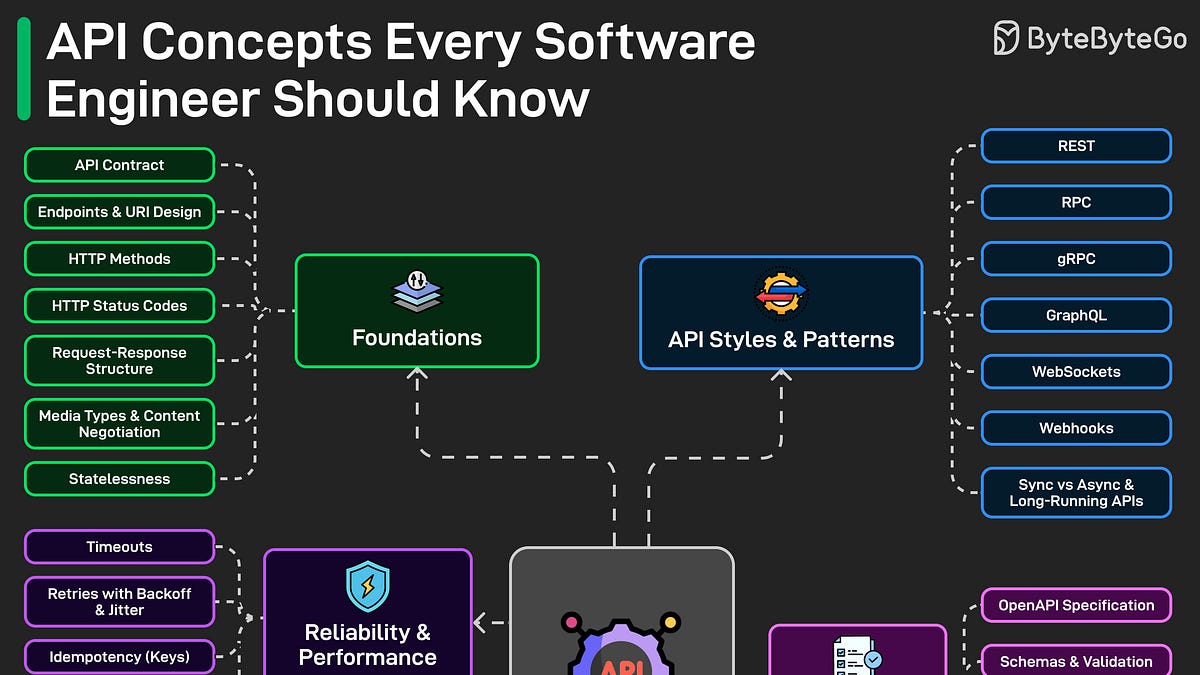
  1. EP226: API Concepts Every Software Engineer Should Know

    This article outlines essential API design considerations, covering HTTP fundamentals, architectural styles like REST and GraphQL, and critical aspects such as naming, versioning, security, and reliability. It serves as a high-level checklist for engineers designing or consuming APIs.

    ByteByteGobytebytego.com5 min
  2. Architecture of a Database System

    The paper surveys the internal architecture of modern relational DBMSs, describing the main components—client communications, process management, query processing, storage, and transaction management—and how they interact during a query lifecycle. It highlights design decisions such as admission control, buffer management, and concurrency control that are critical for scalability and reliability.

    Hall of Fameberkeley.edu161 minpaperHN31
  3. Article: Your Next DSL Author Is a Language Model

    Typed Domain Grounding (TDG) embeds a DSL inside a mainstream language the LLM already knows (e.g., Kotlin) and uses the host compiler as an oracle. The author describes five building blocks—embedding, choosing a host language with high training‑data frequency, compiler‑driven type safety, a generate‑compile‑repair loop, and an on‑demand teaching tool—and shows measured results from kUML, a Kotli…

    InfoQinfoq.com18 min
  4. 6 Ways Traditional API Design Has Changed Forever

    API design is shifting from human‑centric, resource‑based REST toward machine‑friendly, capability‑oriented interfaces as AI agents become major consumers. This drives changes in rate limiting, just‑in‑time security, system‑wide reliability, and regulatory compliance.

    Nordic APIsnordicapis.com6 min