Related reading
Cloudflare Quick Tunnels
Cloudflare Quick Tunnels let you expose a local service via an outbound‑only connection to Cloudflare’s edge network. The service gets a public URL (anycast across 335+ cities) with automatic TLS, DDoS protection, and no inbound ports. It’s positioned for short‑lived agents, webhooks, and testing loops, with JSON health output and no config files.
Hacker News front pagecloudflare.com1 minreleaseHN831316Article: Your Next DSL Author Is a Language Model
Typed Domain Grounding (TDG) embeds a DSL inside a mainstream language the LLM already knows (e.g., Kotlin) and uses the host compiler as an oracle. The author describes five building blocks—embedding, choosing a host language with high training‑data frequency, compiler‑driven type safety, a generate‑compile‑repair loop, and an on‑demand teaching tool—and shows measured results from kUML, a Kotli…
InfoQinfoq.com18 minDoorDash Uses Multi Agent LLMs to Clean up 60,000 Feature Flags
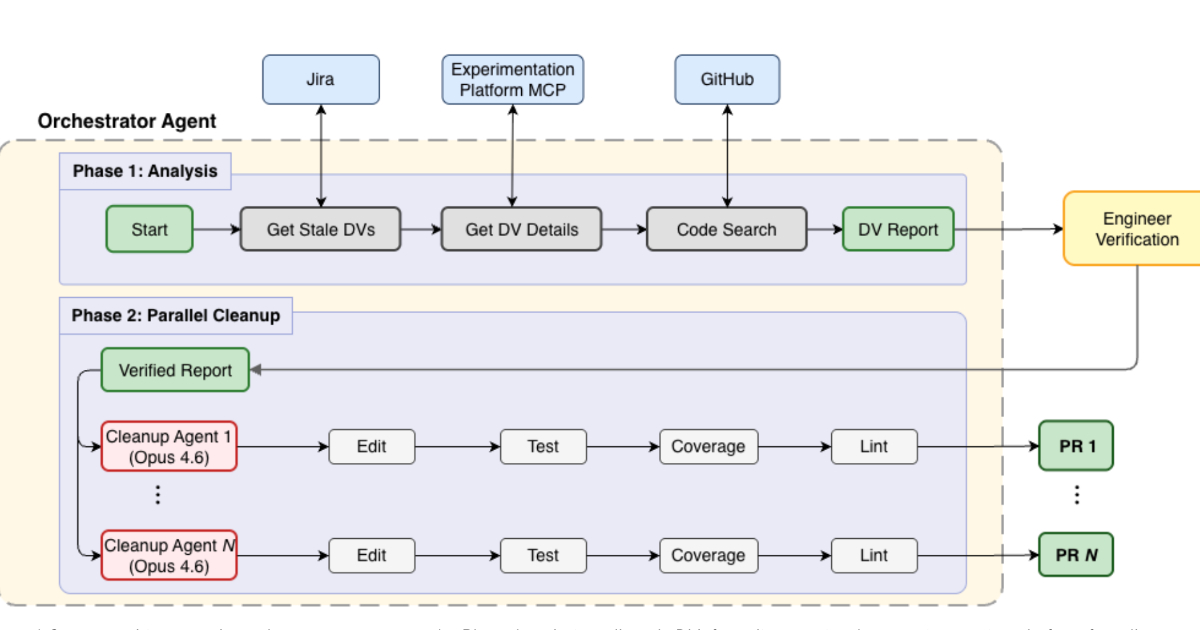
DoorDash built a two‑phase, multi‑agent LLM system (Claude Sonnet orchestrator + Claude Opus cleanup agents) that automatically removes stale feature flags from 623 repos. In a 50‑flag pilot it generated usable PRs for 45 flags at ~14 min and $4.79 each, with 100 % success on simple flags and no regressions.
InfoQinfoq.com2 minSetting Up Cloudflare Tunnels with Docker Compose for Persistent Webhook Debugging
A step‑by‑step tutorial showing how to run a persistent, free Cloudflare Tunnel alongside a TypeScript/Node.js webhook consumer in Docker Compose, replacing ngrok for local webhook debugging.
SitePointsitepoint.com14 minArticle: Architecting Secure and Scalable Facial Verification Systems
A real‑world post‑mortem of a high‑volume face verification service that moved from a naïve synchronous API to an async, layered pipeline (edge validation, preprocessing, decoupled detection/verification, decision engine) to achieve 8.5k rpm, p99 < 1.8 s, 30 % cost savings, and strict privacy controls.
InfoQinfoq.com15 min