proomt

Search

Search posts, papers, and topics

All posts

InfoQLeela Kumili2 min readintermediate
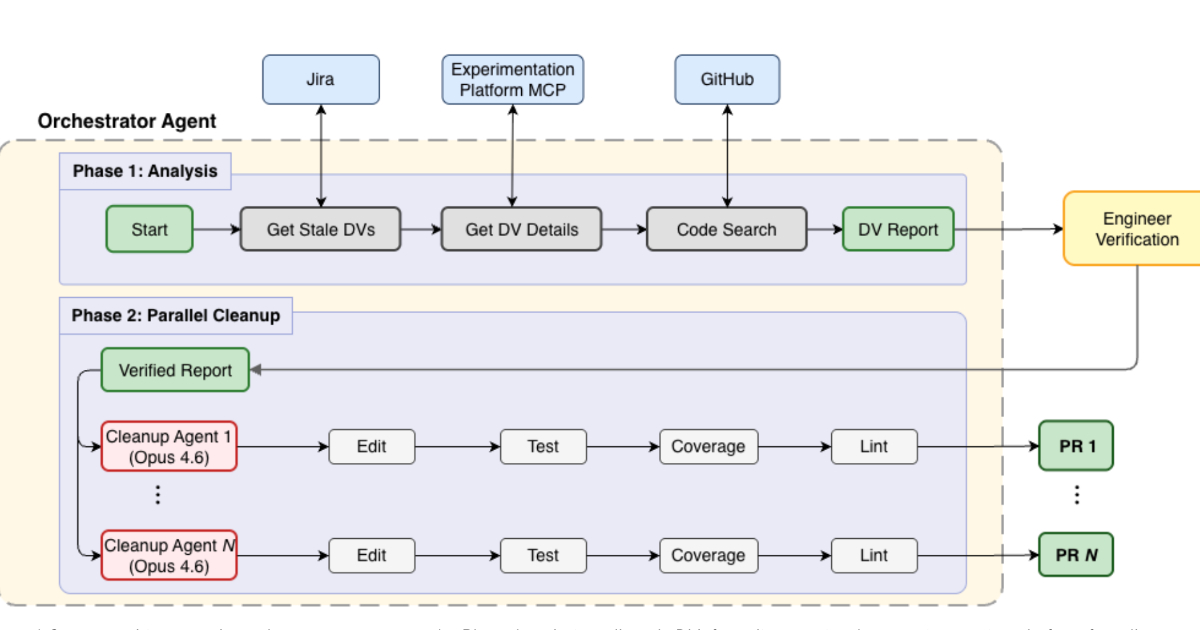
DoorDash Uses Multi Agent LLMs to Clean up 60,000 Feature Flags

Summary

DoorDash built a two‑phase, multi‑agent LLM system (Claude Sonnet orchestrator + Claude Opus cleanup agents) that automatically removes stale feature flags from 623 repos. In a 50‑flag pilot it generated usable PRs for 45 flags at ~14 min and $4.79 each, with 100 % success on simple flags and no regressions.

  • LLM agents can reliably perform non‑trivial refactorings when paired with strict validation (build, tests, coverage, static analysis).
  • Semantic patterns like dependency‑injected flag wrappers defeat pure AST‑based tools; prompting LLMs to reason about call‑graphs can fill the gap.
  • Isolating work in Git worktrees and enforcing timeouts prevents state bleed between concurrent agents.
  • Cost‑per‑cleanup (~$5) and time savings (≈1 h manual vs 14 min automated) make AI‑driven cleanup economically viable at scale.

Feature‑flag debt is a hidden source of technical debt in large codebases. Automating its removal with LLMs shows a practical path to scaling code hygiene without sacrificing safety, and provides a template for other semantic refactoring problems.

8/10

Related reading

  1. Introducing the DevOps Agent Kit

    The DevOps Agent Kit is an Apache‑2.0 open‑source starter kit that lets you plug an LLM‑based coding assistant into your existing CI/CD, security, and feature‑flag tooling via CloudBees Unify. It ships with seven read‑only example skills, enforces RBAC and audit trails, and normalises data from up to 63 tools so the agent can answer a single “are we good to ship?” question with verifiable evidenc…

    Codeshipcloudbees.com5 min
  2. When should you replace a homegrown feature flag system?

    Homegrown feature flag implementations work for small teams but quickly lack ownership, auditability, and stakeholder access as they scale. When flag count, team size, incidents, or compliance audits make these gaps costly, switch to a purpose‑built feature management platform.

    Codeshipcloudbees.com5 min
  3. The Real Cost of a Homegrown Feature Flag System

    Home‑grown feature flag systems look cheap until maintenance, governance, and scaling costs explode, especially as AI‑accelerated development creates more flags faster. Buying a managed solution offloads engineering effort, adds audit trails, and scales with multiple teams.

    Codeshipcloudbees.com6 min
  4. Your Agent Aced the Task. Will It Do It Again?

    The post introduces the Consistency Analyzer, a cheap black‑box diagnostic that flags flip‑prone decision steps in LLM agent traces, and shows how feeding the resulting consistency guidelines back into ALTK‑Evolve halves the gap between mean success and all‑run success (Pass⁵) on the AppWorld benchmark without hurting average accuracy.

    Hugging Facehuggingface.co8 minHN21
  5. Agent Anomaly Detection, now in Private Preview on the Gemini Enterprise Agent Platform

    Google’s Gemini Enterprise Agent Platform now offers a private‑preview Agent Anomaly Detection service that asynchronously analyzes agents’ OpenTelemetry traces and logs to flag risky behavior (e.g., tool misuse, privilege abuse) without adding latency, surfacing findings in Security Command Center and via an API for automated mitigation.

    Google Developersgoogleblog.com4 min
  6. ProgramDistill: From Interactive Web Apps to Verifiable Reference-Guided SWE Tasks

    ProgramDistill is a new benchmark that automatically extracts 1,975 replay‑verified feature behaviors from 26 real web apps, builds 4,063 coding‑agent tasks, and measures how well state‑of‑the‑art agents (e.g., GPT‑6 Astra, Claude Opus 5) can reconstruct full or partial applications, revealing steep drops in success as restoration depth grows.

    Hugging Face Daily Papersarxiv.org1 minpaper