Related reading
CodeMidas: Scaling Agentic Coding RL Environments from Code Itself
CodeMidas builds RL environments directly from open‑source code: agents explore a repo, infer a spec, generate tests from the original implementation, and filter tasks via execution checks. The pipeline yields 5,545 high‑quality coding tasks across 23 languages and 15 domains. Training the MiMo‑V2.5 agent with GRPO on this dataset improves benchmark scores by 8‑18% (e.g., DeepSWE +11.7%, ProgramB…
Hugging Face Daily Papersarxiv.org1 minpaperTowards Self-Driving Codebases
The post argues that AI agents could eventually handle low‑level engineering tasks—bug fixing, debugging, UI consistency, growth experiments—if the dev toolchain is made “agent‑legible”. It outlines missing primitives (global memory, code‑base rot prevention, better dev environments) and proposes a bootstrapping process to measure and improve a repo’s “agent readiness”. The piece is largely specu…
Hacker News front pagedetail.dev9 minHN12099Every tool is green. Can you ship?
A CloudBees blog post argues that existing CI, security, and QA tools don’t give release managers a complete view of AI‑generated code risk. It claims tool consolidation rarely helps and proposes a “control plane” (CloudBees Unify) that aggregates signals from multiple tools and adds AI‑driven test prioritization. The piece is largely promotional, with no concrete implementation details, metrics,…
Codeshipcloudbees.com4 minEliminating AI Code Hallucinations with TypeScript Compiler Diagnostics and TDD Loops
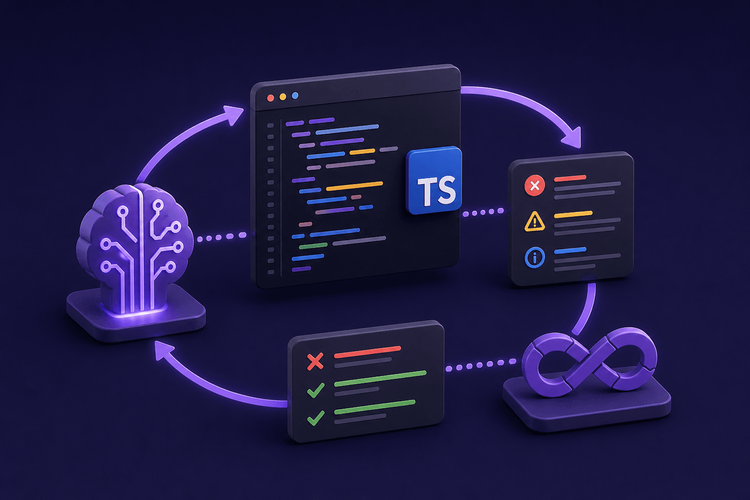
The article shows how to replace raw TypeScript compiler output with a programmatic JSON feedback loop that merges diagnostics and Vitest test failures, feeding the structured data back to an LLM coding agent for self‑correction. It provides concrete code for extracting, enriching, validating, and de‑duplicating errors, and demonstrates token savings and deterministic iteration until compilation…
SitePointsitepoint.com15 minYour AI coding agent evaluation is only as good as its sandbox
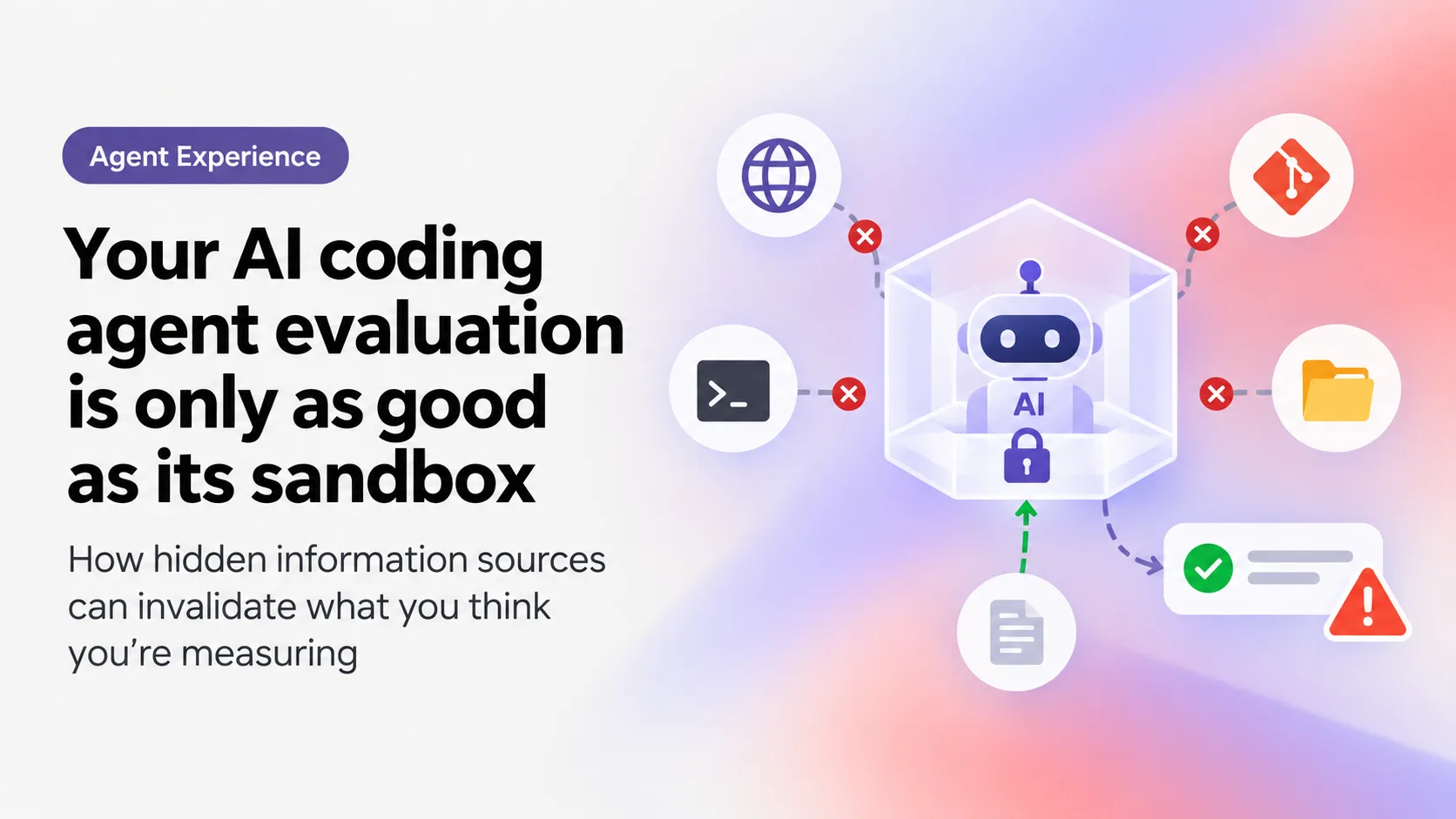
Evaluating AI coding agents requires a robust sandbox to prevent agents from retrieving answers from the environment, which can invalidate tests of internal knowledge. A correct answer doesn't guarantee a valid measurement if the agent accessed information it shouldn't have, highlighting the need to define sandboxes by information boundaries rather than just tool restrictions. Always review agent…
Microsoft for Developersmicrosoft.com5 minWho Owns AI-Generated Code Failures?
AI‑generated code breaks the traditional chain of ownership: developers merge PRs they didn’t write, reviewers approve logic they didn’t originate, and QA validates tests chosen by a model. A CloudBees survey shows 81% of firms see more production failures from AI code, and accountability often drifts upward to CTO/VP. The post argues role‑based accountability isn’t enough; you need end‑to‑end tr…
Codeshipcloudbees.com4 min