proomt

Search

Search posts, papers, and topics

All posts

SitePoint15 min readtutorialintermediate
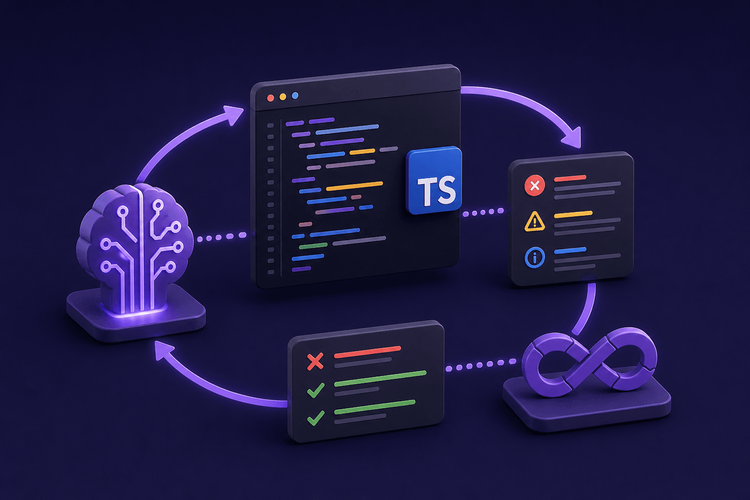
Eliminating AI Code Hallucinations with TypeScript Compiler Diagnostics and TDD Loops

Summary

The article shows how to replace raw TypeScript compiler output with a programmatic JSON feedback loop that merges diagnostics and Vitest test failures, feeding the structured data back to an LLM coding agent for self‑correction. It provides concrete code for extracting, enriching, validating, and de‑duplicating errors, and demonstrates token savings and deterministic iteration until compilation…

  • Use TypeScript's Compiler API (createProgram) to get typed diagnostics instead of parsing tsc CLI output.
  • Enrich each diagnostic with surrounding symbol info via ts-morph to give the agent clearer context.
  • Validate diagnostic and test‑failure payloads with Zod schemas before sending them to the LLM.
  • Merge diagnostics and Vitest programmatic test results into a compact JSON payload, reducing token usage by ~60% compared to raw output.

Teams building AI‑assisted code generation need deterministic, low‑token feedback to keep LLM agents from hallucinating TypeScript code.

6/10
Related reading

  1. Building Deterministic Multi-Agent State Machines in TypeScript

    The article shows how to build a deterministic, checkpoint‑backed finite state machine engine in TypeScript for orchestrating multi‑agent AI workflows. It uses Zod for schema validation, better‑sqlite3 for atomic persistence, and a pure transition function to make workflows traceable and recoverable in serverless environments.

    SitePointsitepoint.com18 min
  2. Build a Typed Context Compaction Gate for AI Agents

    A step‑by‑step tutorial showing how to build a typed context‑compaction gate for AI agents in TypeScript using LangChain and Zod. It defines a discriminated‑union schema for keep/summarize/discard actions, implements a fast gpt‑4o‑mini classifier, validates decisions at runtime, and wires the gate as middleware in an agent loop, with testing and production‑grade tuning advice.

    SitePointsitepoint.com16 min
  3. CodeMidas: Scaling Agentic Coding RL Environments from Code Itself

    CodeMidas builds RL environments directly from open‑source code: agents explore a repo, infer a spec, generate tests from the original implementation, and filter tasks via execution checks. The pipeline yields 5,545 high‑quality coding tasks across 23 languages and 15 domains. Training the MiMo‑V2.5 agent with GRPO on this dataset improves benchmark scores by 8‑18% (e.g., DeepSWE +11.7%, ProgramB…

    Hugging Face Daily Papersarxiv.org1 minpaper
  4. Who Owns AI-Generated Code Failures?

    AI‑generated code breaks the traditional chain of ownership: developers merge PRs they didn’t write, reviewers approve logic they didn’t originate, and QA validates tests chosen by a model. A CloudBees survey shows 81% of firms see more production failures from AI code, and accountability often drifts upward to CTO/VP. The post argues role‑based accountability isn’t enough; you need end‑to‑end tr…

    Codeshipcloudbees.com4 min