proomt

Search

Search posts, papers, and topics

All posts

Hugging Face Daily PapersUday Allu, Abhivanth Sivaprakash, Pratik Singh1 min readpaperadvanced

Document Retrieval-Aware Chunking (D-RAC): Universal Retrieval-Aware Ingestion of Enterprise Documents via PDF Normalization and Multimodal Markdown Conversion

Summary

D‑RAC extends the W‑RAC pipeline to any document type by first rendering it to PDF, then using a single multimodal LLM pass to turn each page into a retrieval‑optimized Markdown representation (tables become prose, headings are kept). Chunking works on deterministic IDs, avoiding re‑tokenising the source text. On a 236‑doc, 795‑page benchmark D‑RAC processes the whole set in 72 min, creates 1,748…

  • Render any input (Word, PPT, scans) to PDF first – PDF is a deterministic, lossless target for visual layout.
  • A single multimodal LLM pass converts rendered pages to Markdown, preserving hierarchy and rewriting tables as self‑contained prose.
  • Chunk planning operates on identifier metadata, not raw text, keeping token cost low and the process deterministic.
  • Empirical results: 72 min for 236 docs, 1,748 chunks, 95.7 % token reduction, 77.8 % cost reduction (GPT‑4.1) and 75 % time reduction vs. agentic chunking.

Enterprise RAG pipelines struggle with heterogeneous formats and expensive, error‑prone OCR or full‑text LLM chunking. D‑RAC offers a reproducible, low‑cost ingestion path that retains structural information crucial for retrieval, making large‑scale knowledge base construction feasible without mass…

8/10
Related reading

  1. WeVisDoc: From Coverage to Capability for Robust End-to-End Document Parsing

    WeVisDoc introduces a two‑stage data‑centric pipeline for end‑to‑end document parsing. Stage I expands coverage using heterogeneous data and structure‑preserving degradations. Stage II probes the Stage I model with a held‑out set, clusters residual errors, and directs targeted data creation and token‑budget reallocation. The 4‑billion‑parameter model reaches 95.38 Overall on OmniDocBench v1.6 and…

    Hugging Face Daily Papersarxiv.org1 minpaper
  2. How LLMs Can Find a Needle in a Haystack

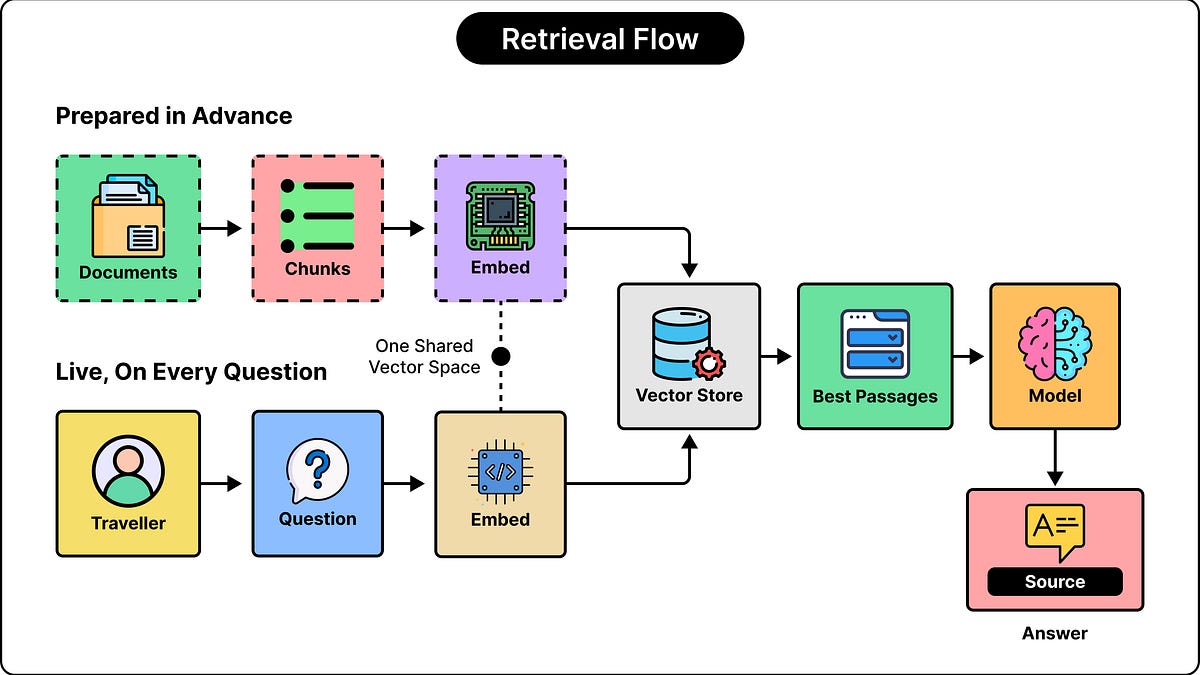
    The post explains how retrieval‑augmented generation (RAG) lets LLM‑based assistants answer questions from private corpora. It covers chunking documents into passages, embedding queries and chunks, similarity metrics, and the trade‑offs of different vector indexes (flat, IVF, HNSW). The focus is on practical design choices rather than new research.

    ByteByteGobytebytego.com12 min
  3. Chaining Activities — from text to vectors

    This post details how Temporal Activities orchestrate an RAG pipeline, from text embedding to vector storage, ensuring PII compliance and idempotency. It covers using an on-premise embedding model, caching vectors in Redis, and upserting to Pinecone with robust retry mechanisms.

    Temporaltemporal.io5 min
  4. How LlamaIndex uses Temporal to scale reliable document orchestration

    LlamaIndex migrated from RabbitMQ to Temporal for orchestrating complex, multi-stage document processing workflows, scaling to tens of millions of pages daily. This shift enabled them to replace ad-hoc state management and concurrency controls with Temporal's durable execution and workflow primitives, improving reliability and resource efficiency.

    Temporaltemporal.io7 min