Related reading
Continual Learning Mechanisms Compose for Long-Horizon Memorization
The paper studies long‑horizon memorization where a language model must learn 100 tasks via continual fine‑tuning without retaining data or task IDs. By composing data, function, and weight anchors with merged LoRA, they boost final retention from 1.2% to 34.9%, a 28× improvement.
Hugging Face Daily Papersarxiv.org1 minpaperHN2Article: Architecting Secure and Scalable Facial Verification Systems
A real‑world post‑mortem of a high‑volume face verification service that moved from a naïve synchronous API to an async, layered pipeline (edge validation, preprocessing, decoupled detection/verification, decision engine) to achieve 8.5k rpm, p99 < 1.8 s, 30 % cost savings, and strict privacy controls.
InfoQinfoq.com15 minDesigner-RSI: Evolving Procedural Memory from User Traffic for Agentic Graphic Design
The paper introduces Designer‑RSI, a continual‑adaptation system that couples a frozen design‑software‑controlling LLM with an external procedural memory of natural‑language design skills. Over five adaptation rounds on real user briefs, the memory grows from 76 to 139 procedures and lifts execution success from 72.7% to 99.3%, showing that skill accumulation and selective replay can dramatically…
Hugging Face Daily Papersarxiv.org1 minpaperSoL-Pi: Recursively Scaling Auto-Research Loops for Efficient Agent Harness
SoL-Pi is a new approach for scaling auto-research loops in coding agents, focusing on token efficiency for long reasoning trajectories. It achieves comparable performance to existing methods while significantly reducing token traffic by 44.7-49.0% and API costs by about one third on the 51-task EdgeBench evaluation.
Hugging Face Daily Papersarxiv.org1 minpaperA Lie Detector Test for Language Models: Reading Knowledge a Model Won't Reveal
The paper presents Probe of Internal Recognition (PIR), a reference‑free technique that reads a language model’s internal activations to detect which answer it recognizes, achieving 70‑87% balanced accuracy across eight LLMs. PIR reliably distinguishes deliberate concealment from lack of knowledge, enabling audits of sandbagging and unlearning.
Hugging Face Daily Papersarxiv.org1 minpaperDo LLMs Have the Memory of a Goldfish?
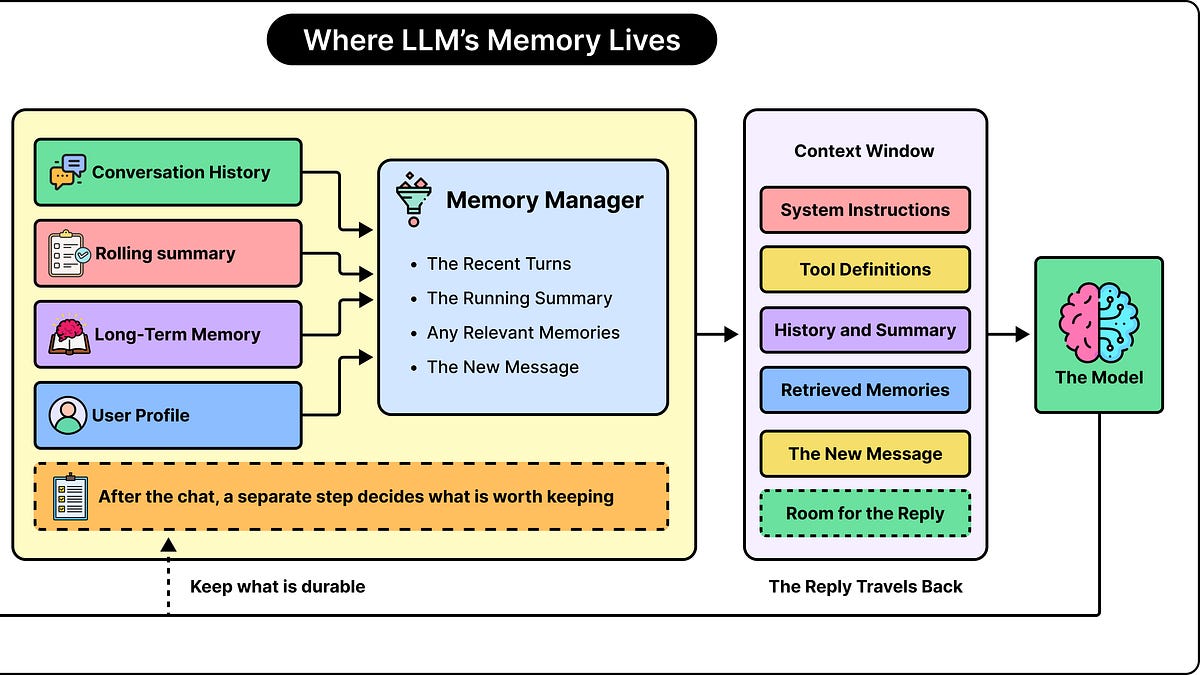
The article explains that LLMs don’t have persistent personal memory; all “memory” is supplied by the surrounding application via the context window, summaries, or external storage. It outlines the distinction between trained weights, working‑memory (token context), and persistent application memory, shows how to construct API calls to preserve conversation state, and discusses the cost and laten…
ByteByteGobytebytego.com12 min