proomt

Search

Search posts, papers, and topics

All posts

Hugging Face Daily PapersHaozhe Liu, Tian Ye, Sensen Gao1 min readpaperadvanced

SoL-Pi: Recursively Scaling Auto-Research Loops for Efficient Agent Harness

Summary

SoL-Pi is a new approach for scaling auto-research loops in coding agents, focusing on token efficiency for long reasoning trajectories. It achieves comparable performance to existing methods while significantly reducing token traffic by 44.7-49.0% and API costs by about one third on the 51-task EdgeBench evaluation.

  • SoL-Pi improves token efficiency for coding agents in long reasoning and tool-use trajectories.
  • It scales auto-research loops across diverse environments for harness rollouts.
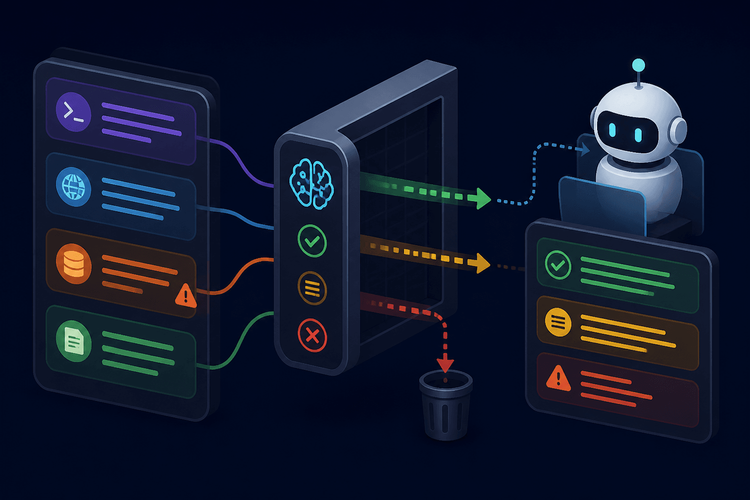
  • Key mechanisms include action execution, context compaction, observation handling, and delegated reading.
  • Achieves 44.7-49.0% token traffic reduction and ~33% API cost reduction compared to native harnesses.

Engineers developing or deploying LLM-powered coding agents should care about SoL-Pi for its potential to significantly reduce operational costs and improve efficiency in complex, long-running tasks.

7/10

Related reading

  1. CodeMidas: Scaling Agentic Coding RL Environments from Code Itself

    CodeMidas builds RL environments directly from open‑source code: agents explore a repo, infer a spec, generate tests from the original implementation, and filter tasks via execution checks. The pipeline yields 5,545 high‑quality coding tasks across 23 languages and 15 domains. Training the MiMo‑V2.5 agent with GRPO on this dataset improves benchmark scores by 8‑18% (e.g., DeepSWE +11.7%, ProgramB…

    Hugging Face Daily Papersarxiv.org1 minpaper
  2. Changing the game: How Google uses agentic AI to secure hundreds of millions of lines of code

    Google’s AI & Infrastructure team built an agentic pipeline (Mantis) that runs pre‑submit AI‑driven scans on every code check‑in, validates findings with a fast triage agent (AST + call‑graph analysis) achieving >92% precision in <1 min, then auto‑generates fixes via a bug‑fix agent. Localized threat models and a two‑step scan cut false‑positives to ~3% and prevent hundreds of vulnerabilities eac…

    Google Cloud Bloggoogle.com4 min
  3. Grounded Skill Synthesis from Code at Scale for Agentic Intelligence

    Code2Skill is an automated pipeline that mines popular GitHub repositories to extract verifiable, implementation‑anchored procedural “skills”. It builds a bank of ~1 M skill records (atomic ops, workflows, patterns) with provenance metadata, verifies each via blind reconstruction, and shows that augmenting LLM‑based agents with these skills yields an average 11.7% performance lift across 72 proto…

    Hugging Face Daily Papersarxiv.org1 minpaper
  4. Towards Self-Driving Codebases

    The post argues that AI agents could eventually handle low‑level engineering tasks—bug fixing, debugging, UI consistency, growth experiments—if the dev toolchain is made “agent‑legible”. It outlines missing primitives (global memory, code‑base rot prevention, better dev environments) and proposes a bootstrapping process to measure and improve a repo’s “agent readiness”. The piece is largely specu…

    Hacker News front pagedetail.dev9 minHN12099
  5. Build a Typed Context Compaction Gate for AI Agents

    A step‑by‑step tutorial showing how to build a typed context‑compaction gate for AI agents in TypeScript using LangChain and Zod. It defines a discriminated‑union schema for keep/summarize/discard actions, implements a fast gpt‑4o‑mini classifier, validates decisions at runtime, and wires the gate as middleware in an agent loop, with testing and production‑grade tuning advice.

    SitePointsitepoint.com16 min