proomt

Search

Search posts, papers, and topics

All posts

Hugging Face Daily PapersVivek Kalyanarangan1 min readpaperadvanced

Fathom: Per-Query Read Depth for Sparse Decoding over Offloaded KV Caches

Summary

Fathom introduces a per-query read depth mechanism for sparse decoding over offloaded KV caches, allowing each query to adaptively decide how many bits of each key channel to read. This method significantly speeds up decoding for large language models with long contexts by reducing host memory traffic, achieving 1.67x faster GPU decoding on Qwen3-8B at one million tokens.

  • KV cache scanning becomes a bottleneck when offloaded to host memory for long LLM agentic sessions.
  • Fathom allows each query to dynamically allocate a bit budget for reading key channels, stored as 4-bit channel-major bit planes.
  • The bit budget is spent by reverse water-filling over variance-weighted channel importance.
  • Achieves 1.67x faster GPU decoding than prior 136-bit scan methods (Double Sparsity, Loki, SparQ r=32) on Qwen3-8B at 1M tokens.

Engineers deploying LLMs with extremely long contexts and offloaded KV caches should care about Fathom, as it offers a concrete path to improve decoding performance and efficiency without sacrificing accuracy.

8/10
Related reading

  1. DeepSeek-V4.1-Flash: Pushing the Limits of KV Cache Compression

    DeepSeek‑V4.1‑Flash is a 552B‑parameter multimodal Mixture‑of‑Experts LLM that supports up to 1 M‑token contexts while slashing KV‑cache memory to 890 bytes/token (≈¼ of its predecessor) via cross‑layer reuse (CSA2) and FP4 quantisation, plus a SWA‑Bounded Replay scheme that cuts persistent cache to 1/8. The Causal Encoder‑Decoder design halves prefill compute (8B vs 16B active parameters) and th…

    Hugging Face Daily Papersarxiv.org3 minpaperHN12710
  2. Shapelearn Qwen 3.8 27B (13.1 GB VRAM)

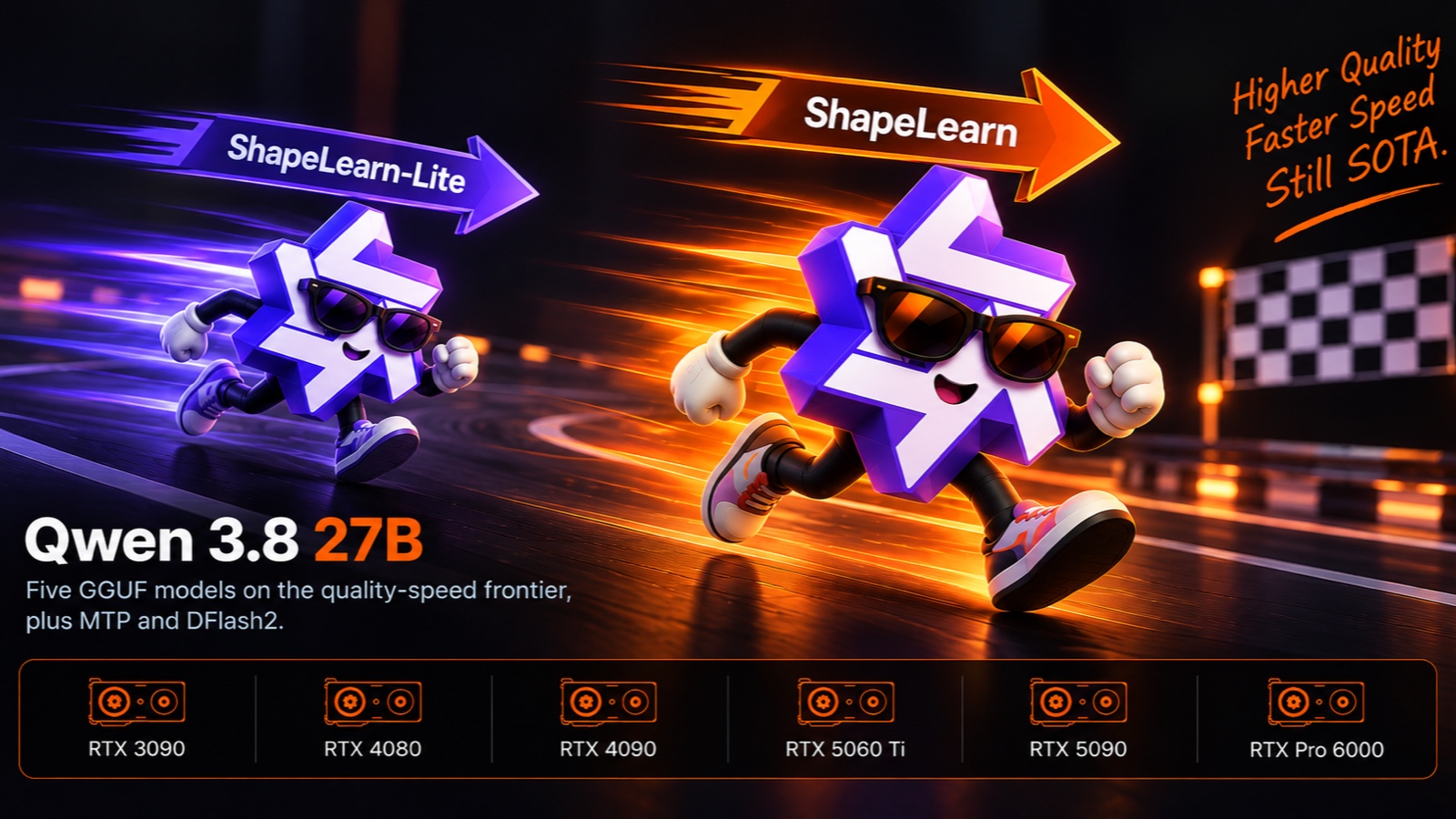
    ByteShape releases full ShapeLearn quantizations for Qwen 3.8 27B, showing that their GPU‑specific GGUFs (GPU‑1…GPU‑5) dominate the quality‑throughput frontier across six GPUs, with GPU‑5 hitting 99.63 % of BF16 accuracy at 90 TPS on a 13.1 GB model. Speculative decoding (MTP, DFlash2) further boosts throughput, and the Lite set remains competitive.

    Hacker News front pagebyteshape.com17 minHN10439
  3. How Lossless Is Lossless Speculative Decoding? The Role of Numerical Precision in Orthrus

    This paper investigates the "lossless" claim of Orthrus, a hybrid architecture for accelerating LLM inference. It finds that under BF16 precision, Orthrus diverges from the exact autoregressive output trajectory in over 50% of cases, though FP32 maintains exact matching. Despite BF16 divergence, downstream task performance was not systematically degraded.

    Hugging Face Daily Papersarxiv.org1 minpaper
  4. MoME: Mixture-of-Memory Embeddings for Context-Aware Sparse Lookup

    The paper proposes Mixture of Memory Embeddings (MoME), a context‑aware sparse lookup that replaces each token’s single memory row with a gated mixture of multiple slots. Experiments on Llama‑3, MobileLLM and Qwen3 show MoME outperforms existing memory‑embedding baselines at equal parameter and FLOP budgets and exhibits interpretable routing for polysemous tokens.

    Hugging Face Daily Papersarxiv.org1 minpaper
  5. tokenizers v1: encode, decode and scaling, measured

    Hugging Face has released `tokenizers` v1, a major performance update that achieves 3-30x faster encoding than v0.23 while maintaining identical output and API compatibility. Key optimizations include a SIMD-accelerated splitter, a thread-local word cache, and an allocation-free BPE merge loop, ensuring tokenization doesn't bottleneck ML workflows.

    Hugging Facehuggingface.co10 min