proomt

Search

Search posts, papers, and topics

All posts

Hugging Face Daily PapersMuchen Li, Leonid Sigal, Renjie Liao1 min readpaperadvanced

MoME: Mixture-of-Memory Embeddings for Context-Aware Sparse Lookup

Summary

The paper proposes Mixture of Memory Embeddings (MoME), a context‑aware sparse lookup that replaces each token’s single memory row with a gated mixture of multiple slots. Experiments on Llama‑3, MobileLLM and Qwen3 show MoME outperforms existing memory‑embedding baselines at equal parameter and FLOP budgets and exhibits interpretable routing for polysemous tokens.

  • MoME uses a learned gate over the hidden state to select among M memory slots per token, enabling context‑dependent retrieval.
  • In iso‑parameter and iso‑FLOP pretraining experiments, MoME beats Value Embedding, Bigram, and STEM baselines on nanochat, Llama‑3/MobileLLM, and Qwen3 backbones.
  • Scaling results indicate MoME’s performance improves with larger memory sizes at sub‑billion model scales while remaining efficient.
  • Routing analysis shows distinct memory slots are activated for different senses of the same token, suggesting semantic interpretability.

LLM engineers seeking efficient, context‑sensitive capacity extensions should care because MoME adds semantic memory without extra compute overhead.

6/10
Related reading

  1. Fathom: Per-Query Read Depth for Sparse Decoding over Offloaded KV Caches

    Fathom introduces a per-query read depth mechanism for sparse decoding over offloaded KV caches, allowing each query to adaptively decide how many bits of each key channel to read. This method significantly speeds up decoding for large language models with long contexts by reducing host memory traffic, achieving 1.67x faster GPU decoding on Qwen3-8B at one million tokens.

    Hugging Face Daily Papersarxiv.org1 minpaper
  2. Register Tokens for Bounded-State Reasoning in Diffusion Language Models

    Register tokens are fixed‑position embeddings that store a compact hidden state across diffusion‑based language model generation chunks, enabling bounded‑state reasoning without retaining all prior text. Post‑training on LLaDA and Dream shows up to +8.5 math and +19.5 code benchmark points versus plain text carry, and RL fine‑tuning further improves long‑horizon tasks.

    Hugging Face Daily Papersarxiv.org1 minpaper
  3. IntBMoE: Integrating Block-Level Conditioning into Expert Composition for Full-Participation Mixture-of-Experts

    IntBMoE introduces block‑level conditioning to MoE, decoupling token participation, compute execution, and memory materialization. A hypernetwork merges all experts into a composed expert per block, while routing remains sparse. Dual‑Path Residual Gating further mixes two composed paths. Experiments show consistent gains on vision, language, and recommendation tasks, and the model is live in AMap…

    Hugging Face Daily Papersarxiv.org2 minpaper
  4. DeepSeek-V4.1-Flash: Pushing the Limits of KV Cache Compression

    DeepSeek‑V4.1‑Flash is a 552B‑parameter multimodal Mixture‑of‑Experts LLM that supports up to 1 M‑token contexts while slashing KV‑cache memory to 890 bytes/token (≈¼ of its predecessor) via cross‑layer reuse (CSA2) and FP4 quantisation, plus a SWA‑Bounded Replay scheme that cuts persistent cache to 1/8. The Causal Encoder‑Decoder design halves prefill compute (8B vs 16B active parameters) and th…

    Hugging Face Daily Papersarxiv.org3 minpaperHN12710
  5. Shared Selective Persistent Memory for Agentic LLM Systems

    Apple proposes a memory architecture for agentic LLMs that selectively persists reusable context (specs, schemas, configs, constraints) across sessions and users. Shared workspaces with role‑based access and a zero‑token data‑refresh mechanism cut token usage by 97×, reduce task time by 14×, and raise task‑completion rates to 96% versus 71%‑79% for baselines.

    Apple Machine Learning Researchapple.com1 minpaper
  6. Do LLMs Have the Memory of a Goldfish?

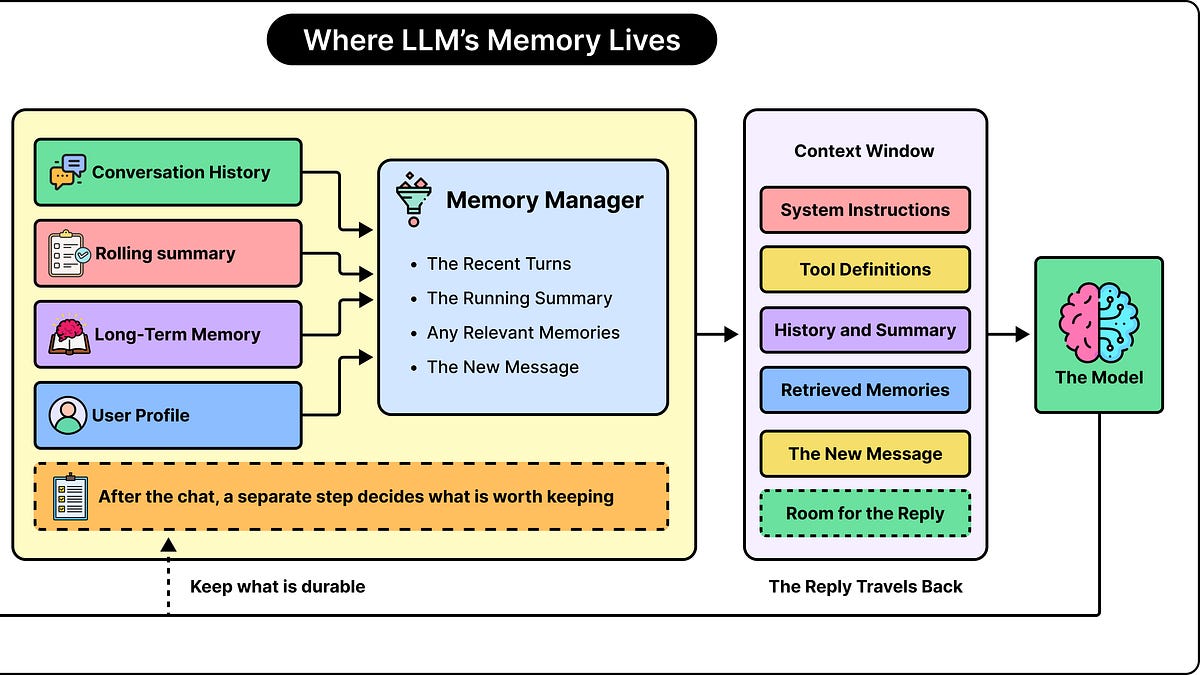
    The article explains that LLMs don’t have persistent personal memory; all “memory” is supplied by the surrounding application via the context window, summaries, or external storage. It outlines the distinction between trained weights, working‑memory (token context), and persistent application memory, shows how to construct API calls to preserve conversation state, and discusses the cost and laten…

    ByteByteGobytebytego.com12 min