proomt

Search

Search posts, papers, and topics

All posts

DatabricksKrishna Rupanagunta, Cynthya Peranandam, Siddesh Pore8 min readintermediate
Genie One MCP: Give any AI Agent the Right Business Context

Summary

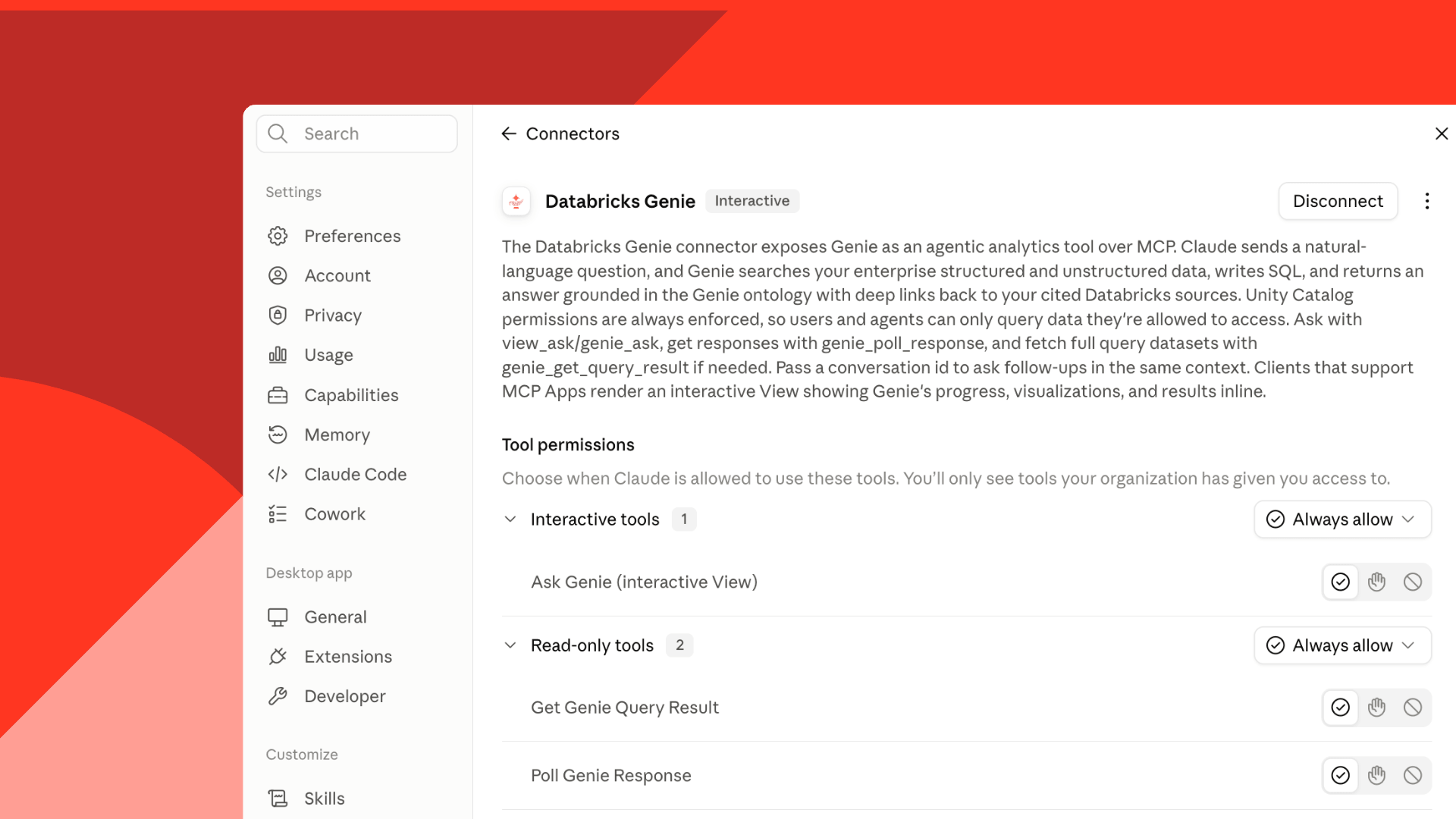
Genie One MCP extends Databricks’ Genie Ontology—a governed business‑context layer—to any Model‑Context‑Protocol‑compatible AI assistant. By exposing five MCP tools (e.g., `genie_ask`, `genie_poll_response`) and enforcing per‑user Unity Catalog permissions via on‑behalf‑of OAuth, the service lets agents retrieve permission‑aware, ontology‑grounded answers and interactive views without each model…

  • Business context (metrics, definitions, lineage, access policies) is centralized in Genie Ontology and can be reused across ChatGPT, Claude, Copilot, and coding agents via MCP.
  • Genie One MCP provides a tool contract (ask, poll, get result, cancel, view) that abstracts query generation, execution, and result rendering, returning Databricks deep links and optional interactive panels.
  • Permission enforcement relies on passing the end‑user’s OAuth token (OBO flow) so Unity Catalog row‑level filters, column masks, and grants are applied per request; service‑principal auth is also supported but loses per…
  • Setup is a preview‑toggle in a Databricks workspace plus client‑specific connector configuration; once registered, agents can invoke Genie via simple CLI commands (e.g., `ug claude`).

Enterprise AI assistants often hallucinate or return inconsistent answers because they lack a shared, governed view of business metrics and data lineage. By externalizing that knowledge into a reusable ontology and enforcing fine‑grained access at query time, organizations can safely scale AI‑drive…

5/10
Related reading

  1. The Genie One MCP is now Generally Available

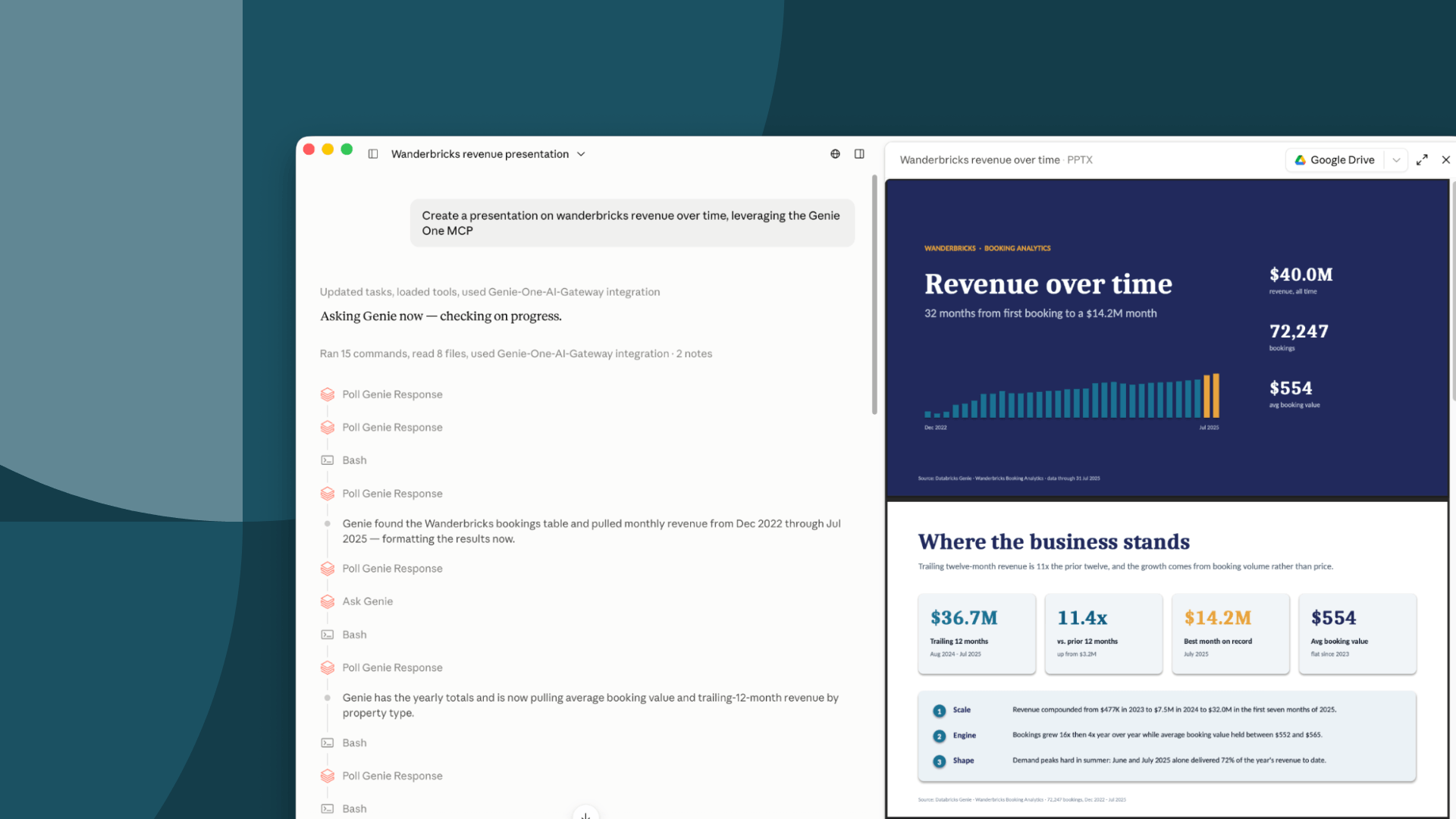
    Databricks announced the general availability of the Genie One Model Context Protocol (MCP) server, a managed service that exposes Genie One’s unified business context (via Genie Ontology) to any AI agent through Unity Gateway, enabling consistent, governed access to structured and unstructured data. The post lists high‑level use cases (slide generation, customer outreach, developer tooling) but…

    Databricksdatabricks.com4 minrelease
  2. How Databricks’ marketers use data 3x more with Genie, an AI analytics assistant

    Databricks built Marge, a Genie‑powered conversational analytics assistant on a governed Marketing Lakehouse. By starting with a single high‑value use case (email campaign performance), documenting data, encoding verified answers, teaching business terminology, and embedding the tool in existing ticket workflows, they achieved 85% adoption, 3× higher data usage in decisions, 50% QoQ usage growth,…

    Databricksdatabricks.com10 min
  3. How energy teams turn theft detection into governed action with Genie and AI business processes

    Databricks shows how to turn energy‑theft ML scores into a governed, end‑to‑end workflow using a Databricks App, Lakebase for live case state, Unity Catalog for data governance, and Genie One for natural‑language executive reporting. The pattern lets utilities act on alerts faster while staying compliant, and can be reused for other fraud‑type use cases.

    Databricksdatabricks.com6 min
  4. Database for AI Agents: 5 Evaluation Criteria

    Databricks outlines five criteria for a production‑ready database for AI agents—branch‑per‑agent isolation, serverless scale‑to‑zero, hybrid search, ACID guarantees, and a unified platform that eliminates ETL lag—illustrating each with features of its Lakebase offering and brief customer anecdotes.

    Databricksdatabricks.com10 min
  5. How Data 360 Builds Trusted Context: The Enduring Layer for Enterprise AI

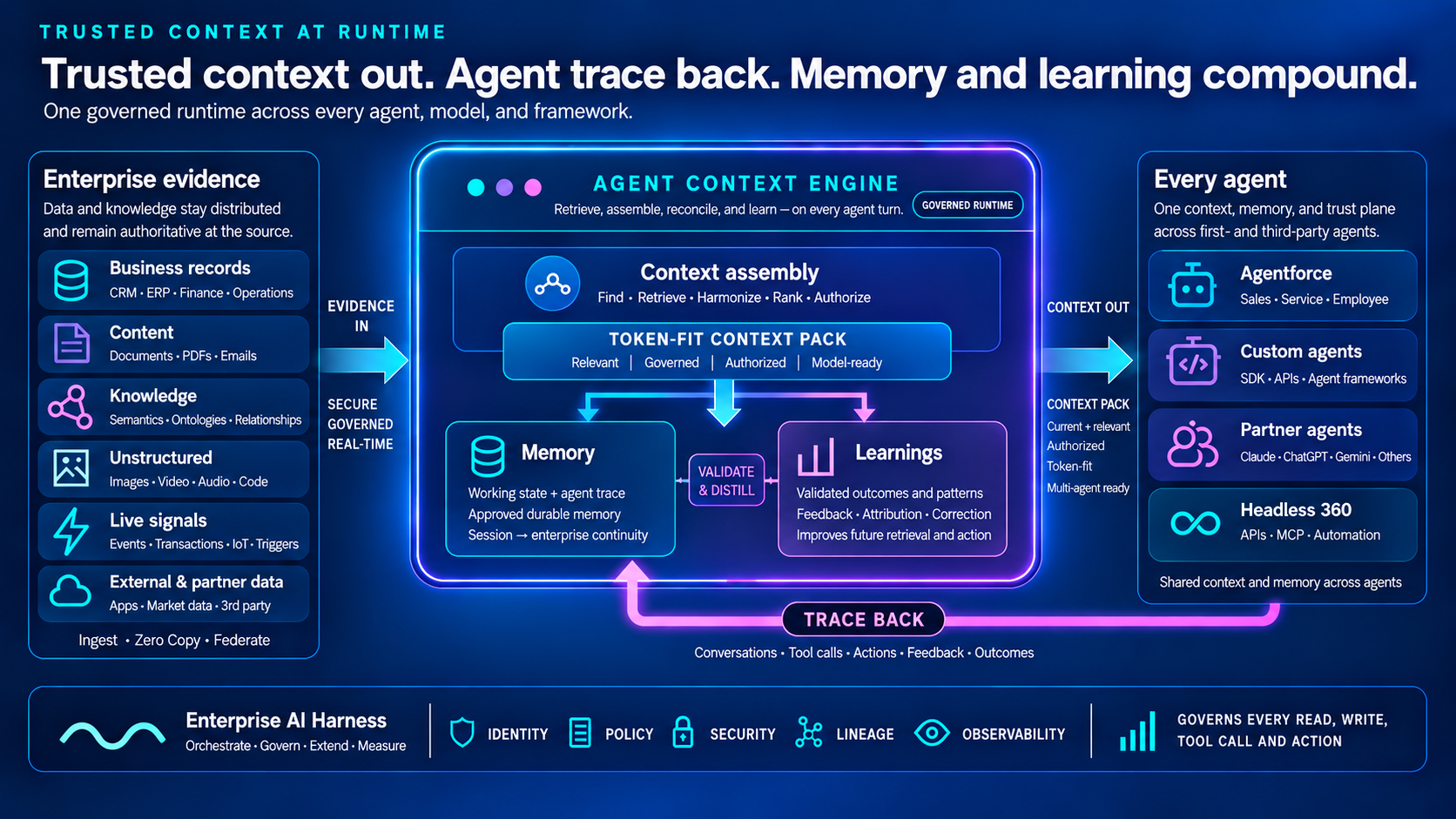
    Salesforce’s Data 360 provides a shared runtime that assembles the minimal, authorized slice of enterprise data (“Trusted Context”) for each AI‑agent turn. A six‑stage Agent Context Engine (Resolve, Plan, Reconcile, Govern, Compile, Learn) pulls data from structured, unstructured, and streaming sources across Salesforce, Snowflake, Databricks, etc., applies fine‑grained policy, and returns a toke…

    Salesforce Engineeringsalesforce.com11 min
  6. Presentation: Context Engineering at LinkedIn: How We Built an Organizational Context Layer for AI Agents with MCP

    LinkedIn built a “Contextual Agent Playbooks and Tools” layer that wraps internal services (code search, docs, feature flags, etc.) behind the open‑source Model Context Protocol (MCP). By feeding LLM‑powered coding agents the exact internal artifacts they need, the agents can diagnose incidents, generate PRs, and update incident tickets in minutes, delivering a reported 20 % productivity gain wit…

    InfoQinfoq.com28 mintalk