proomt

Search

Search posts, papers, and topics

All posts

Hugging Face Daily PapersYongqi Tong, Pan Wang, Hang Wang1 min readpaperadvanced

Grounded Skill Synthesis from Code at Scale for Agentic Intelligence

Summary

Code2Skill is an automated pipeline that mines popular GitHub repositories to extract verifiable, implementation‑anchored procedural “skills”. It builds a bank of ~1 M skill records (atomic ops, workflows, patterns) with provenance metadata, verifies each via blind reconstruction, and shows that augmenting LLM‑based agents with these skills yields an average 11.7% performance lift across 72 proto…

  • Source code can serve as a grounding source for skill synthesis without requiring any prior environment interaction.
  • Code2Skill processes 19,769 actively maintained GitHub repos, producing 1,006,822 accepted skill records with rich metadata (workflow, boundary, provenance, source evidence).
  • Verification combines source‑body‑blind reconstruction and source‑aware comparison to ensure the extracted skill matches the original implementation.
  • In downstream tasks, models that retrieve CodeSkillBank skills improve by 11.7% on average over matched baselines and beat them in 57 out of 72 protocol‑matched evaluations.

Agentic AI systems need reusable procedural knowledge to generalize beyond their training data. Traditional skill acquisition either requires costly environment interaction (trajectory‑based) or relies on unverified textual descriptions (document‑derived). By grounding skills in executable code, Co…

8/10
Related reading

  1. CodeMidas: Scaling Agentic Coding RL Environments from Code Itself

    CodeMidas builds RL environments directly from open‑source code: agents explore a repo, infer a spec, generate tests from the original implementation, and filter tasks via execution checks. The pipeline yields 5,545 high‑quality coding tasks across 23 languages and 15 domains. Training the MiMo‑V2.5 agent with GRPO on this dataset improves benchmark scores by 8‑18% (e.g., DeepSWE +11.7%, ProgramB…

    Hugging Face Daily Papersarxiv.org1 minpaper
  2. Towards Self-Driving Codebases

    The post argues that AI agents could eventually handle low‑level engineering tasks—bug fixing, debugging, UI consistency, growth experiments—if the dev toolchain is made “agent‑legible”. It outlines missing primitives (global memory, code‑base rot prevention, better dev environments) and proposes a bootstrapping process to measure and improve a repo’s “agent readiness”. The piece is largely specu…

    Hacker News front pagedetail.dev9 minHN12099
  3. The DevFest Community Workshop Experience: Building Real Agents Together

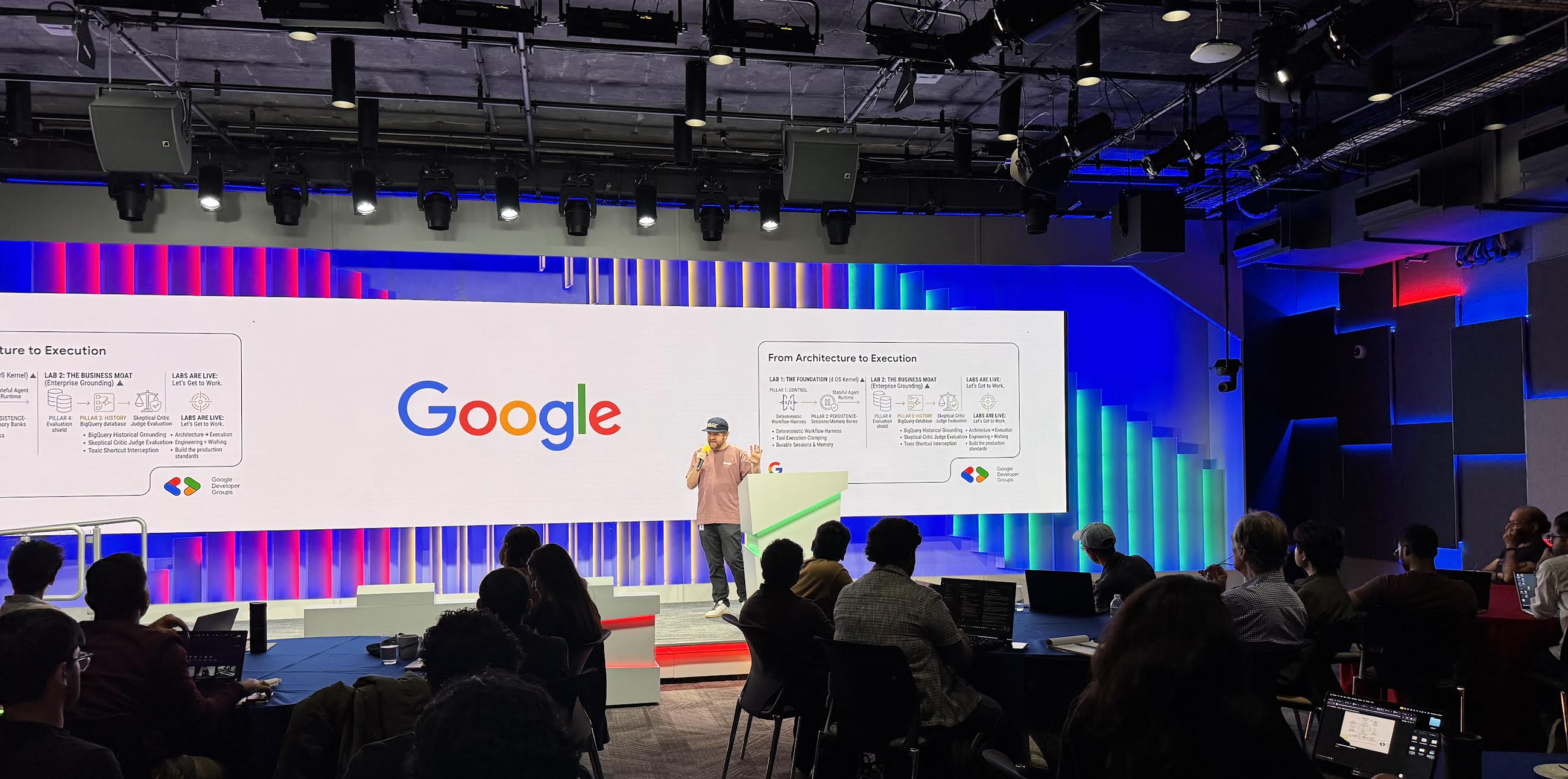
    Google’s DevFest Community Workshop introduced a “Workbench” format that emphasizes architectural mental models over copy‑paste code, guiding engineers to build long‑running, self‑evolving multi‑agent systems with the Agent Development Kit and Gemini Enterprise platforms. Attendees learned state‑separation, workflow pausing, and self‑patching pipelines, and the series will continue in five more c…

    Google Cloud Bloggoogle.com2 min
  4. Designer-RSI: Evolving Procedural Memory from User Traffic for Agentic Graphic Design

    The paper introduces Designer‑RSI, a continual‑adaptation system that couples a frozen design‑software‑controlling LLM with an external procedural memory of natural‑language design skills. Over five adaptation rounds on real user briefs, the memory grows from 76 to 139 procedures and lifts execution success from 72.7% to 99.3%, showing that skill accumulation and selective replay can dramatically…

    Hugging Face Daily Papersarxiv.org1 minpaper
  5. Agentic Skill Decay

    Addy Osmani warns that AI agents can short‑circuit the hands‑on practice (“reps”) that builds deep expertise and judgment. He recommends deliberately inserting hypothesis‑forming, “why” questioning, diff inspection, failure prediction, and occasional manual coding into the workflow, especially for junior engineers. A 2026 Anthropic study showed junior developers using AI scored 17 % lower on a fo…

    Addy Osmaniaddyosmani.com16 min
  6. COBRA-Skills: Contextual Bandit-Guided Evolution for Agent Skill Optimization

    COBRA‑Skills uses a contextual‑bandit loop to selectively evaluate and evolve LLM agent skills, achieving better performance with roughly half the evaluation cost of prior methods. The framework works with limited examples and remains robust across different agent setups and even when the target model creates its own skills.

    Hugging Face Daily Papersarxiv.org1 minpaper