proomt

Search

Search posts, papers, and topics

All posts

Stack OverflowPhoebe Sajor1 min readintro

Haters think AI agents can't write GPU code? This'll ROCm

Summary

The Stack Overflow podcast interviews AMD's VP about ROCm, an open‑source GPU toolchain, and how agentic AI is making low‑level hardware programming more accessible. The discussion is promotional and offers no deep technical insight.

  • ROCm is AMD's unified, open‑source software layer for programming its GPUs.
  • Agentic AI tools are claimed to lower the barrier for writing low‑level GPU code.
  • The interview suggests a faster convergence between hardware and software development timelines, but provides no concrete examples.
  • Listeners are directed to follow the AMD VP on X for more updates.

GPU developers and AI tool builders should note the growing interest in AI‑assisted hardware programming, even if the details are still vague.

4/10
Related reading

  1. Frontier AI on Your Own Hardware

    Tim Dettmers’ lab releases an open‑source stack that lets a single‑GPU desktop run 125‑B‑parameter LLMs (Qwen 3.8 Flash Next) and even a 550‑B model (DeepSeek V4.1) with 1.5‑bit quantisation, 450 t/s token throughput, and an auto‑compaction system (CliffCompaction) that halves inference cost and enables multi‑million‑token agent sessions. The stack combines an agent harness, a fast inference fram…

    Hacker News front pagetimdettmers.com17 minHN17594
  2. Inside OpenAI’s agentic software factory

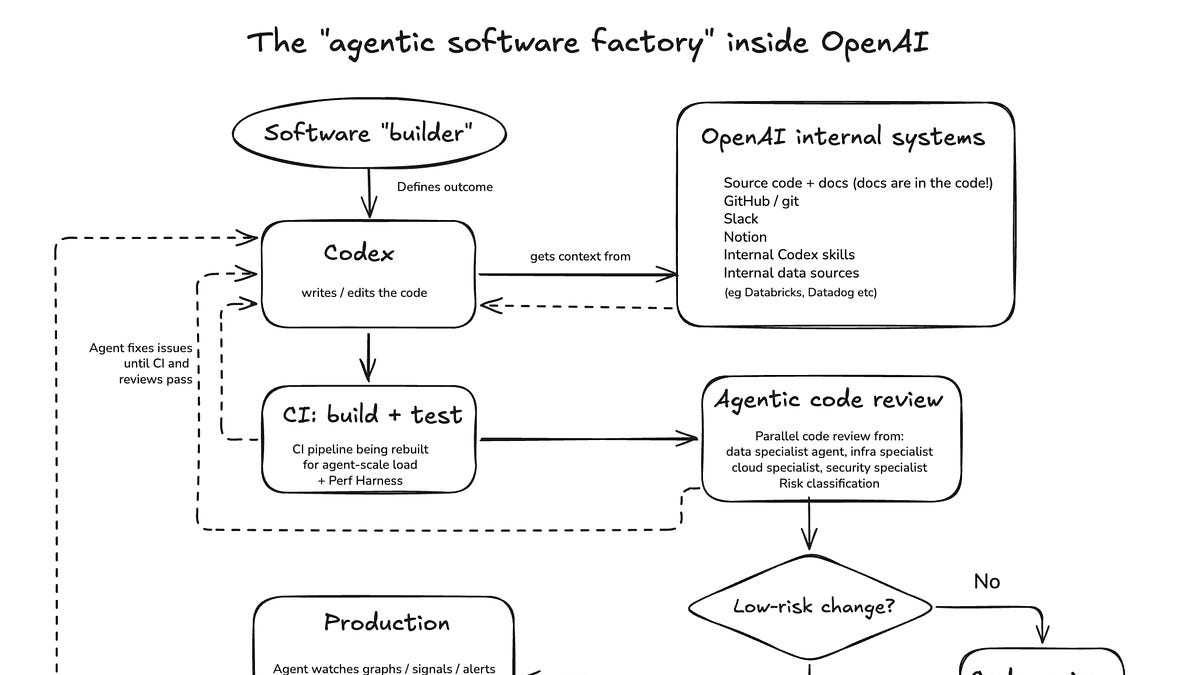
    OpenAI has internalized Codex and ChatGPT Work as a universal coding agent, achieving >90% adoption across the company and reshaping tooling, CI/CD load, and engineering roles. The shift has forced a new agentic software factory, massive infra scaling, and a rethink of IDEs, PRs, and code reviews.

    The Pragmatic Engineerpragmaticengineer.com15 minHN1
  3. AI Security Is an Engineering Problem — How to Solve It at Every Layer of the Agent Stack

    Nvidia frames AI security as an engineering discipline, outlining required controls across the AI agent stack (model, harness, runtime) and advocating for enforceable boundaries, traceable identities, and evidence‑based testing. It highlights OpenShell as a sandboxed runtime, the Open Secure AI Alliance, and several vendor tools for testing and red‑team exercises.

    Nvidianvidia.com4 min
  4. Accurate Models of AMD Matrix Cores

    The authors reverse‑engineer AMD’s CDNA matrix cores, build per‑architecture MATLAB models that match hardware bit‑for‑bit on 10 M random tests, and use them to compare AMD vs NVIDIA tensor‑core accuracy.

    Hacker News front pagearxiv.org2 minpaperHN7911
  5. Towards Self-Driving Codebases

    The post argues that AI agents could eventually handle low‑level engineering tasks—bug fixing, debugging, UI consistency, growth experiments—if the dev toolchain is made “agent‑legible”. It outlines missing primitives (global memory, code‑base rot prevention, better dev environments) and proposes a bootstrapping process to measure and improve a repo’s “agent readiness”. The piece is largely specu…

    Hacker News front pagedetail.dev9 minHN12099
  6. Agentic coding in the enterprise: Is your pipeline ready?

    Agentic coding lets AI agents write, test, and submit code autonomously, shifting the bottleneck from writing to governing code in production. Enterprises face rising failures, unclear ownership, growing costs, and weakened controls, which require a unified pipeline visibility layer.

    Codeshipcloudbees.com6 min