proomt

Search

Search posts, papers, and topics

All posts

ByteByteGo1 min readintermediate
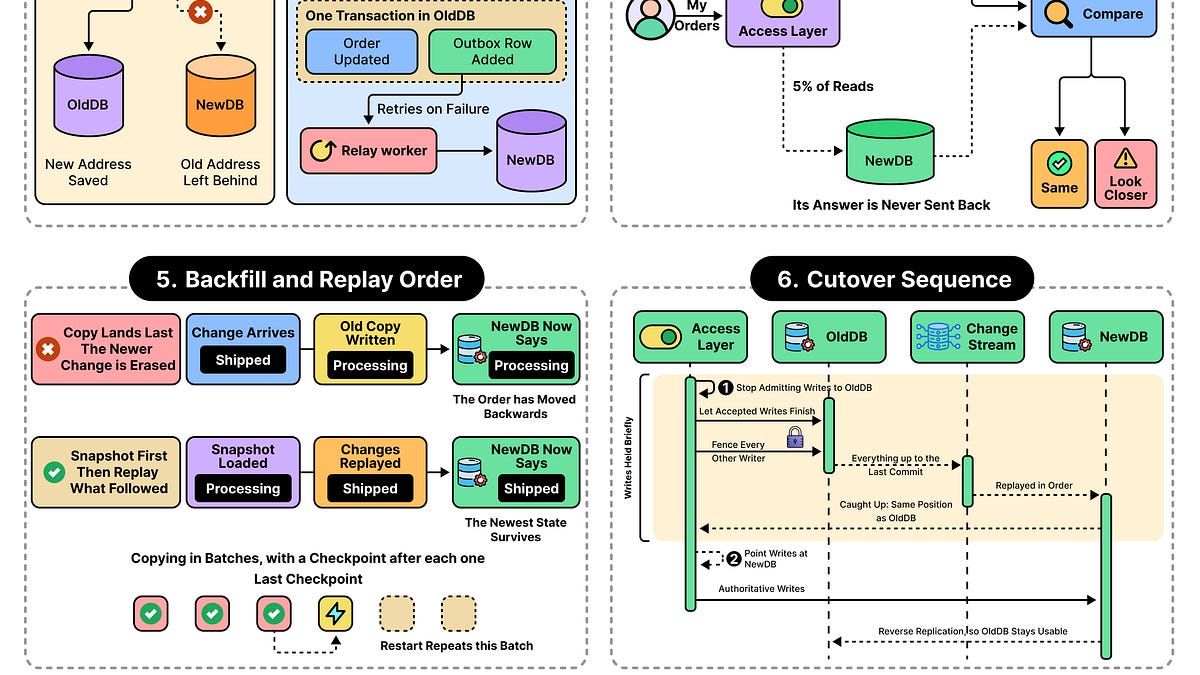
Migrations at Scale: Changing the Application Engine at 30,000 Feet

Summary

The article outlines the challenges of swapping a production database without downtime and surveys common high‑level tactics—dual writes, feature flags, phased rollouts, and continuous sync—to keep the service available during large‑scale migrations.

  • Use dual‑write or change‑data‑capture to keep old and new databases in sync during migration.
  • Gate the new database behind feature flags and gradually shift traffic to validate performance.
  • Employ backfill jobs that run in parallel to populate the new store while the old system remains live.
  • Monitor latency and error rates closely; have a fast rollback path if the new system misbehaves.

Ops and backend engineers planning zero‑downtime database migrations need practical patterns to avoid service disruption.

4/10

Related reading

  1. How Factory scaled its cloud backend to one billion monthly requests on Vercel

    Factory runs its entire SaaS backend on a single Next.js app deployed to Vercel, handling about a billion API requests per day with 350 ms p95 latency. They achieve this with Vercel’s Fluid compute to avoid cold starts, built‑in observability and WAF for security, and internal automation (“Droids”) that let non‑engineers deploy tools without extra infrastructure.

    Vercelvercel.com4 min
  2. CloudBees vs Harness: Why Migration Isn't the Fix

    The article argues that Harness’s “free migration” offer hides significant downstream costs (training, pipeline rebuilds, compliance recertification) and that even after migration you still lack unified governance across heterogeneous CI/CD tools. CloudBees positions its Unify control plane as a tool‑agnostic layer that adds visibility, continuous governance, AI‑driven test selection, and hybrid…

    Codeshipcloudbees.com5 min
  3. Migrating to Java 17: The Hows, Whys, and Whens

    A product‑focused overview of CloudBees CD/RO’s new integration with Argo Rollouts, describing the supported blue‑green and canary strategies, service‑mesh compatibility, and UI/analytics features. No deep technical walkthrough or performance data.

    Codeshipcloudbees.com6 min
  4. Article: Your Next DSL Author Is a Language Model

    Typed Domain Grounding (TDG) embeds a DSL inside a mainstream language the LLM already knows (e.g., Kotlin) and uses the host compiler as an oracle. The author describes five building blocks—embedding, choosing a host language with high training‑data frequency, compiler‑driven type safety, a generate‑compile‑repair loop, and an on‑demand teaching tool—and shows measured results from kUML, a Kotli…

    InfoQinfoq.com18 min
  5. Why Releasing Software as an Application Beats Deploying Components

    This article argues that independent microservice deployments, while seemingly fast, often lead to complex and fragile releases due to environment drift and implicit dependencies. It advocates for "application-level releasing," where a consistent, validated snapshot of interdependent components is promoted together across environments to restore predictability and stability.

    Codeshipcloudbees.com5 min