proomt

Search

Search posts, papers, and topics

All posts

DatadogZara Boddula, Danielle Park5 min readintermediate
Transform and route security logs to Microsoft Sentinel tables using Observability Pipelines

Summary

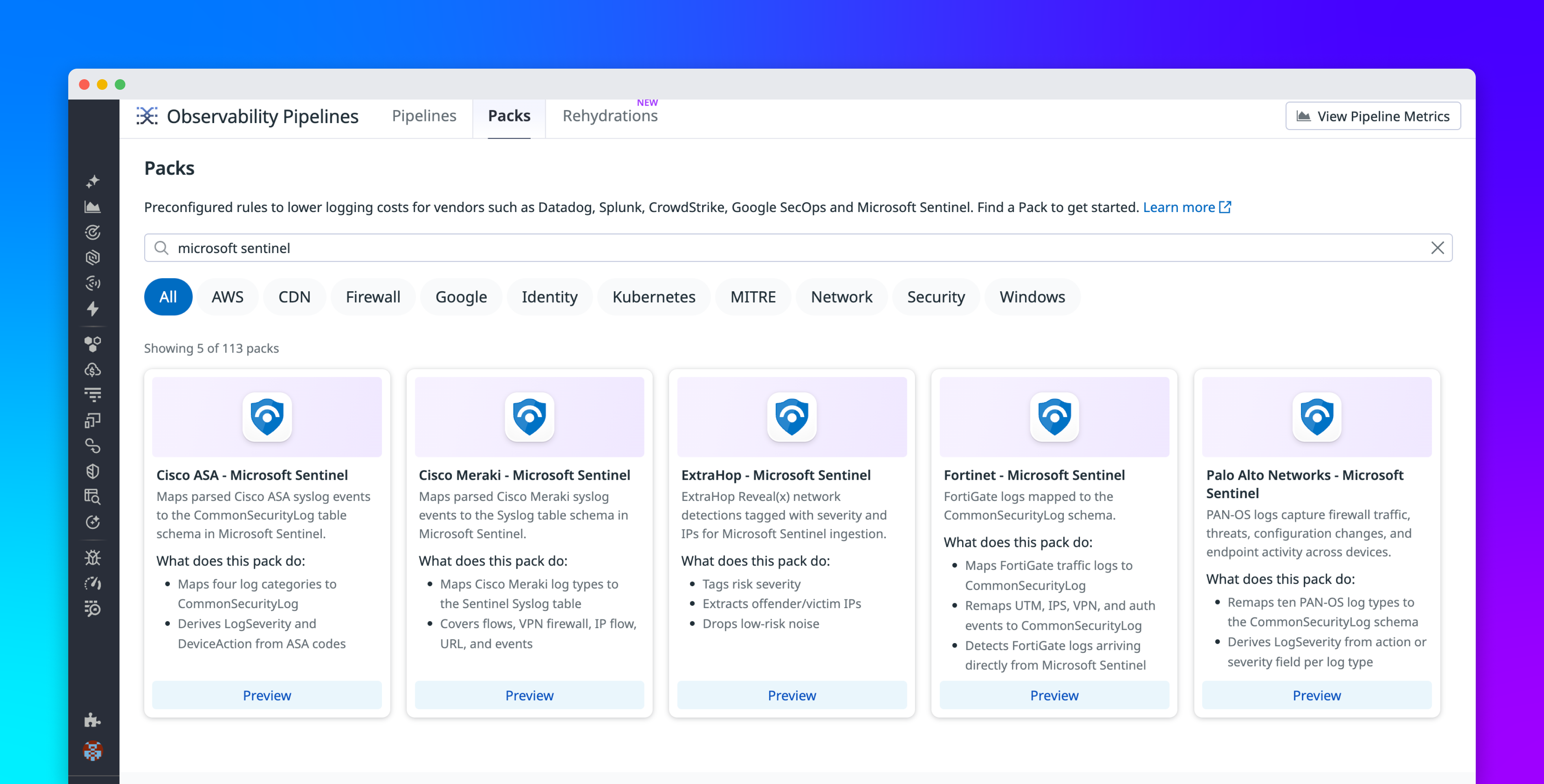
Datadog Observability Pipelines now ships pre‑built Microsoft Sentinel Packs that map logs from Palo Alto, Fortinet, Cisco ASA, Cisco Meraki, and ExtraHop into Sentinel’s CommonSecurityLog or Syslog tables. Packs handle field extraction, severity derivation, and device‑action mapping, letting you filter or drop low‑value events before ingest, validate mappings with Live Capture, and reduce per‑GB…

  • Packs provide out‑of‑the‑box mappings for 5 major firewall/VPN vendors, converting vendor‑specific fields to Sentinel’s schema (e.g., DeviceAction, LogSeverity, SourceIP).
  • Mapping occurs in the pipeline, so you can filter on normalized fields (e.g., only denied connections) before data hits Sentinel, cutting ingest costs.
  • Live Capture lets you compare raw and transformed events in real time to verify mappings.
  • ExtraHop pack can drop low‑risk detections, further reducing noise.

Security teams often spend weeks writing parsers for each firewall/VPN vendor to fit Sentinel’s tables. Pre‑built packs eliminate that effort, ensure consistent field names across sources, and let you control ingest volume at the source, which directly impacts Sentinel’s per‑GB pricing model.

5/10

Related reading

  1. App Hardening: One Obfuscation Pipeline Across Every Port

    Codename One adds a cloud‑side hardening step that runs on the merged JAR before it is split into Android, iOS, JavaScript, and desktop binaries. It can rename symbols, encrypt string literals, and insert opaque‑predicate control‑flow guards at configurable levels (off → standard → aggressive → paranoid). The transforms are selective per platform to avoid breaking optimizers, and a mapping is kep…

    CodeName Onecodenameone.com6 min
  2. CloudBees vs Harness: Why Migration Isn't the Fix

    The article argues that Harness’s “free migration” offer hides significant downstream costs (training, pipeline rebuilds, compliance recertification) and that even after migration you still lack unified governance across heterogeneous CI/CD tools. CloudBees positions its Unify control plane as a tool‑agnostic layer that adds visibility, continuous governance, AI‑driven test selection, and hybrid…

    Codeshipcloudbees.com5 min
  3. Article: Architecting Secure and Scalable Facial Verification Systems

    A real‑world post‑mortem of a high‑volume face verification service that moved from a naïve synchronous API to an async, layered pipeline (edge validation, preprocessing, decoupled detection/verification, decision engine) to achieve 8.5k rpm, p99 < 1.8 s, 30 % cost savings, and strict privacy controls.

    InfoQinfoq.com15 min
  4. Microsoft Open-Sources TauGrid to Simplify AI Workload Management on Kubernetes

    Microsoft open‑sourced TauGrid, a Helm‑installable platform that bundles Kueue, KubeRay and other components to schedule, monitor and checkpoint AI workloads on GPU‑enabled Kubernetes clusters. Engineers define jobs in a simple `tau.yaml`, and TauGrid handles queuing, health checks, and observability, simplifying AI workload management.

    InfoQinfoq.com2 min
  5. OpenTelemetry everywhere: Migrating a metrics platform at scale

    Atlassian replaced its decade‑old gostatsd‑based metrics pipeline with a fully OpenTelemetry‑based stack by keeping the StatsD‑UDP contract on the client side and swapping in purpose‑built OTel Collector distributions for collection, ingest, aggregation, and forwarding. The migration was done incrementally, saved ~3.9% CPU per service, cut sidecar cost ~30% fleet‑wide, halved aggregation CPU, and…

    CNCFcncf.io6 minHN1