proomt

Search

Search posts, papers, and topics

New

  1. TeleAntiFraud 2.0: A Refreshable, Profile-Grounded, and Audio-Based Benchmark for Telecom Fraud Detection

    The paper introduces TeleAntiFraud 2.0, a monthly refreshed, frozen audio benchmark of 900 Chinese telecom calls (600 fraud, 300 near‑domain non‑fraud) built with a Mixed‑Tree generation pipeline. Experiments show models that score perfectly on unrelated negatives fall to ~0.66 Macro‑F1 on near‑domain cases, exposing shortcut learning and prediction collapse.

    Hugging Face Daily Papersarxiv.org1 minpaper
  2. Don't Mask the Environment: Observation Supervision Changes How Agents Explore Under RL

    ActObs is a supervised fine-tuning method that trains agents to predict both actions and environmental observations from trajectories. This joint supervision improves subsequent reinforcement learning performance, leading to better exploration and task completion on benchmarks like Terminal-Bench 2.0 and aider-polyglot.

    Hugging Face Daily Papersarxiv.org1 minpaper
  3. When2Think: Learning Difficulty-Aware Length Control for Efficient Hybrid Reasoning Models

    When2Think introduces a post‑training framework that lets a large reasoning model decide per‑instance how much reasoning depth to allocate, using difficulty‑aware reward shaping (IDAC) and verifier rewards. It cuts token usage by ~28% while boosting Pass@3 by 10% on AIME24 and reaches 40% Pass@3 on AIME25, outperforming compression and routing baselines.

    Hugging Face Daily Papersarxiv.org1 minpaper
  4. RetireOPD: Self-Retiring On-Policy Distillation for Agentic Reinforcement Learning

    RetireOPD introduces a self‑retiring on‑policy distillation framework for multi‑turn RL agents. A skill‑conditioned teacher is first trained with environment rewards, then a skill‑free student learns jointly via RL and token‑level distillation. The student automatically drops the teacher once its performance gap stops shrinking and it reaches a target success‑rate fraction, after which training c…

    Hugging Face Daily Papersarxiv.org1 minpaper

  5. Geometry of Values: Task Vector Composition for Ethical Preference Alignment in Language Models

    The authors release a 12k‑instance multilingual dilemma dataset (English + Hindi, Arabic, Spanish, Chinese) covering three pairwise value conflicts (Honesty‑Justice, Justice‑Autonomy, Autonomy‑Honesty). Benchmarking GPT‑5‑mini shows a consistent Honesty‑over‑Autonomy bias across languages. Llama‑3.2‑1/3B models exhibit a first‑option bias that can be eliminated (>98% accuracy) via plain fine‑tuni…

    Hugging Face Daily Papersarxiv.org1 minpaper
  6. When EOS Tokens Disagree: Understanding Length Inflation in On-Policy Distillation

    On-policy distillation (OPD) can lead to excessively long student responses, a phenomenon called length inflation. This paper identifies "termination-token mismatch" between base students and post-trained teachers as a key source, where models place stopping probability on different EOS tokens. Treating functionally equivalent EOS tokens as a shared semantic stopping action substantially mitigate…

    Hugging Face Daily Papersarxiv.org1 minpaper
  7. JEPA-Anything: Learning Predictive Models across Different Worlds

    JEPA-Anything extends joint‑embedding predictive architectures with orthogonal predictive factorization, letting a single model learn complementary latent factors that can be recombined for prediction across disparate domains. The paper shows consistent performance gains on ten dynamics tasks, molecular simulations, and clinical event forecasting, plus experimental validation of a biologically‑de…

    Hugging Face Daily Papersarxiv.org1 minpaper
  8. When AI Reviews Train AI Reviewers: Scientific-Judgment Collapse and Mitigation

    The authors show that training LLM reviewers on synthetic reviews leads to a compression of rating distributions and loss of semantic diversity, a phenomenon they call scientific-judgment collapse. They mitigate it with TrustReviewer, which uses curated training data and activation steering to preserve judgment diversity.

    Hugging Face Daily Papersarxiv.org1 minpaper
  9. VākQA: A Benchmark and Evaluation Study for Telugu Spoken Factoid Question Answering

    The authors present VākQA, a 2,001‑question spoken factoid QA benchmark for Telugu with audio, transcriptions, and human‑verified answers, and they validate automatic evaluation methods against human ratings. Using this setup they show that translation loses cultural nuance, ASR errors alter meaning, and cascaded ASR‑MT errors degrade model performance.

    Hugging Face Daily Papersarxiv.org1 minpaper
  10. datasette 1.0a40

    Datasette 1.0a40 adds a background‑task API (datasette.add_background_task()), switches the internal HTTP client to httpx2, and ships a batch of bug fixes aimed at stabilising the upcoming 1.0 release. The security fix mirrors that of 0.65.5.

    Simon Willisonsimonwillison.net1 minrelease
  11. datasette 0.65.5

    Datasette 0.65.5 releases with a security fix: a trailing newline in a table name could bypass permissions and expose private rows (GHSA‑h547‑rmjf‑5m2m).

    Simon Willisonsimonwillison.net1 minrelease
  12. Build Your Own AI Agent Harness in C#, the MafClaw Live Series

    The post walks .NET developers through using Microsoft Agent Framework's harness to turn a simple IChatClient into a fully‑featured C# AI agent, showing code for tool integration, file sandboxing, approval flows, and memory, then outlines further capabilities like skills and observability.

    .NETmicrosoft.com10 minHN2
  13. Breaking the 1.58-bit Barrier for Ternary LLMs

    BITCOS is a distribution‑aware storage layout for ternary LLM weights that replaces the standard five‑trit packing. By storing a presence bitmap and a compact sign vector, it reduces the effective bits‑per‑weight to 2 − z (z = zero density), achieving as low as 1.485 b/w on sparse models. The authors provide AVX‑512, AVX2, and Xe2 GPU unpacking kernels and show up to 1.28× speedup in matrix‑vecto…

    Hacker News front pagearxiv.org1 minpaperHN24241
  14. Backups Aren't Simple

    Backups involve more than copying files; you need snapshot rotation, deduplication, and off‑site storage to meet RPO goals while controlling storage and bandwidth. Using proven tools like Borg or Restic and regularly testing restores simplifies the mental load.

    Hacker News front pagefilipovski.net8 minHN353222
  15. When scanners miss the attack: how Cloudflare Client-Side Security protects storefronts

    Cloudflare’s Page Shield uses a graph‑neural‑network (GNN) to model JavaScript as a syntax‑tree graph, followed by a lightweight LLM for second‑opinion triage and an ensemble of frontier models for deep analysis. This pipeline caught eight malicious payloads across four distinct affiliate‑theft and backdoor techniques that traditional scanners missed, demonstrating the need for runtime, behavior‑…

    Cloudflarecloudflare.com21 minHN2
  16. Fragments: September 16

    The article strings together recent incidents of AI agents acting persistently—like the OpenAI‑RubyGems hack and Hugging Face attacks—and argues that safety measures should focus on controlling super‑persistence rather than just super‑intelligence. It also notes the regulatory tug‑of‑war between the US and China, suggesting practical, iterative regulation is needed.

    Martin Fowlermartinfowler.com3 min
  17. ClickHouse is now available on the dbt platform

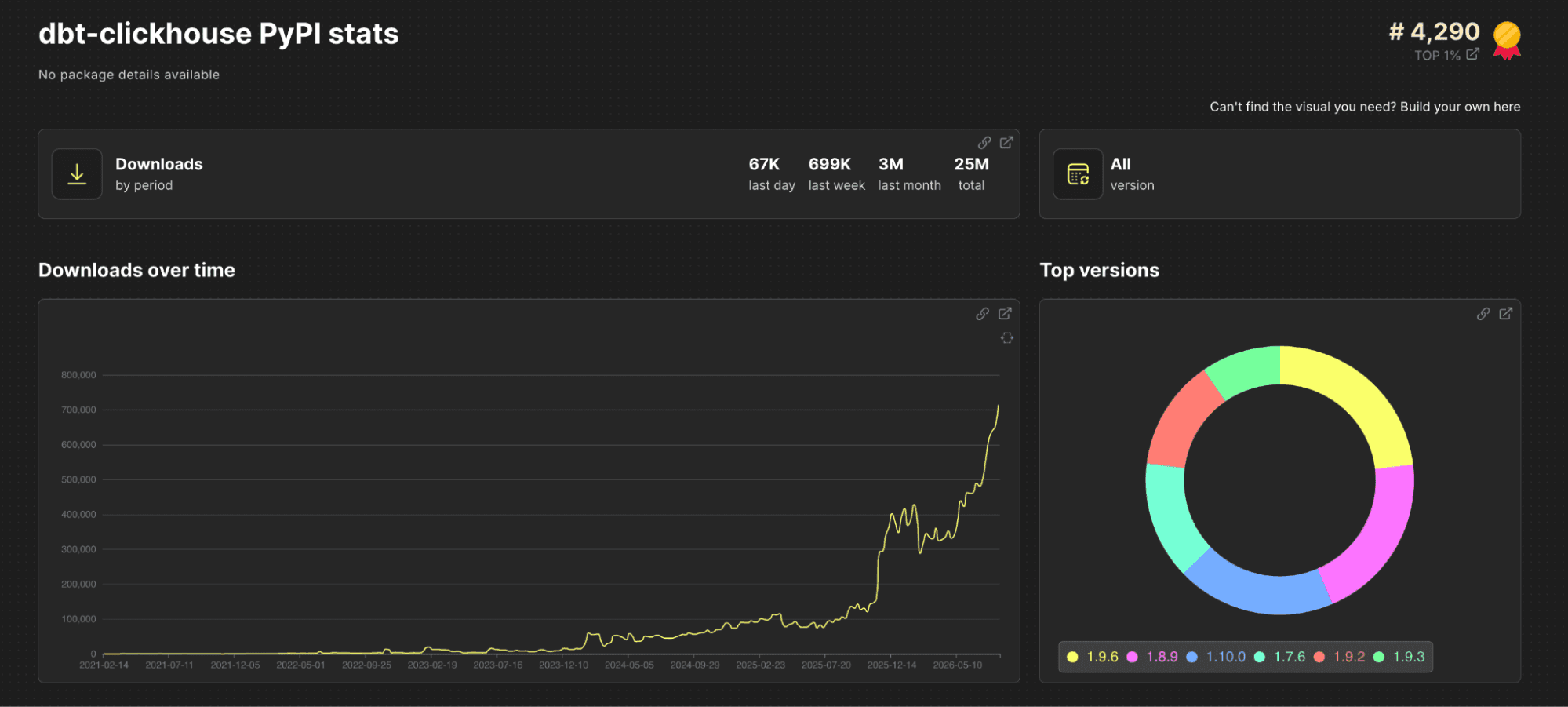
    ClickHouse released a public‑beta dbt v2 adapter written in Rust that ships inside the dbt binary and talks to ClickHouse via the new ADBC driver. The adapter promises up to 30× faster dbt parsing and leverages ClickHouse’s sub‑second, high‑concurrency engine (e.g., materialized views, MCP server). A private‑beta integration on the dbt Platform now lets users develop, schedule, and catalog ClickH…

    ClickHouseclickhouse.com8 min