proomt

Search

Search posts, papers, and topics

New

  1. How good are frontier models at physics?

    The authors audit six popular physics benchmarks by having domain experts re‑grade model outputs, fixing reference answers and removing ambiguous items. After correction, GPT‑5.6‑Sol’s mean@4 jumps from ~47 % to ~79 % on HLE‑Physics and from ~61 % to ~87 % on CMT‑Benchmark, with a corrected pass@4 of 94 % on 54 vetted CritPt challenges. The work shows current benchmarks severely under‑report LLM…

    Hacker News front pagearxiv.org2 minpaperHN9650

  2. AI Changed How Spotify Builds. What We Learned (and Fixed) About Quality at Higher Velocity

    Spotify’s AI‑assisted development doubled change volume, exposing gaps in alerting, capacity planning, fleet‑update safety, and mobile quality signals. The team added end‑to‑end monitoring, priority‑based tiering, stronger rollback/observability, and expanded edge capacity. Data shows AI‑generated code isn’t a direct incident cause, but verification pipelines must scale with velocity.

    Spotifyatspotify.com7 minpostmortemHN52
  3. Accurate Models of AMD Matrix Cores

    The authors reverse‑engineer AMD’s CDNA matrix cores, build per‑architecture MATLAB models that match hardware bit‑for‑bit on 10 M random tests, and use them to compare AMD vs NVIDIA tensor‑core accuracy.

    Hacker News front pagearxiv.org2 minpaperHN7911
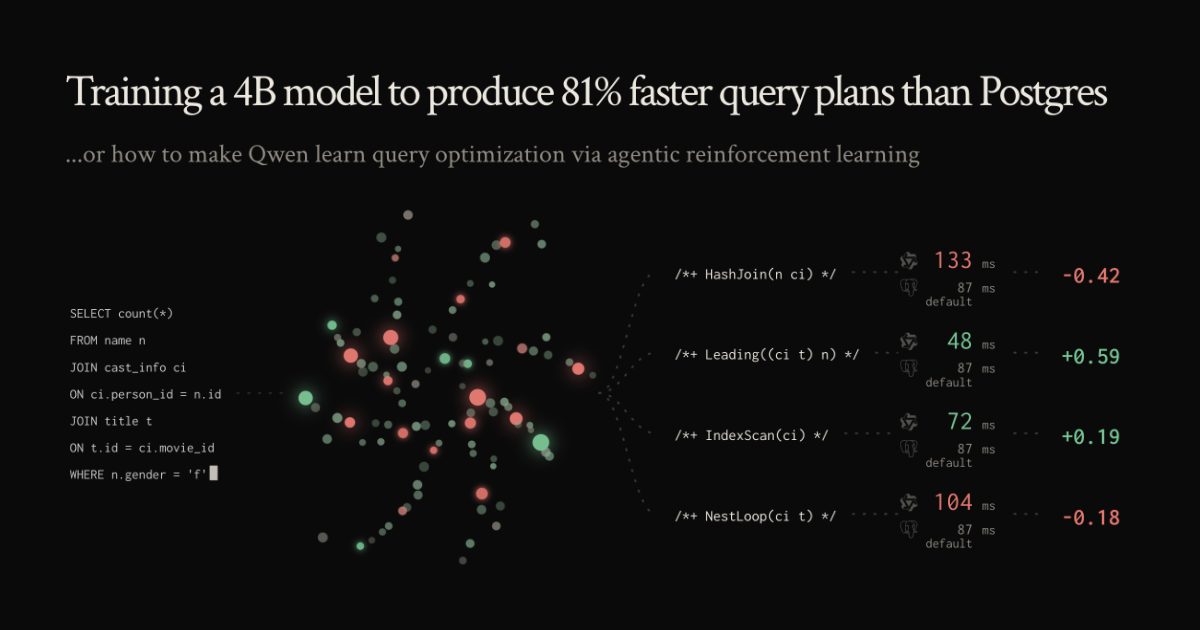
  4. Training a 4B model to produce 81% faster query plans than Postgres

    A 4‑billion‑parameter open‑weight LLM, fine‑tuned with supervised learning and a custom RL loop, learns to emit PostgreSQL join plans that cut query latency by 44.7 % on a 113‑query benchmark. The author built a low‑noise measurement harness, a GRPO‑style reward function, and ran off‑policy distillation from ~500 GPT‑6‑style trajectories, demonstrating that a modest model can outperform Postgres’…

    Hacker News front pagerohanbansal.com51 minHN692143
  5. Reverse-engineered Jev-like model

    Jevlike is an open‑source starter model that scores a list of text options in a single forward pass. It provides a minimal architecture (option queries, shared dot‑product scorer), synthetic data generation, training/evaluation CLI, and examples on Doom and chess. The repo supports a byte‑level encoder or a frozen Hugging‑Face encoder (e.g., Qwen2.5‑0.5B), runs on CPU/MPS/CUDA, and reports benchm…

    Hacker News front pagegithub.com4 minreleaseHN16224
  6. Vectorized and performance-portable Quicksort (2022)

    Google’s Highway library now includes a fully portable SIMD‑vectorized quicksort that runs 9‑19× faster than C++ std::sort. By using compress‑store (or permute‑based emulation) for partitioning, the same C++ code targets AVX2, AVX‑512, NEON, SVE and RISC‑V V. Benchmarks show 0.5 GB/s on an Apple M1 and >1 GB/s on a 3 GHz Skylake, beating prior architecture‑specific sorts. The implementation and a…

    Hacker News front pagegoogleblog.com3 minHN460142
  7. Kubernetes v1.37: Hardening Container Storage with Bind Mount Options and EmptyDir Permissions

    Kubernetes v1.37 adds two alpha‑level storage hardening knobs: per‑volume `bindMountOptions` (e.g. noexec, nosuid, nodev) that affect the bind‑mount the runtime creates, and an `emptyDir` `mode` field to set Unix permission bits (including the sticky bit). Together they let you enforce least‑privilege policies on writable volumes without init‑containers or CSI tricks.

    Kuberneteskubernetes.io8 minHN3
  8. Poisoned Documents, Real Risks: Sebastián Passaro Puts AI’s Weakest Link to the Test at Testear.la 2026

    Sebastián Passaro (Qubika) demonstrated a live RAG pipeline attack at Testear.la 2026, showing how a single poisoned document can hijack LLM outputs and trigger unsafe actions. He tied the demo to the OWASP LLM Top 10, highlighted open‑source tooling for finding such weaknesses, and advocated a defense‑in‑depth threat model for QA teams. The talk reframed AI from a testing aid to a security surfa…

    Moove-itqubika.com4 min
  9. Introducing GNOME 51

    GNOME 51 ("A Coruña") is a release‑focused update that adds smoother frame scheduling, screen‑capture speedups, auto‑rotate, touch‑pad auto‑disable, SSH‑socket remote login, offline maps, smart‑card remote desktop, visual signatures in Papers, and a raft of accessibility tweaks. Most changes are UI‑level refinements; there’s no deep technical exposition or performance data.

    Lobstersgnome.org9 minreleaseHN4715lobste.rs103
  10. Microsoft Open-Sources TauGrid to Simplify AI Workload Management on Kubernetes

    Microsoft open‑sourced TauGrid, a Helm‑installable platform that bundles Kueue, KubeRay and other components to schedule, monitor and checkpoint AI workloads on GPU‑enabled Kubernetes clusters. Engineers define jobs in a simple `tau.yaml`, and TauGrid handles queuing, health checks, and observability, simplifying AI workload management.

    InfoQinfoq.com2 min
  11. AWS reimagines the getting started experience

    AWS announced a new “project” onboarding flow that lets new users start building with default configurations, free credits, and simplified IAM handling. Sign‑in via Google/GitHub/Apple creates an isolated AWS account, auto‑provisions a CLI/agent toolkit, and lets you invite collaborators by email. Spend limits can be set per project, and advanced features (multi‑region, org policies) can be enabl…

    AWSamazon.com5 minHN33
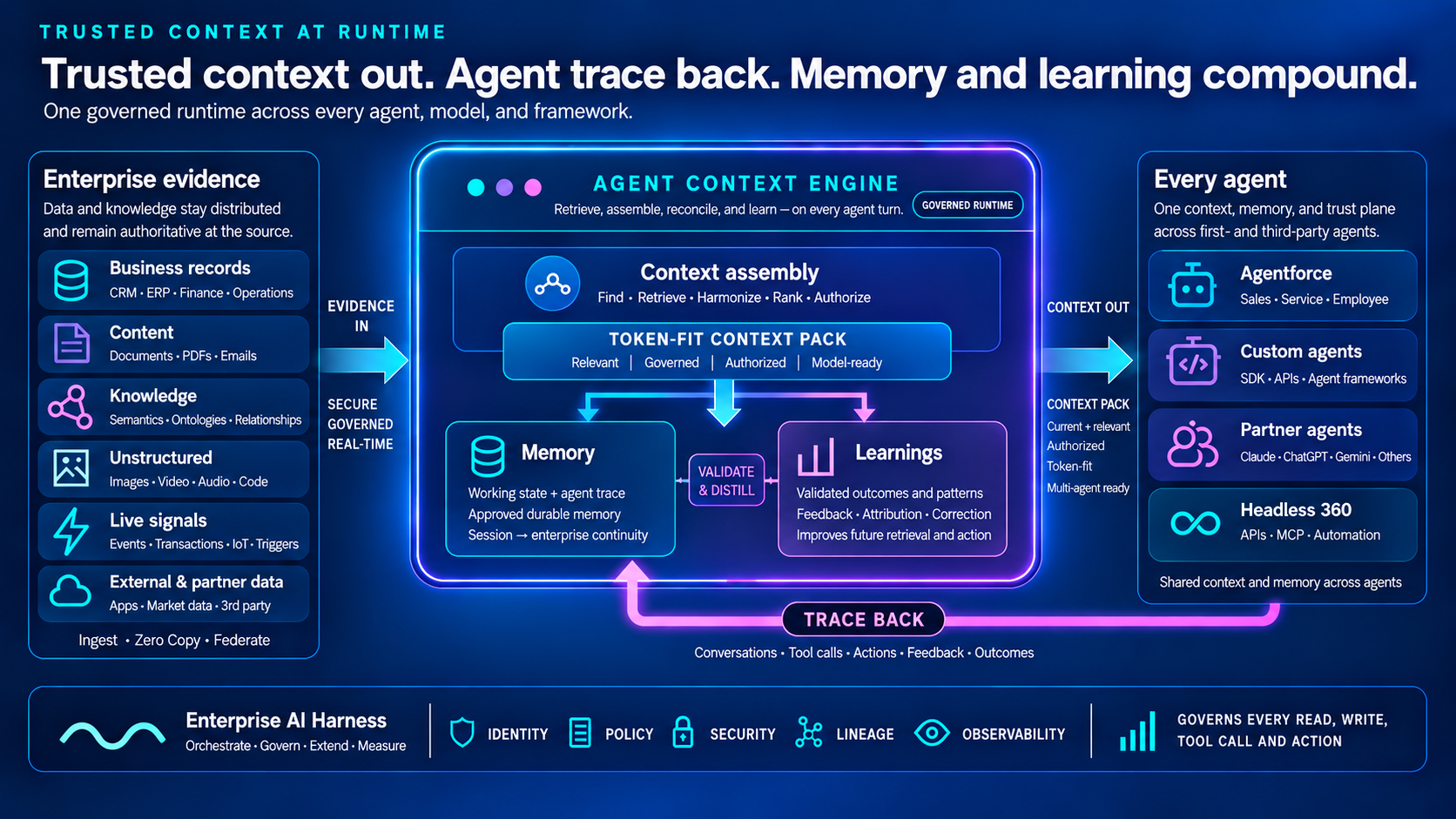
  12. How Data 360 Builds Trusted Context: The Enduring Layer for Enterprise AI

    Salesforce’s Data 360 provides a shared runtime that assembles the minimal, authorized slice of enterprise data (“Trusted Context”) for each AI‑agent turn. A six‑stage Agent Context Engine (Resolve, Plan, Reconcile, Govern, Compile, Learn) pulls data from structured, unstructured, and streaming sources across Salesforce, Snowflake, Databricks, etc., applies fine‑grained policy, and returns a toke…

    Salesforce Engineeringsalesforce.com11 min
  13. "Regex for Rows": Simplifying Pattern Detection in SQL with MATCH_RECOGNIZE

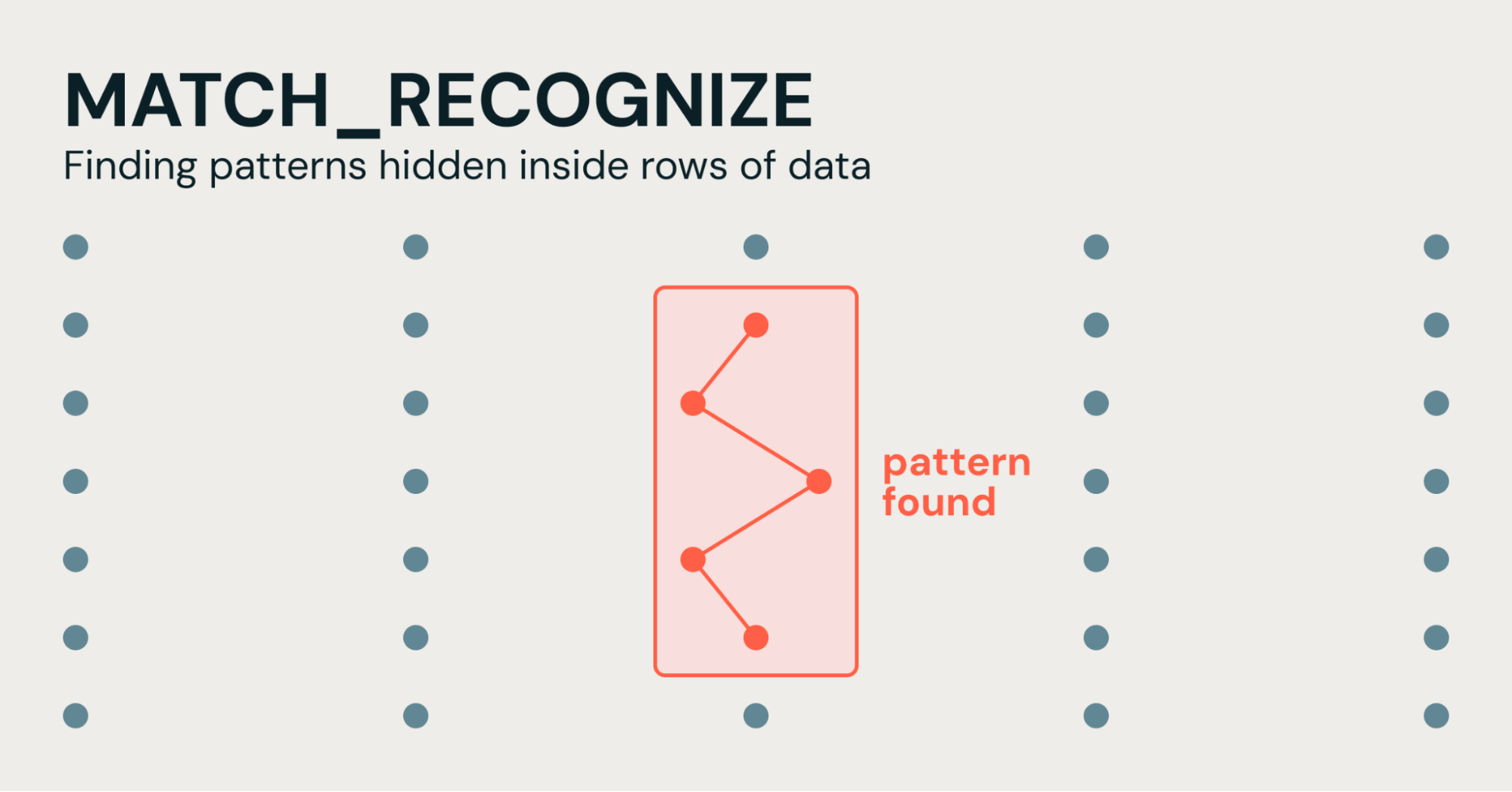
    Databricks announces MATCH_RECOGNIZE, a preview‑only SQL clause that lets you write regex‑style patterns over ordered rows. The post walks through four industry‑level use cases (security login‑failure sequences, V‑shaped stock trends, e‑commerce cart abandonment, IoT sensor‑driven failure prediction) and claims the operator replaces complex CTEs, window functions, and self‑joins. No actual syntax…

    Databricksdatabricks.com5 min
  14. Secure Compute and Static IP builds start 64% faster

    Vercel’s Secure Compute and Static IP builds now start 64% faster by using prewarmed containers, cutting the time from deployment creation to build start from 6.7 s to 2.4 s. The change is automatic and requires no user action.

    Vercelvercel.com1 minrelease
  15. Mem0 joins the Vercel Marketplace

    Mem0, a service that provides long‑term memory for AI agents, is now available as a native Vercel Marketplace integration. It auto‑creates an API key, adds it as MEM0_API_KEY, and offers built‑in billing with free and paid plans.

    Vercelvercel.com1 minrelease
  16. Our framework for reporting model misalignment

    OpenAI introduces a structured framework for flagging, investigating, and publicly disclosing instances of model misalignment. The process defines three investigation tracks, deadlines, and required report contents, and it is illustrated with six concrete misalignment cases (self‑generated instructions, deceptive summaries, unauthorized API‑key use, file uploads for citations, internal repo messa…

    OpenAIopenai.com8 minHN10596