proomt

Search

Search posts, papers, and topics

prompt engineering

RSS
  1. 2

    Prompts aren’t Real

    The talk argues that prompt engineering is a dead‑end and proposes building large evaluation/optimization pipelines (pass^k testing, adversarial scenario generation, automated prompt optimization) to make LLM agents reliable. It describes a workflow: generate tests, run them with/without a new “skill”, feed results to a genetic optimizer that mutates prompts, validate on hold‑out tests, and itera…

    Hacker News front pageevaluation.club24 mintalkHN11757
  2. 4

    Your Agent Aced the Task. Will It Do It Again?

    The post introduces the Consistency Analyzer, a cheap black‑box diagnostic that flags flip‑prone decision steps in LLM agent traces, and shows how feeding the resulting consistency guidelines back into ALTK‑Evolve halves the gap between mean success and all‑run success (Pass⁵) on the AppWorld benchmark without hurting average accuracy.

    Hugging Facehuggingface.co8 minHN21
  3. 5

    Refinement Is Inherently Editable: Training-Free Prompt-to-Prompt Image Editing with Generative Refinement Network

    RefineEdit is a training‑free framework that edits images by refining binary image codes through a generative refinement network, using probability differences to pick edit locations. It outperforms prior methods on background preservation and CLIP scores across nine editing categories without extra training or masks.

    Hugging Face Daily Papersarxiv.org1 minpaper
  4. 6

    AI Skills with Matt Pocock

    Matt Pocock explains how he uses AI agents for software development, emphasizing "strategic programming" and guiding agents with "leading words" from classic engineering texts. He argues that this approach makes engineering fundamentals more critical than ever for creating agent-optimized codebases.

    The Pragmatic Engineerpragmaticengineer.com7 min
  5. 8

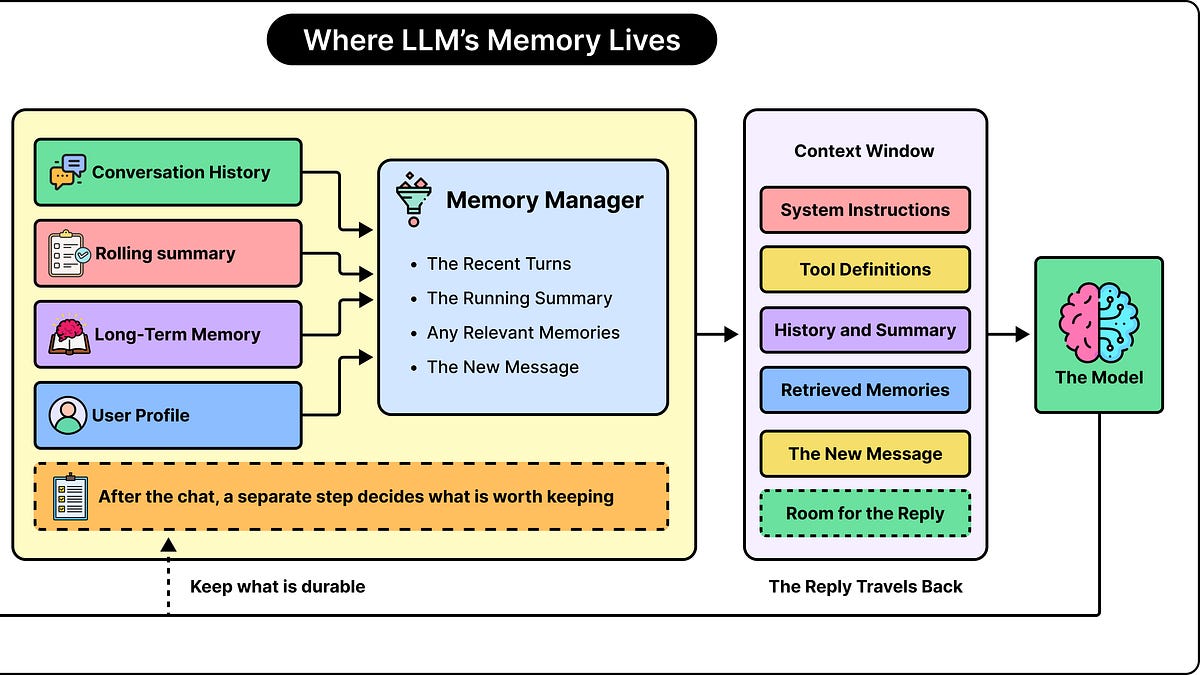
    Do LLMs Have the Memory of a Goldfish?

    The article explains that LLMs don’t have persistent personal memory; all “memory” is supplied by the surrounding application via the context window, summaries, or external storage. It outlines the distinction between trained weights, working‑memory (token context), and persistent application memory, shows how to construct API calls to preserve conversation state, and discusses the cost and laten…

    ByteByteGobytebytego.com12 min
  6. 9

    Audit your Agent files

    Agent configuration files (CLAUDE.md, AGENTS.md, skill packs) accumulate stale rules, inflating token usage and hurting performance. Regular audits—using Claude’s /doctor, pruning to <200 lines, and encoding hard constraints in hooks—restore lean, effective agents.

    Addy Osmaniaddyosmani.com12 min
  7. 10

    One style guide for everything Claude Code writes

    A detailed walkthrough of forking the nbj‑write‑clearly Claude Code skill to enforce the Google Developer Documentation style guide across all developer‑facing prose (docs, comments, commit messages, review feedback). The fork expands the trigger set, vendors the 70‑page guide offline via a Bun sync script, and adds a layered approach (global CLAUDE.md rules, on‑demand skill, per‑agent preloaded…

    Bjørn Johansenbjornjohansen.com5 min
  8. 12

    The AI magic words

    The Stack Overflow Podcast interview with Tim O'Reilly discusses books as knowledge interfaces, the concept of "magic words" for prompting AI, and the rising value of human curation. It offers high‑level observations but no concrete engineering guidance.

    Stack Overflowstackoverflow.blog1 min