proomt

Search

Search posts, papers, and topics

All posts

The Pragmatic EngineerGergely Orosz7 min readintermediate
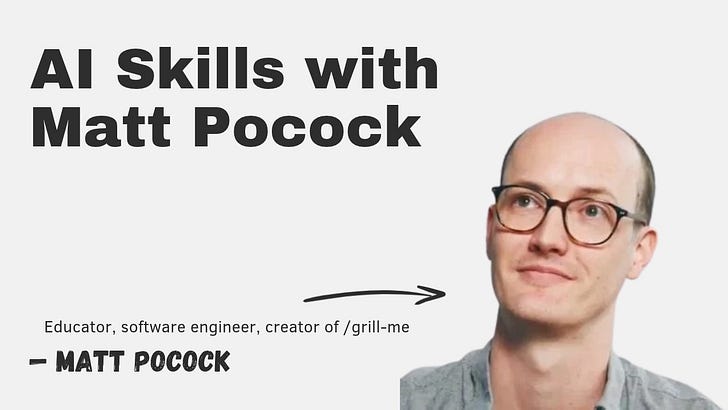
AI Skills with Matt Pocock

Summary

Matt Pocock explains how he uses AI agents for software development, emphasizing "strategic programming" and guiding agents with "leading words" from classic engineering texts. He argues that this approach makes engineering fundamentals more critical than ever for creating agent-optimized codebases.

  • AI agents handle "tactical programming," allowing engineers to focus on "strategic programming."
  • "Leading words" from classic engineering books (e.g., "tracer bullet") significantly improve agent-generated code.
  • "Memento-driven development" optimizes codebases for agents, reinforcing fundamental software principles.
  • Cloud agents offer benefits like continuous operation and collaboration over local agent setups.

Engineers looking to effectively integrate AI agents into their development workflow will gain practical strategies and a renewed appreciation for foundational software design principles.

7/10

Related reading

  1. Agentic Skill Decay

    Addy Osmani warns that AI agents can short‑circuit the hands‑on practice (“reps”) that builds deep expertise and judgment. He recommends deliberately inserting hypothesis‑forming, “why” questioning, diff inspection, failure prediction, and occasional manual coding into the workflow, especially for junior engineers. A 2026 Anthropic study showed junior developers using AI scored 17 % lower on a fo…

    Addy Osmaniaddyosmani.com16 min
  2. Brownfield Agentic Engineering

    Addy Osmani outlines a pragmatic framework for safely introducing AI‑driven agents into legacy (brownfield) codebases. He proposes zoning code by risk, documenting non‑code knowledge, preserving research in durable memos, building a reusable “harness” of tools and rules, and starting with zero‑risk, characterization‑test‑driven work.

    Addy Osmaniaddyosmani.com13 min
  3. Build Your Own AI Agent Harness in C#, the MafClaw Live Series

    The post walks .NET developers through using Microsoft Agent Framework's harness to turn a simple IChatClient into a fully‑featured C# AI agent, showing code for tool integration, file sandboxing, approval flows, and memory, then outlines further capabilities like skills and observability.

    .NETmicrosoft.com10 minHN2
  4. Towards Self-Driving Codebases

    The post argues that AI agents could eventually handle low‑level engineering tasks—bug fixing, debugging, UI consistency, growth experiments—if the dev toolchain is made “agent‑legible”. It outlines missing primitives (global memory, code‑base rot prevention, better dev environments) and proposes a bootstrapping process to measure and improve a repo’s “agent readiness”. The piece is largely specu…

    Hacker News front pagedetail.dev9 minHN12099