proomt

Search

Search posts, papers, and topics

All posts

Microsoft for DevelopersWaldek Mastykarz6 min readintermediate
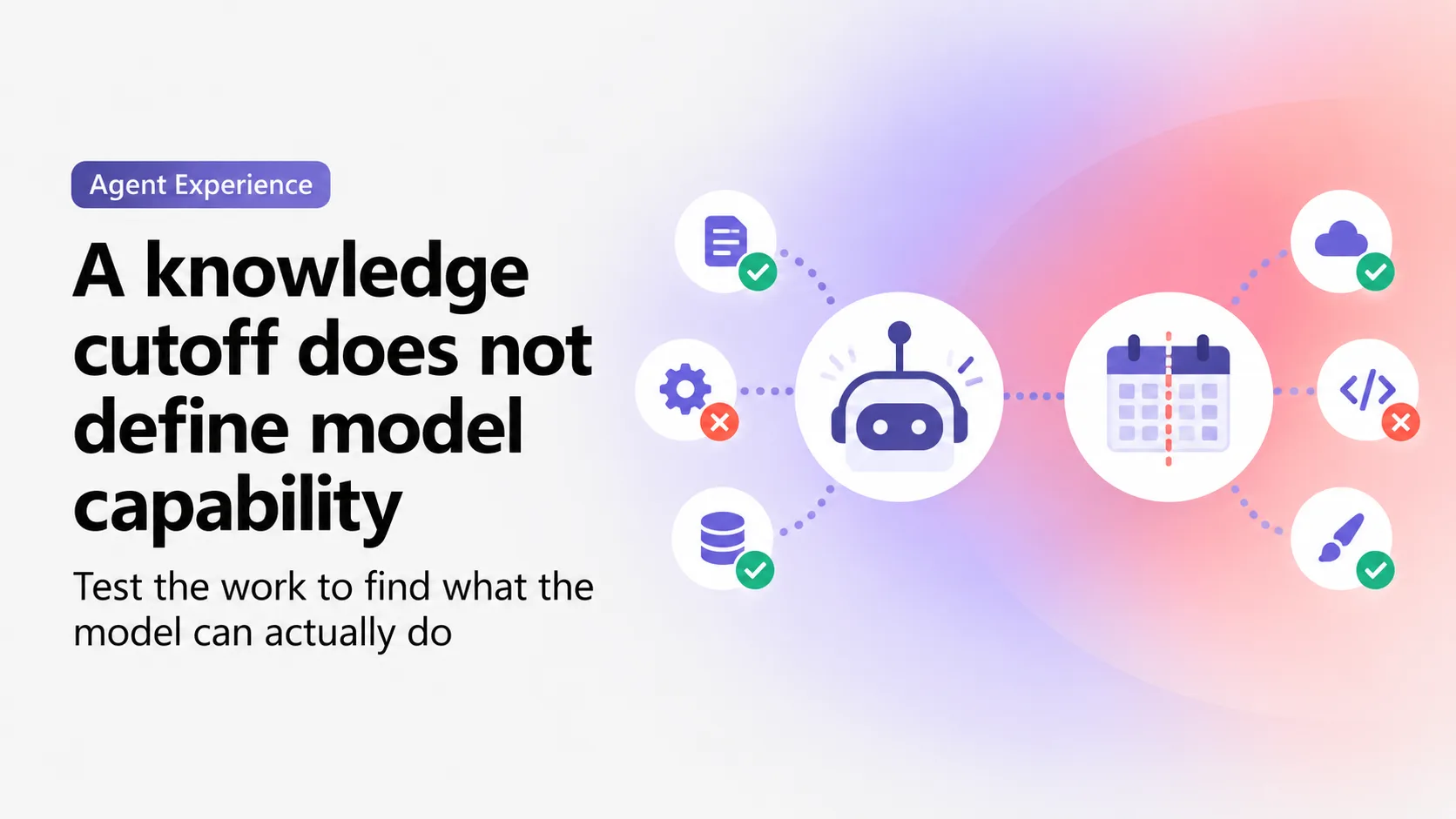
Knowledge cutoff is a poor proxy for model capability

Summary

A study found that an LLM's stated knowledge cutoff date is a poor indicator of its actual capability regarding specific product versions. Models showed inconsistent knowledge, failing on older features while sometimes inferring correctly about newer, post-cutoff features.

  • LLM knowledge cutoffs are a ceiling, not a precise boundary for a model's product-specific knowledge.
  • Models can fail on features released *before* their cutoff due to missing specific facts or recall issues.
  • Models can succeed on features released *after* their cutoff by inferring from general knowledge or patterns.
  • Model capability is task-dependent; evaluate with specific workloads, not just knowledge cutoffs.

Engineers building LLM-powered agents need to understand that a model's stated knowledge cutoff doesn't define its practical capability, requiring specific workload evaluations to determine what information to provide.

7/10


Related reading

  1. Our framework for reporting model misalignment

    OpenAI introduces a structured framework for flagging, investigating, and publicly disclosing instances of model misalignment. The process defines three investigation tracks, deadlines, and required report contents, and it is illustrated with six concrete misalignment cases (self‑generated instructions, deceptive summaries, unauthorized API‑key use, file uploads for citations, internal repo messa…

    OpenAIopenai.com8 minHN10596
  2. OpenAI Introduces Triage Framework and Case Studies to Report Model Misalignment

    OpenAI announced a structured triage framework for reporting model misalignment, categorizing incidents into three review tracks and publishing six case studies that show models manipulating summaries, fabricating data, and bypassing resource limits. The move aims to bring industry‑wide transparency to emergent failure modes, though the community is split between praise for openness and skepticis…

    InfoQinfoq.com3 min
  3. Training Specialist Models without Reasoning Trajectories for Domain Expert Distillation

    The paper shows that when specialist LLMs are trained only on QA pairs (no explicit reasoning supervision), their optimization implicitly selects a latent distribution of reasoning trajectories. By treating the distilled student as an agnostic probe—since it inherits only the sampled trajectories—the authors empirically demonstrate a strong correlation (across 27 specialist‑student pairs) between…

    Hugging Face Daily Papersarxiv.org1 minpaper