proomt

Search

Search posts, papers, and topics

Top

  1. 91

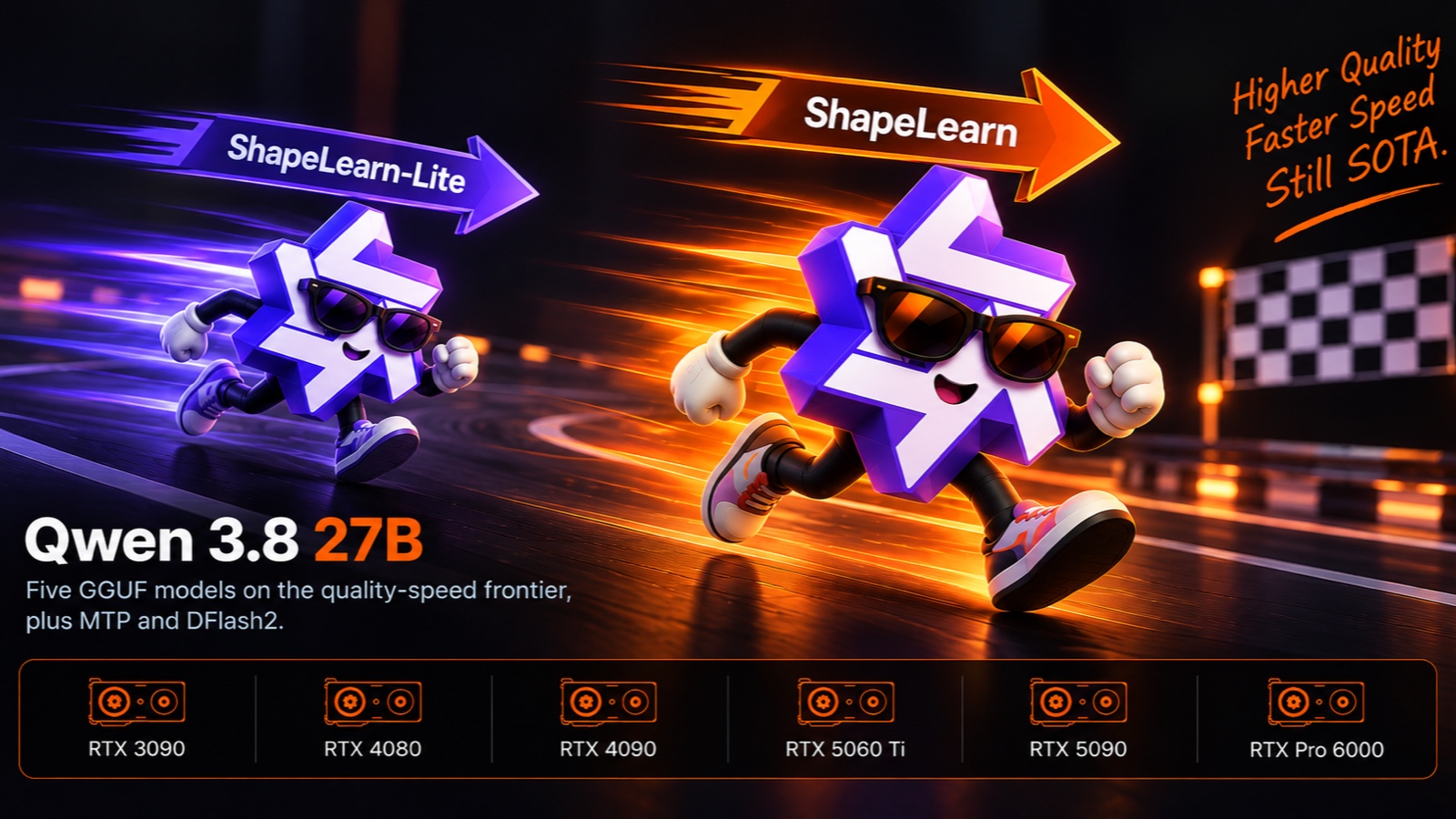
    Shapelearn Qwen 3.8 27B (13.1 GB VRAM)

    ByteShape releases full ShapeLearn quantizations for Qwen 3.8 27B, showing that their GPU‑specific GGUFs (GPU‑1…GPU‑5) dominate the quality‑throughput frontier across six GPUs, with GPU‑5 hitting 99.63 % of BF16 accuracy at 90 TPS on a 13.1 GB model. Speculative decoding (MTP, DFlash2) further boosts throughput, and the Lite set remains competitive.

    Hacker News front pagebyteshape.com17 minHN10439

  2. 92

    English: A vs. An

    The indefinite article in English depends on the initial sound, not the spelling. An analysis of the CMU pronunciation dictionary shows only 129 of 32,455 words are exceptions, and the first two letters are usually enough to decide between “a” and “an”.

    Hacker News front pageredblobgames.com1 minHN354499
  3. 94

    Cloudflare/Security-Audit-Skill

    Cloudflare open‑sources a “security‑audit” skill that turns an LLM‑enabled coding agent into a structured vulnerability auditor. It runs six deterministic phases, validates findings against a JSON schema, and supports additive runs to improve coverage.

    Hacker News front pagegithub.com3 minreleaseHN20938
  4. 95

    Nobody pays for FOSS, we can force them to

    The post argues that the free‑software model (MIT/BSD/Apache licenses) is an evolutionarily stable strategy: anyone can use the code for free, and attempts to charge via restrictive licenses fail because forks quickly replace them. This stability comes at a human cost—most maintainers are unpaid, many burn out, and the rapid velocity of modern ecosystems (npm, cloud services) amplifies the mainte…

    Hacker News front pageseldo.com23 minHN184182
  5. 97

    US Military had close call after using AI for hallucinated intelligence report

    A US Special Operations analyst used an AI chatbot to augment an intelligence report that falsely claimed a Chinese vessel was carrying nuclear‑related cargo. The report triggered a near‑miss military operation that was aborted once the hallucination was discovered. The incident highlights the lack of verification standards and the risk of relying on AI‑generated intel for targeting decisions.

    Hacker News front pagecnn.com4 minHN513388
  6. 98

    Learning to solve hard problems in RL for LLMs by never giving up

    The post introduces the *Matthew Effect* in RL‑fine‑tuning of LLMs—performance gains concentrate on tasks the model already solves— and proposes *Never Give Up* (NGU), an adaptive sampling scheme that uses a small k for easy prompts and retries hard prompts with a high‑probability “never give up” loop. Experiments on math (AIME, GSM8k), code (Manufactoria), and larger‑scale setups (DeepScaler) sh…

    Hacker News front pagegithub.io11 minHN1179
  7. 103

    IntBMoE: Integrating Block-Level Conditioning into Expert Composition for Full-Participation Mixture-of-Experts

    IntBMoE introduces block‑level conditioning to MoE, decoupling token participation, compute execution, and memory materialization. A hypernetwork merges all experts into a composed expert per block, while routing remains sparse. Dual‑Path Residual Gating further mixes two composed paths. Experiments show consistent gains on vision, language, and recommendation tasks, and the model is live in AMap…

    Hugging Face Daily Papersarxiv.org2 minpaper
  8. 104

    ScienceIDE: Turning World's Scientific Codebase into Agent Learnable Environments

    ScienceIDE is a framework that turns existing scientific software repositories into programmable environments that agents can use for task generation, execution, and verification. Training on these environments yields LLMs (PhAI‑IDE series) that outperform baselines on scientific code repair and several general code‑reasoning benchmarks.

    Hugging Face Daily Papersarxiv.org2 minpaper
  9. 105

    Backups Aren't Simple

    Backups involve more than copying files; you need snapshot rotation, deduplication, and off‑site storage to meet RPO goals while controlling storage and bandwidth. Using proven tools like Borg or Restic and regularly testing restores simplifies the mental load.

    Hacker News front pagefilipovski.net8 minHN353222
  10. 106

    Our brain evolved from two primitive nervous systems that merged: Study

    A new study shows that the forebrain and hindbrain develop from distinct progenitor cells (OTX2‑expressing and GBX2‑expressing) in mouse, human, chicken, zebrafish and acorn worm embryos, suggesting the vertebrate brain originated from the merger of two primitive nervous systems over 550 M years ago. This insight enabled the first successful in‑vitro generation of human hindbrain motor neurons.

    Hacker News front pagenewscientist.com3 minHN13275
  11. 107

    Towards Self-Driving Codebases

    The post argues that AI agents could eventually handle low‑level engineering tasks—bug fixing, debugging, UI consistency, growth experiments—if the dev toolchain is made “agent‑legible”. It outlines missing primitives (global memory, code‑base rot prevention, better dev environments) and proposes a bootstrapping process to measure and improve a repo’s “agent readiness”. The piece is largely specu…

    Hacker News front pagedetail.dev9 minHN12099
  12. 108

    Labeled matches: why is this not in every regex engine?

    The author shows how to label tokens (dates, money, emails, etc.) with a single regex pass using extended operators (`&` for intersection, `~` for complement) in the resharp library. A tiny benchmark compares 10 patterns against spaCy’s NER, reporting ~1.9 GB/s (≈4500× faster) on 8 threads. The post lists the concrete patterns and argues that for deterministic, regular‑language entities regex can…

    Lobstersiev.ee7 minHN5lobste.rs27
  13. 111

    Reinventing issue tracking: Local-first and Git-native

    A devlog describing how Manganin’s issue tracker stores issues in a dedicated Git repo as plain files, after rejecting earlier approaches that tried to embed issue data in the code tree or Git refs. The author explains the pitfalls of using refs for issue storage, shows the low‑level Git commands needed for that approach, and then outlines the final design: a hidden sister repository where each i…

    Lobstersmanganin.dev6 minHN1lobste.rs27
  14. 113

    Trying the Software Factory Pattern

    The post describes an experiment implementing the software‑factory pattern: an AI‑driven loop that audits a Linear project, syncs goals from Notion, metrics from Datadog/Snowflake, creates and updates issues, and executes non‑blocked tasks. It shows how tying together a unified task tracker, observability data, and an orchestrated agent harness can keep projects aligned without manual state hoard…

    Hacker News front pagelethain.com3 minHN8343
  15. 118

    How Uber Protects Against Retry Storms

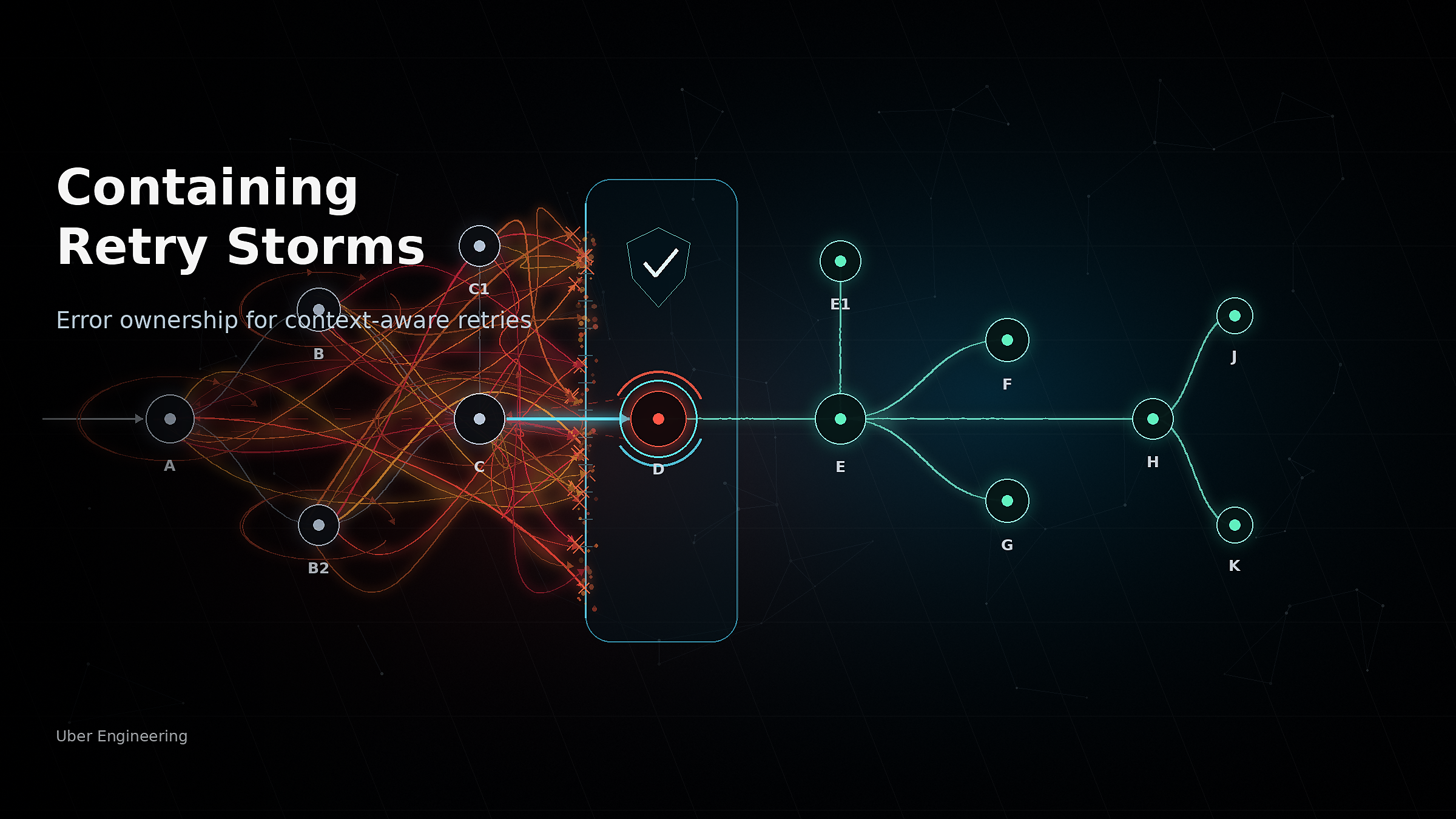
    Uber developed a context-aware mechanism to prevent retry storms in deep microservice dependency chains. It introduces "error ownership" where services claim errors they originate and unclaim errors they propagate, allowing upstream callers to make informed retry decisions and avoid amplifying load on already struggling services.

    Hacker News front pageuber.com12 minHN11949
  16. 119

    CodeMidas: Scaling Agentic Coding RL Environments from Code Itself

    CodeMidas builds RL environments directly from open‑source code: agents explore a repo, infer a spec, generate tests from the original implementation, and filter tasks via execution checks. The pipeline yields 5,545 high‑quality coding tasks across 23 languages and 15 domains. Training the MiMo‑V2.5 agent with GRPO on this dataset improves benchmark scores by 8‑18% (e.g., DeepSWE +11.7%, ProgramB…

    Hugging Face Daily Papersarxiv.org1 minpaper
  17. 120

    Accurate Models of AMD Matrix Cores

    The authors reverse‑engineer AMD’s CDNA matrix cores, build per‑architecture MATLAB models that match hardware bit‑for‑bit on 10 M random tests, and use them to compare AMD vs NVIDIA tensor‑core accuracy.

    Hacker News front pagearxiv.org2 minpaperHN7911