31
Top
- 32
Be alert: targeted attacks on prominent Rustaceans
The Mozilla Automation Team warns of a targeted social‑engineering campaign aimed at Rust community members and popular crate owners, using fake video‑call offers to deliver malware. They advise staying skeptical of cold outreach, using trusted call platforms, enabling MFA, and reporting any concerns to Rust security contacts.
- 33
- 34
Building a Linux GPU Driver for the M4 Mac Mini in One Month
Built a clean‑room OpenGL ES 3.0 Linux driver for Apple‑silicon M4/A18 Pro GPUs in ~4 weeks, covering reverse‑engineered firmware ABI, a Rust kernel driver, a custom IR/shader compiler, and user‑space Metal translation; achieved 200 fps Minecraft and WebGL demos, with heavy LLM assistance for debugging and code generation.
Hacker News front pagecodyho.dev15 minHN416281 - 35
How OpenAI Used Its Own LLMs to Design Its Jalapeño Chip
OpenAI designed its Jalapeño AI accelerator chip in under 20 months, claiming 3.6x lower inference latency than Nvidia's GB300. This rapid timeline was achieved by leveraging internal LLMs to accelerate front-end design, high-level synthesis, and post-silicon software optimization.
- 36
Show HN: Cactus Needle 3: 8-29MB automation models can match DeepSeek V4 Flash
Cactus Needle 3 is a laddered attention LLM (29‑121 M params, CQ2‑bit quantised) that fits in 9‑29 MB binaries and runs on devices like a Raspberry Pi 5 (400‑4k t/s decode, 1‑10k t/s pre‑fill). It can perform tool‑calling, structured extraction, and text embedding locally, matching DeepSeek V4 Flash on downstream tasks after a single fine‑tune epoch. The post includes architecture details, benchm…
Hacker News front pagecactuscompute.com7 minreleaseHN537185 - 37
Cloudflare Quick Tunnels
Cloudflare Quick Tunnels let you expose a local service via an outbound‑only connection to Cloudflare’s edge network. The service gets a public URL (anycast across 335+ cities) with automatic TLS, DDoS protection, and no inbound ports. It’s positioned for short‑lived agents, webhooks, and testing loops, with JSON health output and no config files.
Hacker News front pagecloudflare.com1 minreleaseHN831316 - 38
- 39
- 40
- 41
- 42
AI-generated posters don’t have to be horrible
Prompting LLMs with explicit design style descriptors yields a wide variety of non‑generic AI‑generated event posters, letting you avoid the bland, repetitive look that dominates many community flyers.
Hacker News front pagehartnup.uk7 minHN1854942 - 43
Nvidia announces native GPU programming in Rust
NVIDIA released CUDA‑Rust, letting you write GPU kernels directly in Rust and compile to PTX. Two programming models are supported: the traditional SIMT model via the `cuda-oxide` backend (nightly Rust, custom codegen) and the newer Tile model via `cutile‑rs` (stable Rust, JIT‑compiled Tile IR). Both provide Rust‑typed safety guarantees (e.g., `DisjointSlice`, tensor partitioning) and simple Carg…
Hacker News front pagenvidia.com11 minHN961402 - 44
Learning to solve hard problems in RL for LLMs by never giving up
The post introduces the *Matthew Effect* in RL‑fine‑tuning of LLMs—performance gains concentrate on tasks the model already solves— and proposes *Never Give Up* (NGU), an adaptive sampling scheme that uses a small k for easy prompts and retries hard prompts with a high‑probability “never give up” loop. Experiments on math (AIME, GSM8k), code (Manufactoria), and larger‑scale setups (DeepScaler) sh…
Hacker News front pagegithub.io11 minHN1179 - 45
- 46
Vectorized and performance-portable Quicksort (2022)
Google’s Highway library now includes a fully portable SIMD‑vectorized quicksort that runs 9‑19× faster than C++ std::sort. By using compress‑store (or permute‑based emulation) for partitioning, the same C++ code targets AVX2, AVX‑512, NEON, SVE and RISC‑V V. Benchmarks show 0.5 GB/s on an Apple M1 and >1 GB/s on a 3 GHz Skylake, beating prior architecture‑specific sorts. The implementation and a…
Hacker News front pagegoogleblog.com3 minHN460142 - 47
The Golden Spike, and Resurrecting the Vale(n) Programming Language
Evan Ovadia announces Valen, a fork of his Vale language aimed at seamless Rust interop with features like linear types, group borrowing, and cross‑language generics. He outlines current capabilities, open challenges, and a lazy AST‑signature approach to bridge the Rust ABI gap.
- 48
- 49
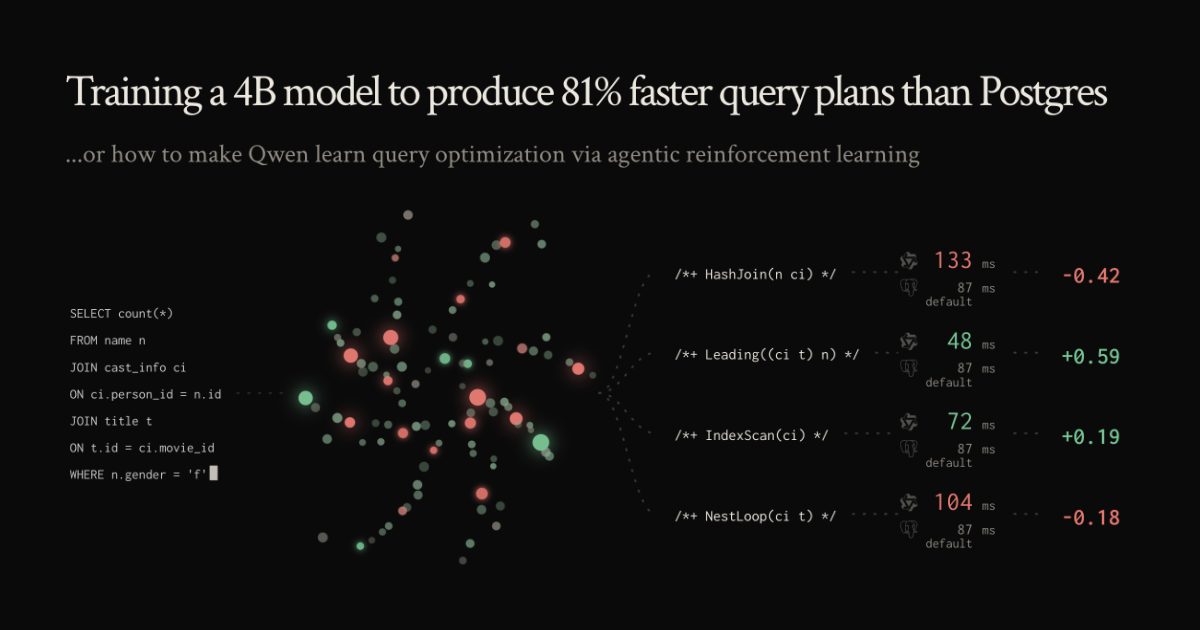
Training a 4B model to produce 81% faster query plans than Postgres
A 4‑billion‑parameter open‑weight LLM, fine‑tuned with supervised learning and a custom RL loop, learns to emit PostgreSQL join plans that cut query latency by 44.7 % on a 113‑query benchmark. The author built a low‑noise measurement harness, a GRPO‑style reward function, and ran off‑policy distillation from ~500 GPT‑6‑style trajectories, demonstrating that a modest model can outperform Postgres’…
Hacker News front pagerohanbansal.com51 minHN692143 - 50
HarnessTax: How Much Does the Harness Matter for Coding Agents?
The article content is unavailable, providing no details about HarnessTax or its findings. Therefore we cannot extract any conclusions or takeaways.
- 51
- 52
- 53
- 54
- 55
Reverse-engineered Jev-like model
Jevlike is an open‑source starter model that scores a list of text options in a single forward pass. It provides a minimal architecture (option queries, shared dot‑product scorer), synthetic data generation, training/evaluation CLI, and examples on Doom and chess. The repo supports a byte‑level encoder or a frozen Hugging‑Face encoder (e.g., Qwen2.5‑0.5B), runs on CPU/MPS/CUDA, and reports benchm…
Hacker News front pagegithub.com4 minreleaseHN16224 - 56
IBM Built the Cold War’s Most Powerful Code Breaker for the NSA
IBM’s Harvest (IBM 7950) was a 1960s NSA‑dedicated streaming coprocessor attached to an IBM Stretch mainframe. It ran up to 200× faster than contemporary machines, used a custom bit‑addressable memory model, pipelined parallel streams (P, Q → R), and introduced the world’s first automated tape library. IBM also created a domain‑specific language, Alpha, for cryptanalytic programmers. The article…
- 57
OpenJev
OpenJev is a browser‑only demo that lets you load small LLM checkpoints (e.g., MiniCPM‑5 2B, Qwen3 0.6B) onto your GPU and compare two inference paths: reading raw logits for a set of options versus prompting the model to emit a JSON with option probabilities token‑by‑token. The page reports model sizes, download times, balanced accuracy on a few benchmarks, and wall‑clock timings measured with `…
Hacker News front pageopenjev.com2 minreleaseHN709288 - 58
Human brain is two separate organs, Stanford Medicine-led research finds
Stanford researchers discovered that the human brain develops from two separate progenitor lineages—one for forebrain/midbrain (Otx2) and one for hindbrain (Gbx2)—and used this insight to grow functional hindbrain neurons from pluripotent stem cells. This breakthrough provides a platform for studying brain‑stem diseases such as SMA and ALS and reshapes our understanding of brain evolution.
Hacker News front pagestanford.edu5 minreleaseHN654257 - 59
ZuckOff Is a Free App That Sees Meta Glasses Before They See You
ZuckOff is a free mobile app that scans for Bluetooth signatures of Meta smart glasses and notifies you when they are in range. It can’t detect recording activity, but it gives a simple way to spot nearby glasses.
Hacker News front pagewired.me2 minHN339318 - 60