proomt

Search

Search posts, papers, and topics

All posts

SitePoint10 min readintermediate
Building Event-Driven Enterprise Applications with . NET and AWS

Summary

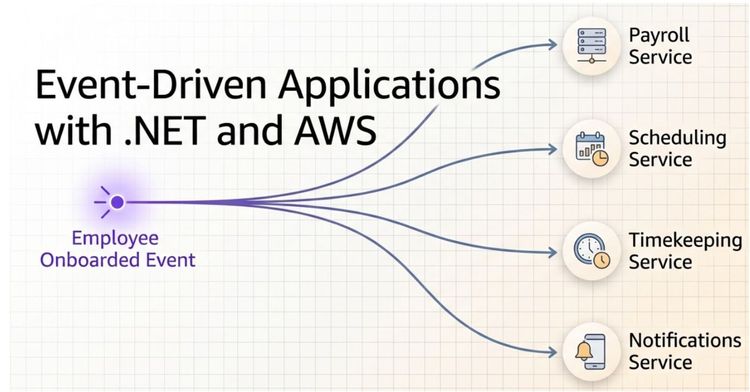
A practical guide to refactoring a monolithic onboarding API into an event‑driven architecture using ASP.NET Core, AWS SNS/SQS (or EventBridge), the outbox pattern, and idempotent consumers, with concrete code snippets and operational tips.

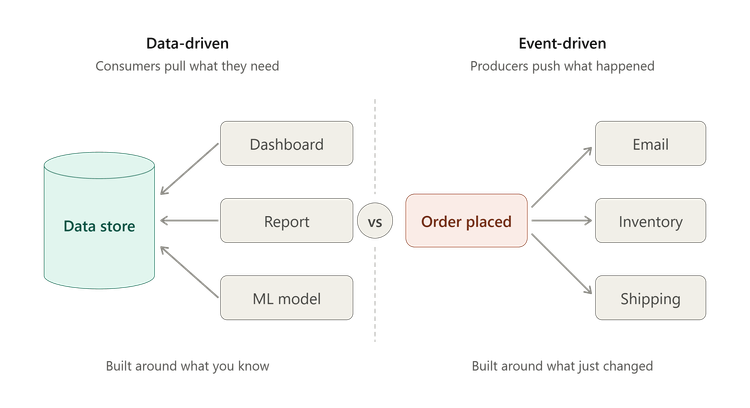
  • Separate commands (synchronous) from events (asynchronous) to decouple services.
  • Use SNS for fan‑out publishing and SQS queues per consumer for durable buffering and independent scaling.
  • Avoid dual‑write bugs by persisting events to an Outbox table within the same DB transaction as the business change, then publishing asynchronously.
  • Implement consumers as BackgroundService (or Lambda) that poll SQS, handle messages idempotently (store EventId), and respect visibility timeouts and DLQs.

Shows a realistic migration path from a tightly‑coupled request‑per‑operation flow to a resilient, scalable event‑driven system, highlighting pitfalls (dual‑write, duplicate processing) that only surface in production.

6/10
Related reading

  1. AWS reimagines the getting started experience

    AWS announced a new “project” onboarding flow that lets new users start building with default configurations, free credits, and simplified IAM handling. Sign‑in via Google/GitHub/Apple creates an isolated AWS account, auto‑provisions a CLI/agent toolkit, and lets you invite collaborators by email. Spend limits can be set per project, and advanced features (multi‑region, org policies) can be enabl…

    AWSamazon.com5 minHN33
  2. Article: Beyond Relevance: A Governance-First Architecture for Enterprise Personalization

    The article proposes a governance‑first architecture for enterprise personalization, where policy‑driven steps (memory, journey graph, AI routing, scoring, trust checks, outcome simulation) shape the recommendation before it is returned. A reference FastAPI implementation demonstrates the pattern with external YAML policies and optional LLM assistance.

    InfoQinfoq.com19 min
  3. Article: Your Next DSL Author Is a Language Model

    Typed Domain Grounding (TDG) embeds a DSL inside a mainstream language the LLM already knows (e.g., Kotlin) and uses the host compiler as an oracle. The author describes five building blocks—embedding, choosing a host language with high training‑data frequency, compiler‑driven type safety, a generate‑compile‑repair loop, and an on‑demand teaching tool—and shows measured results from kUML, a Kotli…

    InfoQinfoq.com18 min