proomt

Search

Search posts, papers, and topics

All posts

Apple Machine Learning Research1 min readpaperadvanced

Glyph: A Multi-Strategy Agentic System for Column Description and Sensitivity-Ontology Tagging of Enterprise Data Catalogs

Summary

Glyph is a production system that uses coordinated LLM agents and a fine‑tuned MiniLM encoder to automatically generate column descriptions and assign ontology tags in enterprise data catalogs. It combines code‑grounded retrieval, regex, and contrastive vector search, achieving NDCG@10 0.92 and MAP@100 0.90, and provides auditable provenance for each tag.

  • Glyph frames column description and ontology tagging as cooperating LLM agents in a stateful graph, using active RAG to ground descriptions in source code.
  • The Tagger runs three parallel strategies—LLM description tagger, regex tagger, and a fine‑tuned MiniLM contrastive encoder—and fuses results with Reciprocal Rank Fusion.
  • Fine‑tuning a 6‑layer MiniLM with in‑batch contrastive loss raises NDCG@10 from 0.55 to 0.92 and MAP@100 from 0.19 to 0.90 on held‑out data.
  • Evaluation uses recall‑weighted F2 across three groups; ablations show each strategy and the RRF fusion contribute measurably to performance.

Data engineers and governance teams need scalable, auditable cataloging to reduce documentation debt and meet compliance.

8/10
Related reading

  1. How LLMs Can Find a Needle in a Haystack

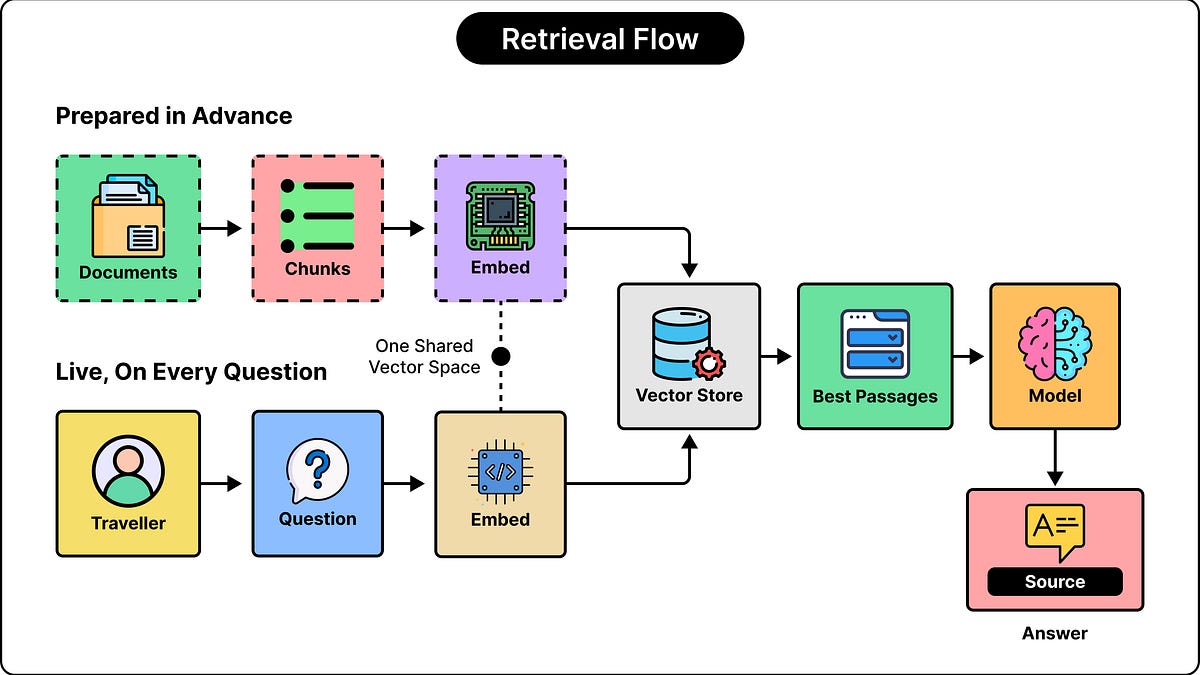
    The post explains how retrieval‑augmented generation (RAG) lets LLM‑based assistants answer questions from private corpora. It covers chunking documents into passages, embedding queries and chunks, similarity metrics, and the trade‑offs of different vector indexes (flat, IVF, HNSW). The focus is on practical design choices rather than new research.

    ByteByteGobytebytego.com12 min
  2. BI-Agent and BI-Bench: Towards Automating End-to-End Business Intelligence

    The paper introduces BI‑Bench, a new benchmark of real‑world BI questions derived from public dashboards, and BI‑Agent, a tool‑augmented LLM system that breaks BI workflows into search, join, and transform subtasks. Baseline LLMs hit <50 % accuracy on BI‑Bench. By orchestrating specialized data‑management tools and post‑training the model with supervised fine‑tuning and reinforcement learning on…

    Hugging Face Daily Papersarxiv.org2 minpaper
  3. Database for AI Agents: 5 Evaluation Criteria

    Databricks outlines five criteria for a production‑ready database for AI agents—branch‑per‑agent isolation, serverless scale‑to‑zero, hybrid search, ACID guarantees, and a unified platform that eliminates ETL lag—illustrating each with features of its Lakebase offering and brief customer anecdotes.

    Databricksdatabricks.com10 min
  4. Article: Beyond Relevance: A Governance-First Architecture for Enterprise Personalization

    The article proposes a governance‑first architecture for enterprise personalization, where policy‑driven steps (memory, journey graph, AI routing, scoring, trust checks, outcome simulation) shape the recommendation before it is returned. A reference FastAPI implementation demonstrates the pattern with external YAML policies and optional LLM assistance.

    InfoQinfoq.com19 min
  5. Introducing Filestore agent volumes: fully managed storage for agent workspaces

    Google Cloud adds Filestore agent volumes, a fully‑managed, elastic file‑system that automatically provisions isolated POSIX workspaces for GKE‑based AI agent sandboxes. Volumes attach in milliseconds, support RWX with file‑level locking, and charge only for used capacity with automatic tiering, aiming to cut cold‑start latency and storage waste for large‑scale agent fleets.

    Google Cloud Bloggoogle.com4 min