proomt

Search

Search posts, papers, and topics

All posts

Freek Van der Herten1 min readintro
Prevent cognitive debt by manually retyping LLM-generated code

Summary

Ankur Sethi argues that manually retyping LLM-generated code helps prevent cognitive debt. This practice, though slower, aids in understanding the code, catching errors, and maintaining a strong mental model of the codebase.

  • Retyping LLM code forces active understanding of its logic.
  • It helps identify and correct flawed AI-generated suggestions.
  • This practice strengthens your mental model of the codebase.
  • Initial slowdown is a trade-off for long-term clarity and reduced cognitive debt.

Engineers relying on LLMs for code generation should consider this approach to avoid accumulating technical debt and maintain code quality.

3/10
Related reading

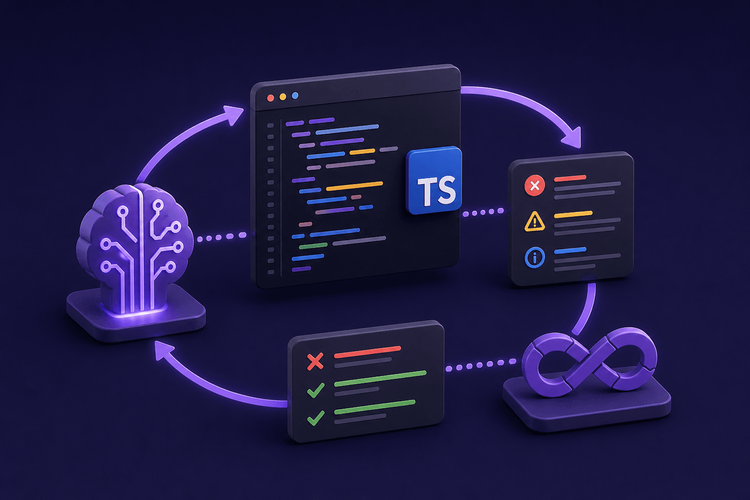
  1. Eliminating AI Code Hallucinations with TypeScript Compiler Diagnostics and TDD Loops

    The article shows how to replace raw TypeScript compiler output with a programmatic JSON feedback loop that merges diagnostics and Vitest test failures, feeding the structured data back to an LLM coding agent for self‑correction. It provides concrete code for extracting, enriching, validating, and de‑duplicating errors, and demonstrates token savings and deterministic iteration until compilation…

    SitePointsitepoint.com15 min
  2. Bend 2 and the Vibe-Coding Trap

    The author argues that “vibe‑coding” with LLMs can cause engineers to reinvent existing solutions, using Bend 2—a language that asks LLMs to write long formal proofs—as a case study. By re‑implementing the same demo in SPARK/Ada, the author shows that established formal‑verification tools achieve the same guarantees with a tiny proof, highlighting the need for domain research before prompting LLM…

    Hacker News front pageliampwll.com5 minHN326235
  3. Do LLMs Have the Memory of a Goldfish?

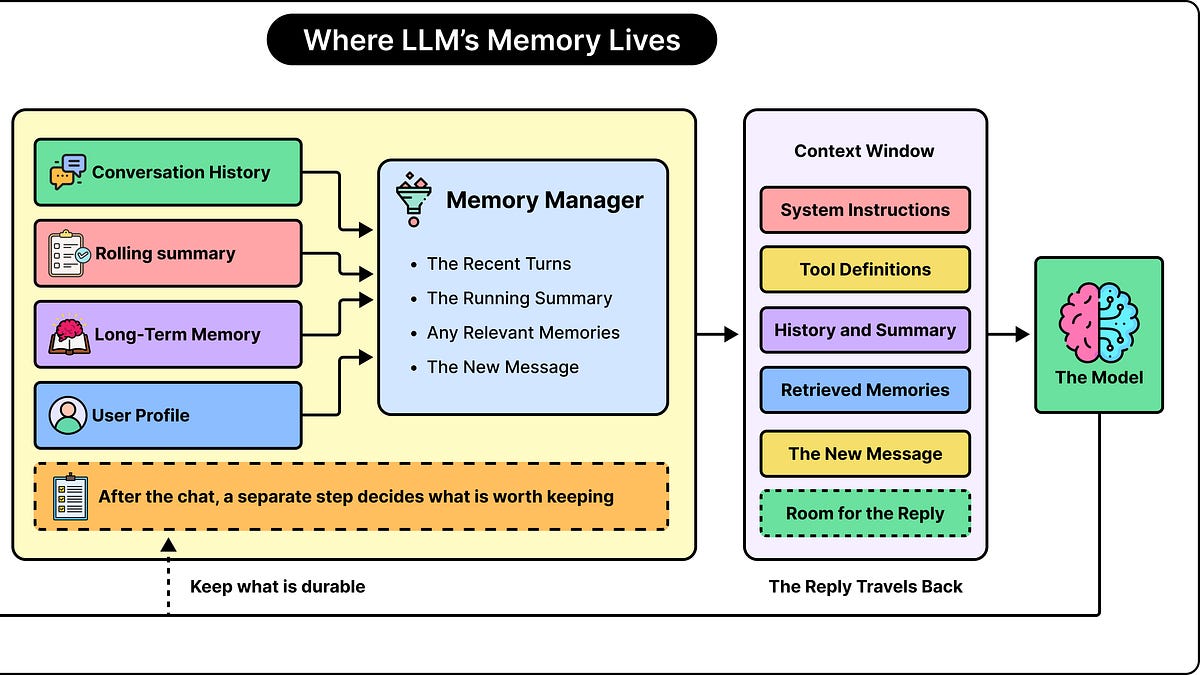
    The article explains that LLMs don’t have persistent personal memory; all “memory” is supplied by the surrounding application via the context window, summaries, or external storage. It outlines the distinction between trained weights, working‑memory (token context), and persistent application memory, shows how to construct API calls to preserve conversation state, and discusses the cost and laten…

    ByteByteGobytebytego.com12 min
  4. Learning to solve hard problems in RL for LLMs by never giving up

    The post introduces the *Matthew Effect* in RL‑fine‑tuning of LLMs—performance gains concentrate on tasks the model already solves— and proposes *Never Give Up* (NGU), an adaptive sampling scheme that uses a small k for easy prompts and retries hard prompts with a high‑probability “never give up” loop. Experiments on math (AIME, GSM8k), code (Manufactoria), and larger‑scale setups (DeepScaler) sh…

    Hacker News front pagegithub.io11 minHN1179
  5. Presentation: Complexity and Creativity in Software Engineering

    Phillip Mortimer argues that AI‑generated code makes all software effectively "write‑only" due to volume, and proposes managing this by treating tests as the sole specification, automating code reviews with LLMs, and decoupling intent from implementation.

    InfoQinfoq.com28 mintalk