proomt

Search

Search posts, papers, and topics

Hall of Fame

Hall of FameBetsy Beyer et al. (Google)20161 min readintro

Site Reliability Engineering

Summary

The SRE book’s table of contents outlines a comprehensive guide to site reliability engineering, split into parts on introduction, principles, practices, management, and conclusions, with appendices of checklists and examples.

  • The book is organized into five parts: intro, principles (SLOs, toil, monitoring), practices (alerting, on‑call, troubleshooting), management (career, communication), and conclusions.
  • Core principles include embracing risk, defining service level objectives, and automating to reduce toil.
  • Practical practices cover alerting, incident response, postmortems, load balancing, and reliability testing.
  • Appendices provide ready‑to‑use artifacts like availability tables, incident docs, launch checklists, and postmortem templates.

Any engineer building or operating production services should know the SRE framework and where to find detailed guidance.

4/10
Related reading

  1. Best practices for handling cloud reliability incidents

    The article outlines a structured Verify→Investigate→Report→Resolve→Review workflow for GCP reliability incidents and stresses pre‑incident preparation across design, data, playbooks, and training. It lists concrete tools (Cloud Logging, Service Health, Gemini Assist) and reporting steps to help engineers reduce outage impact.

    Google Cloud Bloggoogle.com11 min
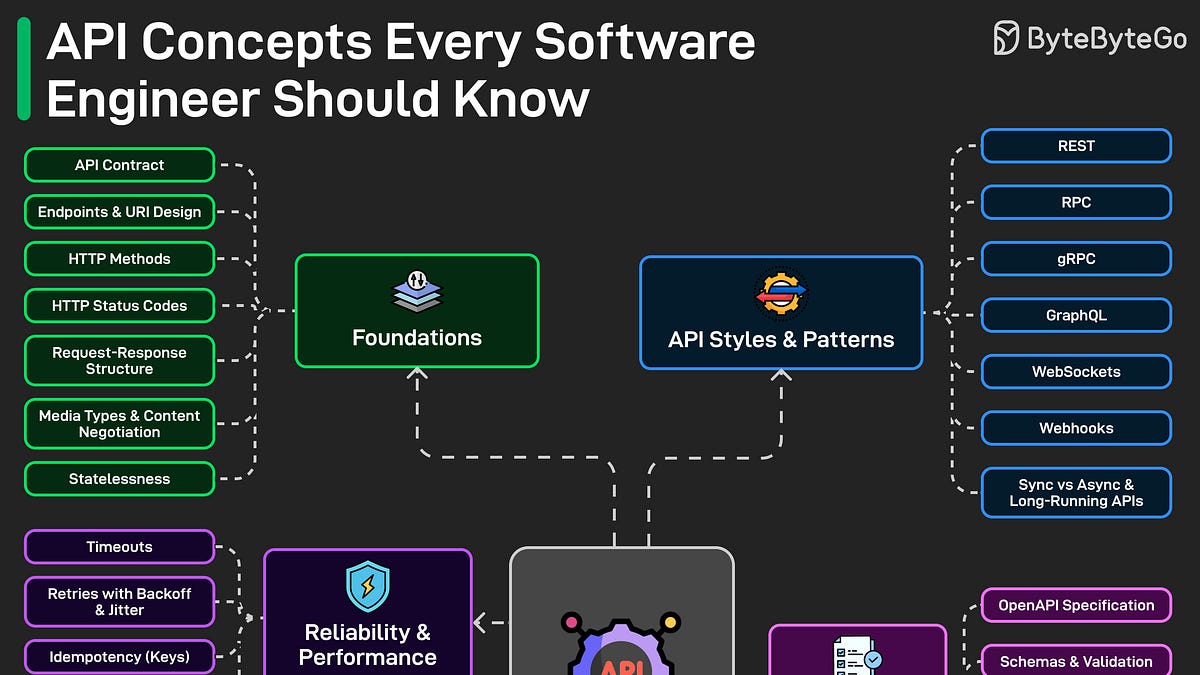
  2. EP226: API Concepts Every Software Engineer Should Know

    This article outlines essential API design considerations, covering HTTP fundamentals, architectural styles like REST and GraphQL, and critical aspects such as naming, versioning, security, and reliability. It serves as a high-level checklist for engineers designing or consuming APIs.

    ByteByteGobytebytego.com5 min
  3. Security Engineering

    Ross Anderson’s third edition of Security Engineering is now released, with the full text and individual chapter PDFs available for free online after a brief embargo. The book spans 29 chapters covering threat modeling, cryptography, distributed systems, economics, and more, and is supported by 15 teaching videos.

    Hall of Famecam.ac.uk5 minrelease
  4. On Designing and Deploying Internet-Scale Services

    James Hamilton’s 2007 paper distills a set of concrete best‑practice tenets for building operations‑friendly, internet‑scale services—design for failure, keep things simple, and automate everything. Applying these guidelines (commodity hardware, single‑version software, redundancy, multi‑tenancy) enables ratios of thousands of servers per administrator while maintaining reliability.

    Hall of Fameusenix.org43 minpaper
  5. The Twelve-Factor App

    The Twelve‑Factor App outlines a set of twelve best‑practice guidelines for building SaaS applications that are portable, scalable, and maintainable. Following the factors—codebase, dependencies, config, backing services, build/release/run, processes, port binding, concurrency, disposability, dev/prod parity, logs, admin processes—helps teams ship reliably to modern cloud platforms.

    Hall of Fame12factor.net1 min
  6. Article: Your Next DSL Author Is a Language Model

    Typed Domain Grounding (TDG) embeds a DSL inside a mainstream language the LLM already knows (e.g., Kotlin) and uses the host compiler as an oracle. The author describes five building blocks—embedding, choosing a host language with high training‑data frequency, compiler‑driven type safety, a generate‑compile‑repair loop, and an on‑demand teaching tool—and shows measured results from kUML, a Kotli…

    InfoQinfoq.com18 min