proomt

Search

Search posts, papers, and topics

All posts

Hacker News front pageSølvi Normannsen6 min readintro

Study: Young users (9 to 18Y) ditch Google for AI, with unknown consequences

Summary

A systematic review of 173 studies finds that generative AI neither improves nor harms critical thinking or problem‑solving in isolation; outcomes hinge on how teachers integrate the tools. However, 80% of the evidence comes from university students and is regionally biased, leaving a major knowledge gap for K‑12 education.

  • Generative AI tools themselves have no net effect on critical thinking or problem‑solving; outcomes depend on usage context.
  • 80% of the reviewed studies focus on university students, leaving K‑12 impacts largely unknown.
  • Most evidence is self‑reported and geographically skewed toward Asia and Europe, reducing reliability.
  • Using AI as a shortcut can weaken independent reasoning and widen learning disparities.

Educators and edtech developers should care because current evidence on AI’s impact on school‑age learners is sparse and biased, making informed tool design and policy difficult.

5/10

Related reading

  1. The future of practice: Enabling teachers to create learning interactives with generative UI

    Google Research demonstrates a generative‑UI system that lets teachers author interactive, game‑style learning modules. The pipeline uses pedagogical guardrails, iterative self‑correcting loops (including automated solvability checks), and teacher vetting. A pilot library of 30+ STEM interactives is publicly available, and early teacher studies report good‑to‑excellent ratings.

    Google Researchresearch.google8 minHN4
  2. Agentic Skill Decay

    Addy Osmani warns that AI agents can short‑circuit the hands‑on practice (“reps”) that builds deep expertise and judgment. He recommends deliberately inserting hypothesis‑forming, “why” questioning, diff inspection, failure prediction, and occasional manual coding into the workflow, especially for junior engineers. A 2026 Anthropic study showed junior developers using AI scored 17 % lower on a fo…

    Addy Osmaniaddyosmani.com16 min
  3. How Generative AI Is Changing Modern Software Development

    Generative AI tools can assist developers by producing code snippets, tests, documentation, and debugging hints, but their output must be reviewed and validated. Engineers should adopt prompt‑writing skills and maintain core software‑engineering expertise to use AI safely and productively.

    SitePointsitepoint.com4 min
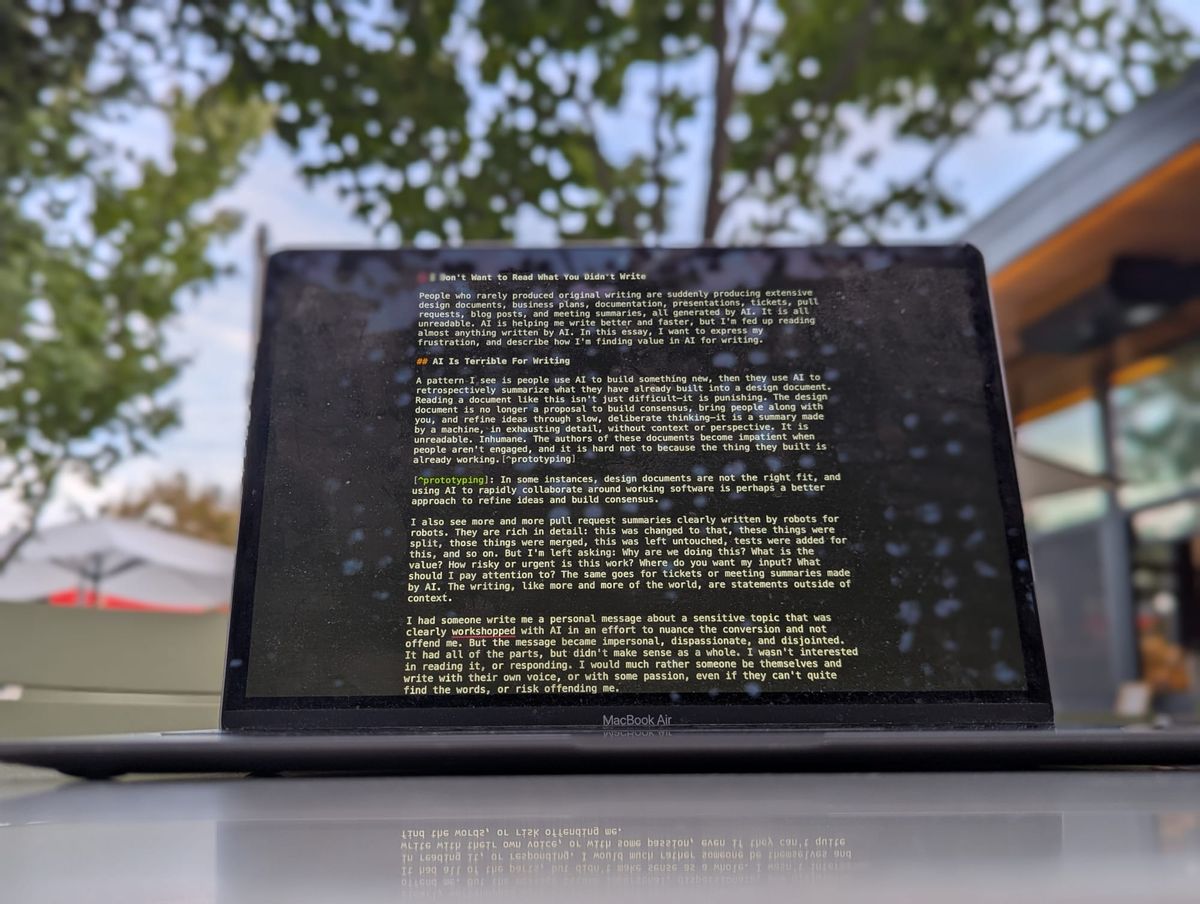
  4. I don't want to read what you didn't write

    The essay laments the unreadability of AI‑generated design docs, PR summaries, and other engineering writing, citing a survey where 78% of readers quit when they suspect AI involvement. The author finds AI useful only when they control the prompt and context—e.g., for grammar checks, citation generation, and diagram creation while writing a paper—but not for producing the core narrative. He highl…

    Hacker News front pagecolinbreck.com13 minHN985419
  5. The Bitter Lesson

    Rich Sutton’s essay argues that over the past 70 years AI progress has consistently come from methods that can scale with more computation—search and learning—while hand‑crafted, human‑knowledge approaches give only short‑term gains. The piece uses chess, Go, speech and vision as case studies to warn researchers to favor general, compute‑driven techniques.

    Hall of Fameincompleteideas.net5 min