proomt

Search

Search posts, papers, and topics

All posts

Hugging Face Daily PapersZixuan Wang, Yufan Zhou, Jinzhou Tang2 min readpaperadvanced

Mind2Dialogue: Training Human-Aware Language Models by Simulating User Mental States

Summary

Mind2Dialogue introduces a psychology‑guided simulator that generates user mental states and uses privileged distillation to train LLM assistants on Oracle responses that know those states. The resulting models improve personalization and theory‑of‑mind metrics by up to 41 percentage points versus standard instruction‑tuned baselines.

  • A user simulator maintains personal traits and updates a shared mental state across turns to drive realistic dialogue behavior.
  • Privileged distillation trains the assistant on Oracle responses that have direct access to the simulated mental state, bypassing the supervision gap.
  • Evaluation combines personalization and theory‑of‑mind metrics, showing 26.6–40.9 pp improvements in preference‑following over Qwen, Llama, and OLMo baselines.
  • The trained models also outperform baselines on belief and action reasoning tasks, indicating broader reasoning benefits.

Researchers building conversational AI need scalable supervision for user beliefs and goals; this work offers a concrete method and dataset to achieve that.

7/10
Related reading

  1. Verifiable Social Reasoning for LLM Assistants

    The paper introduces Fuse, a multi‑agent simulation that gives LLM assistants a verifiable ground‑truth task for social reasoning by hiding a target agent’s motive and letting a user‑mediated conversation infer it. Experiments on 12 LLMs show user mediation makes reasoning harder, models are biased by user framing, need more detail than humans, and longer chats don’t always help.

    Hugging Face Daily Papersarxiv.org1 minpaper
  2. Do LLMs Have the Memory of a Goldfish?

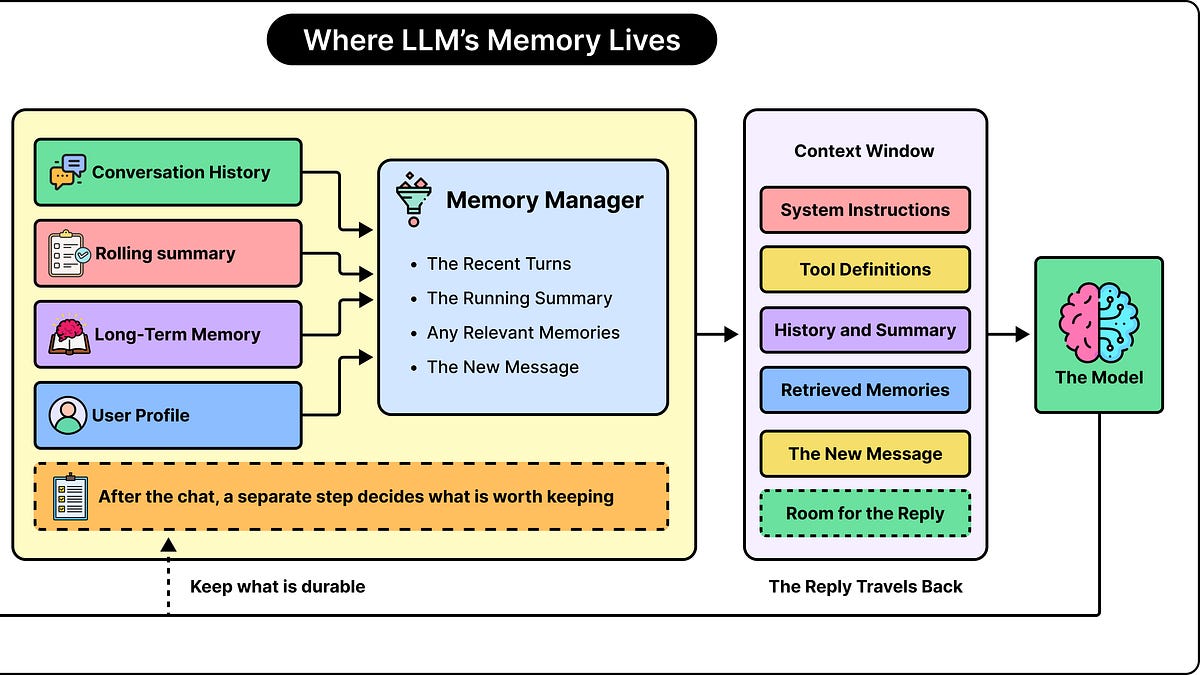
    The article explains that LLMs don’t have persistent personal memory; all “memory” is supplied by the surrounding application via the context window, summaries, or external storage. It outlines the distinction between trained weights, working‑memory (token context), and persistent application memory, shows how to construct API calls to preserve conversation state, and discusses the cost and laten…

    ByteByteGobytebytego.com12 min
  3. Article: Your Next DSL Author Is a Language Model

    Typed Domain Grounding (TDG) embeds a DSL inside a mainstream language the LLM already knows (e.g., Kotlin) and uses the host compiler as an oracle. The author describes five building blocks—embedding, choosing a host language with high training‑data frequency, compiler‑driven type safety, a generate‑compile‑repair loop, and an on‑demand teaching tool—and shows measured results from kUML, a Kotli…

    InfoQinfoq.com18 min
  4. When2Think: Learning Difficulty-Aware Length Control for Efficient Hybrid Reasoning Models

    When2Think introduces a post‑training framework that lets a large reasoning model decide per‑instance how much reasoning depth to allocate, using difficulty‑aware reward shaping (IDAC) and verifier rewards. It cuts token usage by ~28% while boosting Pass@3 by 10% on AIME24 and reaches 40% Pass@3 on AIME25, outperforming compression and routing baselines.

    Hugging Face Daily Papersarxiv.org1 minpaper
  5. Register Tokens for Bounded-State Reasoning in Diffusion Language Models

    Register tokens are fixed‑position embeddings that store a compact hidden state across diffusion‑based language model generation chunks, enabling bounded‑state reasoning without retaining all prior text. Post‑training on LLaDA and Dream shows up to +8.5 math and +19.5 code benchmark points versus plain text carry, and RL fine‑tuning further improves long‑horizon tasks.

    Hugging Face Daily Papersarxiv.org1 minpaper