proomt

Search

Search posts, papers, and topics

All posts

Codeship5 min readintermediate

When should you replace a homegrown feature flag system?

Summary

Homegrown feature flag implementations work for small teams but quickly lack ownership, auditability, and stakeholder access as they scale. When flag count, team size, incidents, or compliance audits make these gaps costly, switch to a purpose‑built feature management platform.

  • Homegrown flags usually have no native governance: owners disappear and flags linger without decommissioning.
  • Missing audit trails make it hard to answer who changed a flag, when, and why—problematic for incident response and compliance.
  • When multiple non‑engineer stakeholders need to view or toggle flags, the engineering ticket bottleneck becomes a release blocker.
  • Trigger events like a production incident tied to a flag or a compliance audit without a paper trail signal that flag debt is too high.

Engineering leads, product managers, and compliance officers should care because unmanaged flags can cause outages, slow releases, and regulatory penalties.

6/10
Related reading

  1. The Real Cost of a Homegrown Feature Flag System

    Home‑grown feature flag systems look cheap until maintenance, governance, and scaling costs explode, especially as AI‑accelerated development creates more flags faster. Buying a managed solution offloads engineering effort, adds audit trails, and scales with multiple teams.

    Codeshipcloudbees.com6 min
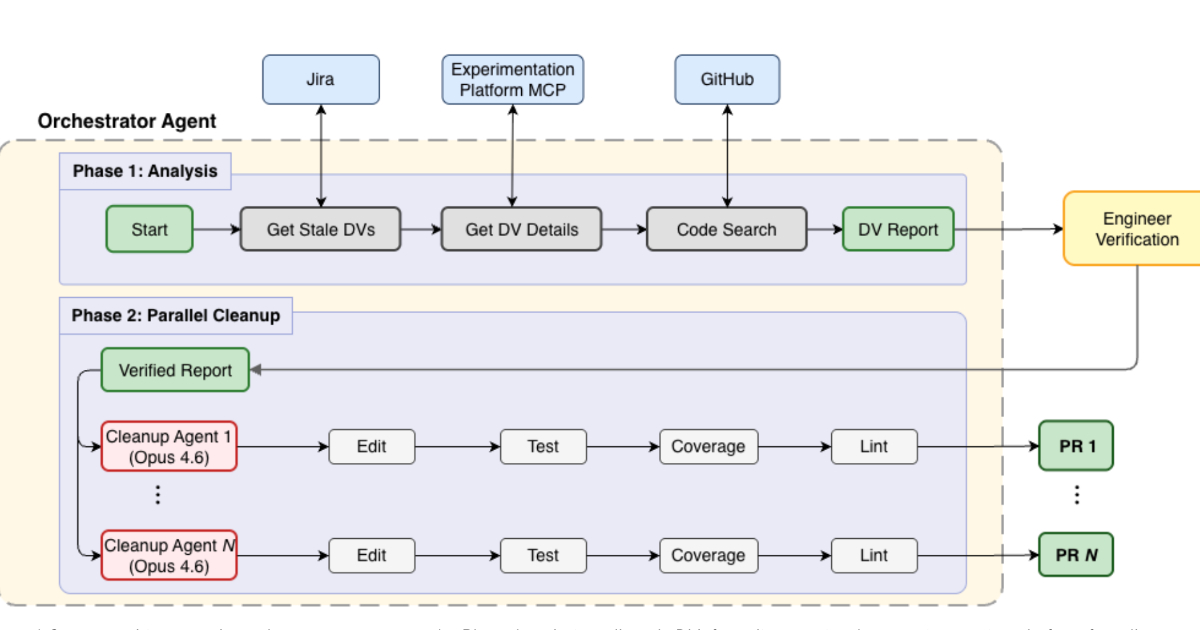
  2. DoorDash Uses Multi Agent LLMs to Clean up 60,000 Feature Flags

    DoorDash built a two‑phase, multi‑agent LLM system (Claude Sonnet orchestrator + Claude Opus cleanup agents) that automatically removes stale feature flags from 623 repos. In a 50‑flag pilot it generated usable PRs for 45 flags at ~14 min and $4.79 each, with 100 % success on simple flags and no regressions.

    InfoQinfoq.com2 min
  3. Microsoft Open-Sources TauGrid to Simplify AI Workload Management on Kubernetes

    Microsoft open‑sourced TauGrid, a Helm‑installable platform that bundles Kueue, KubeRay and other components to schedule, monitor and checkpoint AI workloads on GPU‑enabled Kubernetes clusters. Engineers define jobs in a simple `tau.yaml`, and TauGrid handles queuing, health checks, and observability, simplifying AI workload management.

    InfoQinfoq.com2 min
  4. Best practices for handling cloud reliability incidents

    The article outlines a structured Verify→Investigate→Report→Resolve→Review workflow for GCP reliability incidents and stresses pre‑incident preparation across design, data, playbooks, and training. It lists concrete tools (Cloud Logging, Service Health, Gemini Assist) and reporting steps to help engineers reduce outage impact.

    Google Cloud Bloggoogle.com11 min
  5. CloudBees vs Harness: Why Migration Isn't the Fix

    The article argues that Harness’s “free migration” offer hides significant downstream costs (training, pipeline rebuilds, compliance recertification) and that even after migration you still lack unified governance across heterogeneous CI/CD tools. CloudBees positions its Unify control plane as a tool‑agnostic layer that adds visibility, continuous governance, AI‑driven test selection, and hybrid…

    Codeshipcloudbees.com5 min