proomt

Search

Search posts, papers, and topics

All posts

Addy Osmani13 min readintermediate
Brownfield Agentic Engineering

Summary

Addy Osmani outlines a pragmatic framework for safely introducing AI‑driven agents into legacy (brownfield) codebases. He proposes zoning code by risk, documenting non‑code knowledge, preserving research in durable memos, building a reusable “harness” of tools and rules, and starting with zero‑risk, characterization‑test‑driven work.

  • Classify code into green/yellow/red zones based on test coverage, isolation, and business criticality; let agents act only in green, require tests in yellow, and enforce human pairing in red.
  • Record only the knowledge the code cannot convey (business nuances, trade‑offs, domain rules, historical context) to guide agent decisions.
  • Create a durable “comprehension memo” after each read‑only research pass that cites files, owners, dashboards, etc., so subsequent agents don’t repeat archaeology.
  • Build a harness of reusable skills, plugins, lint rules, CI checks, and scoped credentials that capture repeated corrections and enforce constraints automatically.

Legacy systems hide critical invariants in undocumented conventions and institutional knowledge. Without explicit boundaries and durable artifacts, AI agents can introduce subtle regressions, increasing technical debt. The proposed patterns give teams a concrete, low‑risk path to leverage agentic a…

6/10
Related reading

  1. Towards Self-Driving Codebases

    The post argues that AI agents could eventually handle low‑level engineering tasks—bug fixing, debugging, UI consistency, growth experiments—if the dev toolchain is made “agent‑legible”. It outlines missing primitives (global memory, code‑base rot prevention, better dev environments) and proposes a bootstrapping process to measure and improve a repo’s “agent readiness”. The piece is largely specu…

    Hacker News front pagedetail.dev9 minHN12099
  2. AI Skills with Matt Pocock

    Matt Pocock explains how he uses AI agents for software development, emphasizing "strategic programming" and guiding agents with "leading words" from classic engineering texts. He argues that this approach makes engineering fundamentals more critical than ever for creating agent-optimized codebases.

    The Pragmatic Engineerpragmaticengineer.com7 min
  3. Agentic Skill Decay

    Addy Osmani warns that AI agents can short‑circuit the hands‑on practice (“reps”) that builds deep expertise and judgment. He recommends deliberately inserting hypothesis‑forming, “why” questioning, diff inspection, failure prediction, and occasional manual coding into the workflow, especially for junior engineers. A 2026 Anthropic study showed junior developers using AI scored 17 % lower on a fo…

    Addy Osmaniaddyosmani.com16 min
  4. Changing the game: How Google uses agentic AI to secure hundreds of millions of lines of code

    Google’s AI & Infrastructure team built an agentic pipeline (Mantis) that runs pre‑submit AI‑driven scans on every code check‑in, validates findings with a fast triage agent (AST + call‑graph analysis) achieving >92% precision in <1 min, then auto‑generates fixes via a bug‑fix agent. Localized threat models and a two‑step scan cut false‑positives to ~3% and prevent hundreds of vulnerabilities eac…

    Google Cloud Bloggoogle.com4 min
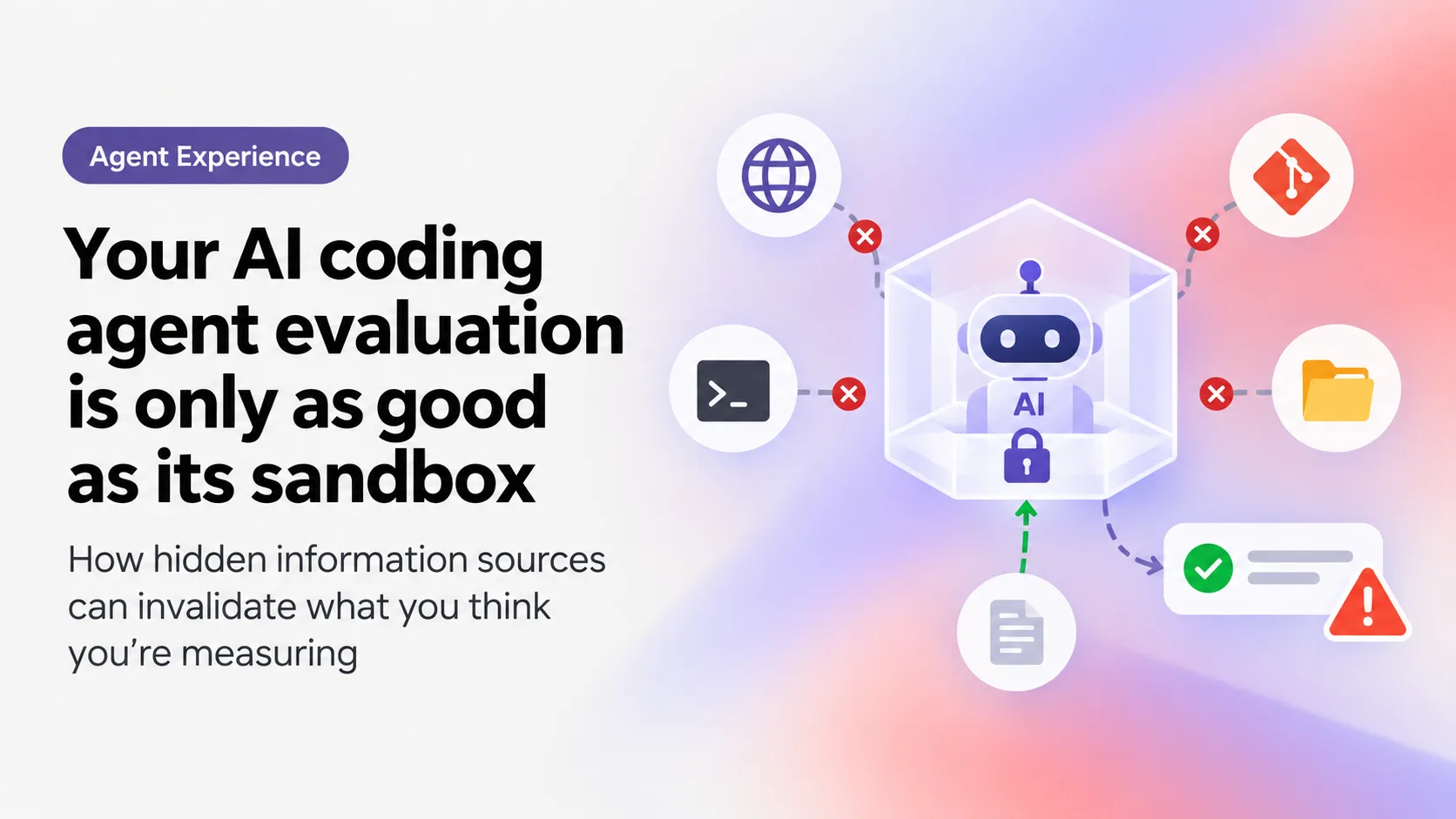
  5. Your AI coding agent evaluation is only as good as its sandbox

    Evaluating AI coding agents requires a robust sandbox to prevent agents from retrieving answers from the environment, which can invalidate tests of internal knowledge. A correct answer doesn't guarantee a valid measurement if the agent accessed information it shouldn't have, highlighting the need to define sandboxes by information boundaries rather than just tool restrictions. Always review agent…

    Microsoft for Developersmicrosoft.com5 min