proomt

Search

Search posts, papers, and topics

All posts

RenderJacob Prall4 min readintermediate
Build, deploy, and operate with coding agents on Render

Summary

Render adds OAuth‑based MCP access, expands its “skills” library to 20+ actions, and upgrades the CLI to manage full service lifecycles, enabling coding agents (Cursor, Claude, Codex, ChatGPT) to trigger deploys, adjust plans, and spin up disposable PR environments via structured JSON/YAML commands.

  • OAuth login replaces manual API‑key setup for the hosted MCP server, simplifying agent authentication while still supporting keys for CI.
  • The skills library now covers services, deploys, debugging, monitoring, Postgres, Key‑Value stores, and the Render CLI, giving agents concrete guidance for common ops tasks.
  • Render CLI can create, inspect, update, suspend, resume, and delete services, Postgres, and KV stores with non‑interactive JSON/YAML output, making it script‑friendly for agents.
  • Agents can automate PR‑level disposable environments: provision web service + DB + KV, run integration tests, report results, and clean up after merge.

Bridging AI coding agents with production‑grade infra ops lets developers offload repetitive deployment and environment‑management steps, reducing context‑switching and accelerating PR feedback loops. The OAuth flow lowers credential‑management friction, and the CLI’s structured output makes agent‑…

5/10
Related reading

  1. Blog: How to Build a DevOps Agent

    This blog walks through the open‑source DevOps Agent Kit, which lets Claude Code or Cursor act as a DevOps assistant by connecting to CloudBees Unify, Jira, and Slack via MCP servers and to GitHub via the CLI. It provides a repeatable setup (Docker, Node, env file) and seven slash commands for pipeline overview, triage, security, release readiness, flag management, CI health scoring, and Jira tic…

    Codeshipcloudbees.com10 min
  2. CodeMidas: Scaling Agentic Coding RL Environments from Code Itself

    CodeMidas builds RL environments directly from open‑source code: agents explore a repo, infer a spec, generate tests from the original implementation, and filter tasks via execution checks. The pipeline yields 5,545 high‑quality coding tasks across 23 languages and 15 domains. Training the MiMo‑V2.5 agent with GRPO on this dataset improves benchmark scores by 8‑18% (e.g., DeepSWE +11.7%, ProgramB…

    Hugging Face Daily Papersarxiv.org1 minpaper
  3. Inside OpenAI’s agentic software factory

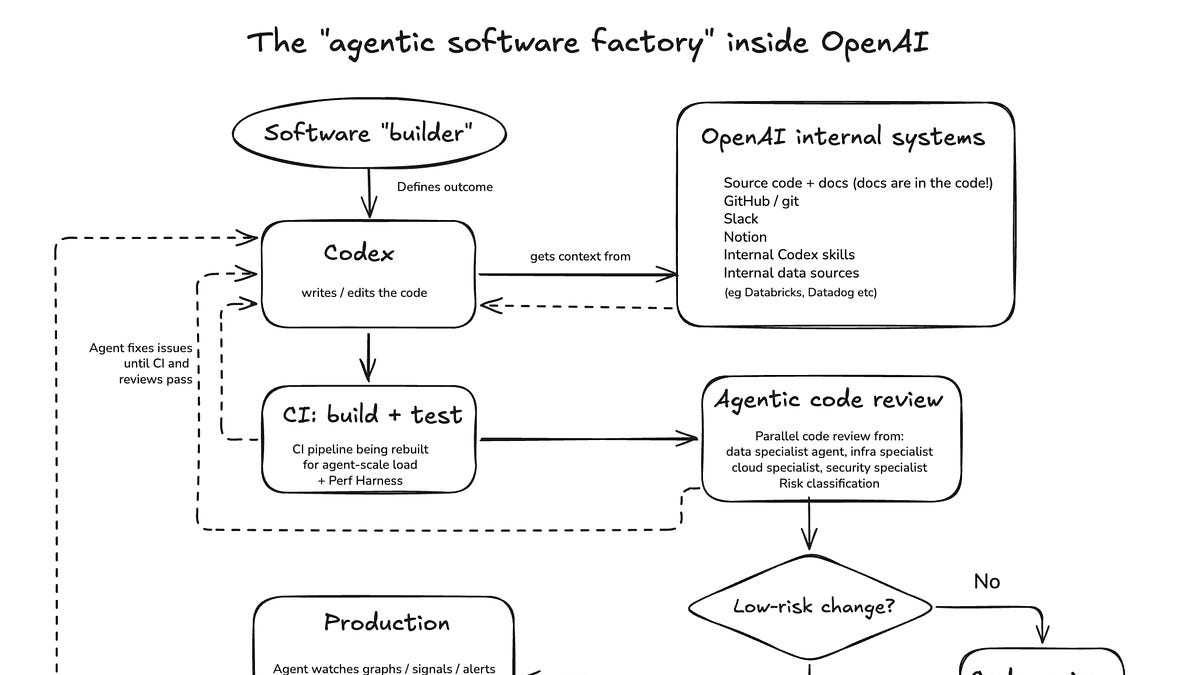
    OpenAI has internalized Codex and ChatGPT Work as a universal coding agent, achieving >90% adoption across the company and reshaping tooling, CI/CD load, and engineering roles. The shift has forced a new agentic software factory, massive infra scaling, and a rethink of IDEs, PRs, and code reviews.

    The Pragmatic Engineerpragmaticengineer.com15 minHN1
  4. Rails Hyperdrive: supercharged agentic development for Rails

    Rails Hyperdrive is a development‑only Rails engine that mounts a Model Context Protocol (MCP) server and lets any gem ship agent knowledge (skills, agents, commands, guidelines) as markdown files. The engine adds no knowledge itself; companion gems provide the context‑aware artifacts that agents can query at runtime, avoiding token‑heavy guessing and stale schema reads. Installation is a single…

    Evil Martiansevilmartians.com22 min
  5. Optimizing GitHub Actions for Agent PRs: Speculative Test Slicing and AST Impact Analysis

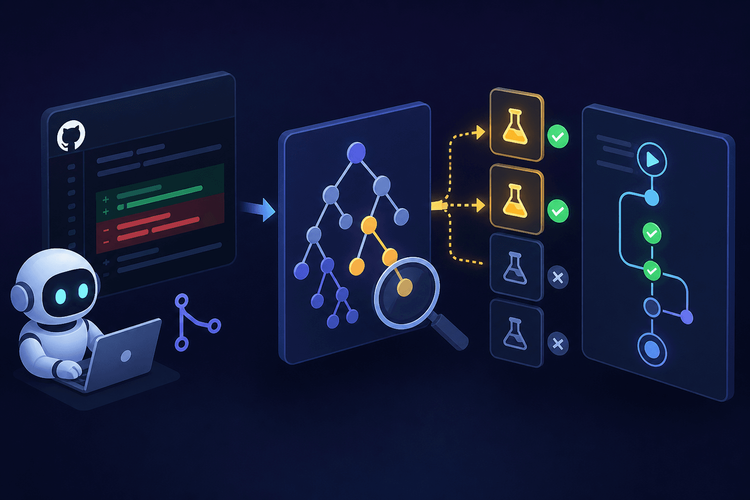
    A step‑by‑step guide for handling the flood of pull requests generated by code‑generation agents. It builds a TypeScript CLI that uses ts‑morph to do AST‑level change‑impact analysis, maps affected symbols to tests, and runs only those tests in a “speculative” GitHub Actions job while a full‑suite verification runs in the background. The article includes concrete CLI code, dependency choices, con…

    SitePointsitepoint.com17 min