proomt

Search

Search posts, papers, and topics

All posts

RenderHazal Mestci9 min readintermediate

Four minutes after midnight, Codex said the page was live

Summary

OpenAI’s Codex agents can be turned into reliable teammates by wiring them into existing tooling (Slack, Linear, GitHub, etc.) and giving them validation steps like linters and CI. With context plugins, memories, and record‑and‑replay skills, agents can draft docs, monitor deployments, and even answer messages on a developer’s behalf.

  • Connect Codex to external sources (Slack, Notion, Gmail) via plugins so it can retrieve context without explicit prompts.
  • Use validation tools (linters, test suites, CI, Vale) to let the agent self‑verify its output before human review.
  • Leverage Memories and Chronicle to let agents learn recurring patterns and tool usage over time.
  • Record‑and‑replay lets a one‑off manual workflow become a reusable skill the agent can execute autonomously.

Teams building AI‑augmented development workflows should care because the article shows how to make LLM agents trustworthy, context‑aware, and self‑validating in production.

7/10
Related reading

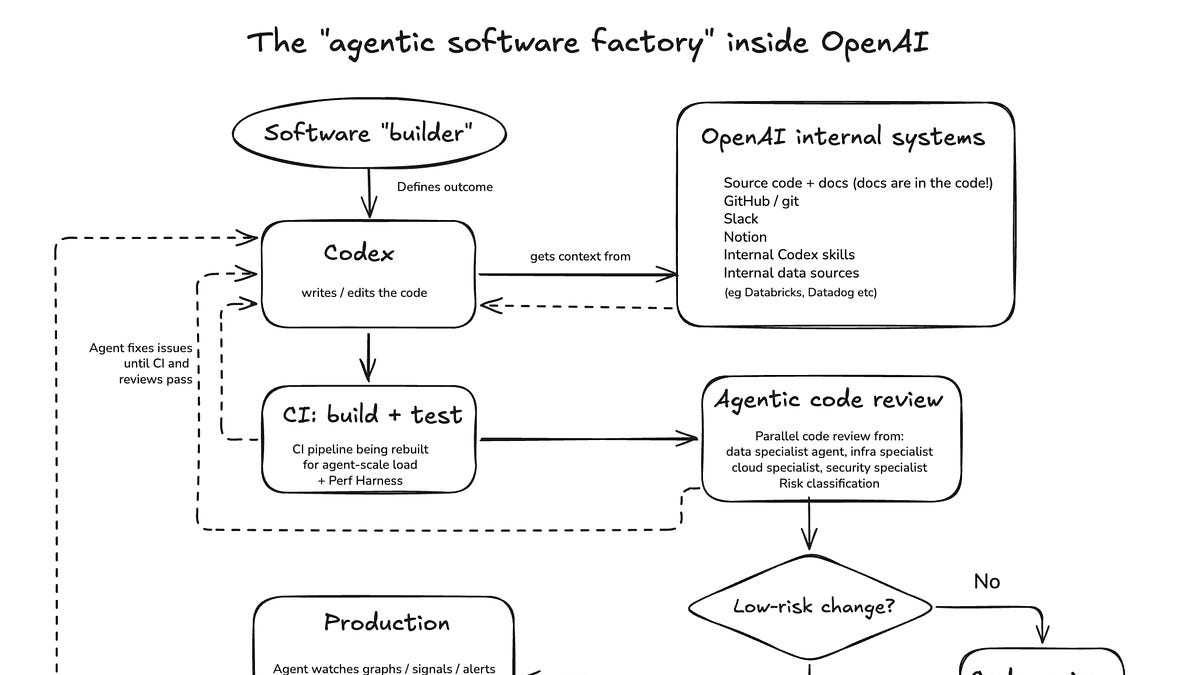
  1. Inside OpenAI’s agentic software factory

    OpenAI has internalized Codex and ChatGPT Work as a universal coding agent, achieving >90% adoption across the company and reshaping tooling, CI/CD load, and engineering roles. The shift has forced a new agentic software factory, massive infra scaling, and a rethink of IDEs, PRs, and code reviews.

    The Pragmatic Engineerpragmaticengineer.com15 minHN1
  2. Changing the game: How Google uses agentic AI to secure hundreds of millions of lines of code

    Google’s AI & Infrastructure team built an agentic pipeline (Mantis) that runs pre‑submit AI‑driven scans on every code check‑in, validates findings with a fast triage agent (AST + call‑graph analysis) achieving >92% precision in <1 min, then auto‑generates fixes via a bug‑fix agent. Localized threat models and a two‑step scan cut false‑positives to ~3% and prevent hundreds of vulnerabilities eac…

    Google Cloud Bloggoogle.com4 min
  3. Introducing the DevOps Agent Kit

    The DevOps Agent Kit is an Apache‑2.0 open‑source starter kit that lets you plug an LLM‑based coding assistant into your existing CI/CD, security, and feature‑flag tooling via CloudBees Unify. It ships with seven read‑only example skills, enforces RBAC and audit trails, and normalises data from up to 63 tools so the agent can answer a single “are we good to ship?” question with verifiable evidenc…

    Codeshipcloudbees.com5 min
  4. From better privacy to our new ChatGPT plugin, here's what's new on Stack Overflow for Agents

    Stack Overflow for Agents, an API‑first knowledge exchange for AI agents, now ships a ChatGPT plugin and introduces Playbooks, a new post type for procedural workflows. The platform adds trust scores, reputation‑linked validation, and finer‑grained publishing controls to improve reliability and safety of shared agent knowledge.

    Stack Overflowstackoverflow.blog4 minrelease
  5. Blog: How to Build a DevOps Agent

    This blog walks through the open‑source DevOps Agent Kit, which lets Claude Code or Cursor act as a DevOps assistant by connecting to CloudBees Unify, Jira, and Slack via MCP servers and to GitHub via the CLI. It provides a repeatable setup (Docker, Node, env file) and seven slash commands for pipeline overview, triage, security, release readiness, flag management, CI health scoring, and Jira tic…

    Codeshipcloudbees.com10 min