proomt

Search

Search posts, papers, and topics

All posts

Hacker News front pageDaniel W. Hieber, Ph.D.43 min readintro
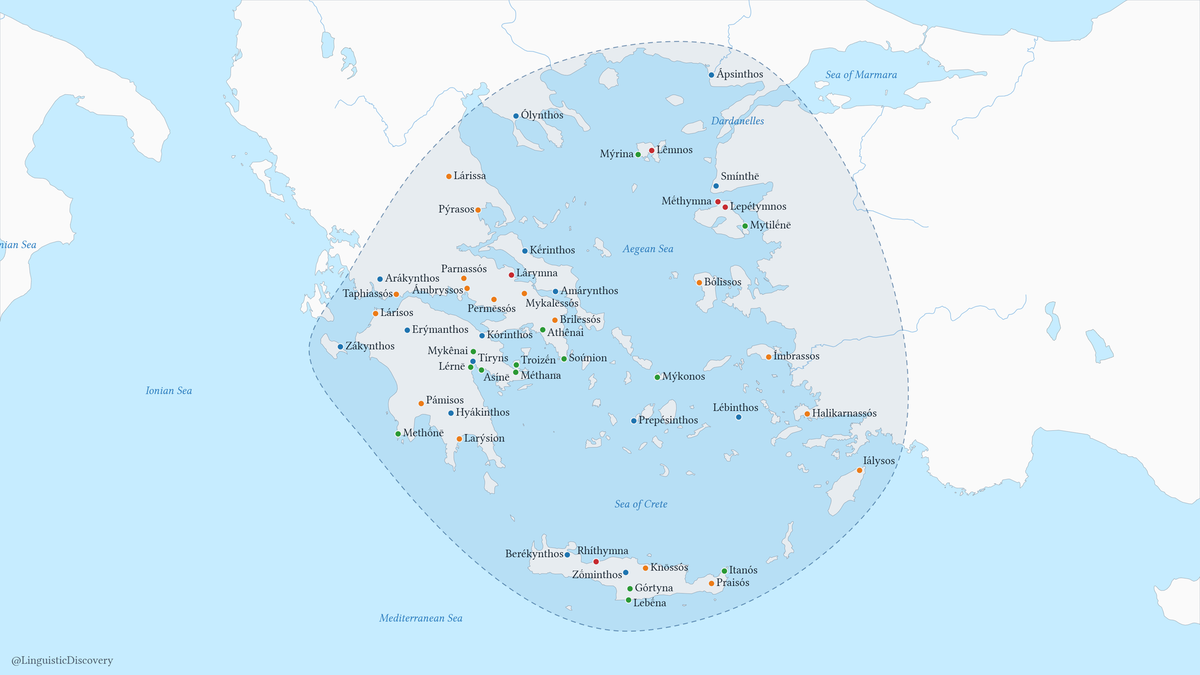
Pre-Greek: The lost language hidden within Ancient Greek

Summary

The article surveys the mysterious set of ~1,000 Ancient Greek words with no Indo‑European etymology, arguing they are borrowings from a now‑lost “Pre‑Greek” substrate spoken by earlier Neolithic farmers. It explains linguistic concepts (substrate, superstrate, adstrate), gives examples (olive, fig, cypress, etc.), and outlines how such borrowings reveal migration and contact patterns.

  • Around 1 000 Greek lexical items lack Indo‑European roots and are likely loans from a pre‑Greek substrate language.
  • Substrate/superstrate/adstrate frameworks explain how dominant cultures overwrite languages while leaving lexical traces.
  • Greek terms for Mediterranean flora and fauna (e.g., *elaía*, *kypárissos*) illustrate borrowing from earlier non‑IE peoples.

Shows how linguistic fossils can reconstruct prehistoric population movements—useful for anyone interested in the deep history of language, but not directly relevant to software engineering practice.

3/10


Related reading

  1. The Farnese letter

    The author reverse‑engineers a 1542 Italian cipher from a Farnese letter by combining digit‑frequency analysis with a beam‑search decoder guided by a five‑gram Italian language model, ultimately recovering the key and partial plaintext.

    Hacker News front pagesimonklee.dk42 minHN476
  2. Article: Your Next DSL Author Is a Language Model

    Typed Domain Grounding (TDG) embeds a DSL inside a mainstream language the LLM already knows (e.g., Kotlin) and uses the host compiler as an oracle. The author describes five building blocks—embedding, choosing a host language with high training‑data frequency, compiler‑driven type safety, a generate‑compile‑repair loop, and an on‑demand teaching tool—and shows measured results from kUML, a Kotli…

    InfoQinfoq.com18 min
  3. MoME: Mixture-of-Memory Embeddings for Context-Aware Sparse Lookup

    The paper proposes Mixture of Memory Embeddings (MoME), a context‑aware sparse lookup that replaces each token’s single memory row with a gated mixture of multiple slots. Experiments on Llama‑3, MobileLLM and Qwen3 show MoME outperforms existing memory‑embedding baselines at equal parameter and FLOP budgets and exhibits interpretable routing for polysemous tokens.

    Hugging Face Daily Papersarxiv.org1 minpaper