proomt

Search

Search posts, papers, and topics

All posts

SitePoint7 min readintermediate
Why Your AI Video Pipeline Shouldn’t Be Built Around One Model

Summary

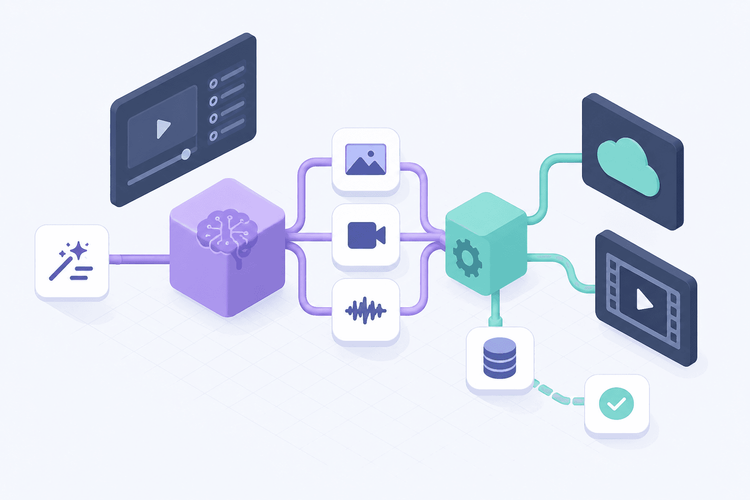
AI video generation APIs share a stable async task lifecycle but constantly change request payload details like duration limits and reference handling. Abstract those specifics behind a small VideoProvider interface and centralize validation to avoid rewrites whenever a provider updates.

  • Implement a provider‑agnostic task lifecycle function; only the payload varies per vendor.
  • Create a VideoProvider interface with generate() and provider‑specific subclasses handling validation and request building.
  • Centralize reference‑asset validation so limits can be updated in one place when providers change.
  • Add a lineage field to job state now to support multi‑round generation without later schema migrations.

Integration engineers building production AI video pipelines should care, as it prevents frequent rewrites when providers evolve their APIs.

6/10

Related reading

  1. Building a Reliable Script-to-Video Pipeline for Modern Web Applications

    A practical guide to building a reliable, observable script‑to‑video pipeline. It advocates a staged architecture (scene manifest → asset generation → voice → rendering → encoding), validates AI‑generated JSON with Zod, persists project and scene state, uses explicit workflow states, runs heavy work in background queues, limits concurrency, and stores voice, captions, and assets separately to ena…

    SitePointsitepoint.com11 min
  2. OmniVBench: A Benchmark and Large-Scale Dataset for Omni Reference-to-Video Generation

    OmniVBench is a new benchmark and the Omni‑R2V Dataset, offering 7 task families, 18 fine‑grained reference‑to‑video generation tasks and a factor‑grounded evaluation checklist of over 12 k items. The dataset provides 340 k industrial‑grade video samples and pipelines for constructing reference‑target pairs, exposing large performance gaps in current R2V models.

    Hugging Face Daily Papersarxiv.org2 minpaper
  3. 6 Ways Traditional API Design Has Changed Forever

    API design is shifting from human‑centric, resource‑based REST toward machine‑friendly, capability‑oriented interfaces as AI agents become major consumers. This drives changes in rate limiting, just‑in‑time security, system‑wide reliability, and regulatory compliance.

    Nordic APIsnordicapis.com6 min
  4. Cloudflare Introduces the Agent Development Lifecycle to Replace Traditional SDLC

    Cloudflare’s Agent Development Lifecycle (ADLC) replaces the classic SDLC with an autonomous, event‑driven workflow system that lets AI agents handle code generation, testing, deployment, and maintenance. The platform builds on Cloudflare Workflows and the new @cloudflare/ci library to spin up containers, run headless browsers, and chain steps with caching and credential support. Observability is…

    InfoQinfoq.com2 min
  5. Who Owns AI-Generated Code Failures?

    AI‑generated code breaks the traditional chain of ownership: developers merge PRs they didn’t write, reviewers approve logic they didn’t originate, and QA validates tests chosen by a model. A CloudBees survey shows 81% of firms see more production failures from AI code, and accountability often drifts upward to CTO/VP. The post argues role‑based accountability isn’t enough; you need end‑to‑end tr…

    Codeshipcloudbees.com4 min