proomt

Search

Search posts, papers, and topics

New

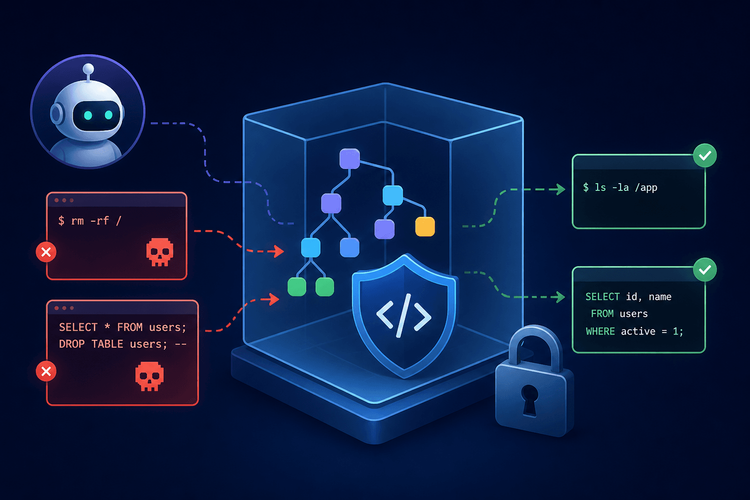
  1. AI Security Is an Engineering Problem — How to Solve It at Every Layer of the Agent Stack

    Nvidia frames AI security as an engineering discipline, outlining required controls across the AI agent stack (model, harness, runtime) and advocating for enforceable boundaries, traceable identities, and evidence‑based testing. It highlights OpenShell as a sandboxed runtime, the Open Secure AI Alliance, and several vendor tools for testing and red‑team exercises.

    Nvidianvidia.com4 min
  2. Squalk: an old-school forum engine built on Nostr (NIP-29 groups, NIP-7D threads)

    Squalk is a SvelteKit‑based forum built on the Nostr protocol, implementing NIP‑29 groups and NIP‑7D threads. It can run in a single‑forum “simple” mode or a multi‑forum “full” mode, with chat sidebars, markdown resources, and optional server‑side rendering for SEO. Configuration is done entirely via `PUBLIC_` environment variables, and deployment scripts support both static hosting and Node SSR,…

    Lobstersgithub.com5 minlobste.rs12
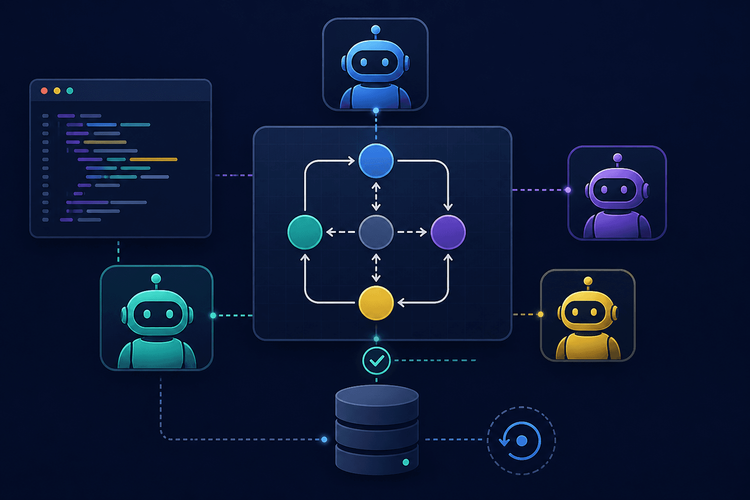
  3. Building Deterministic Multi-Agent State Machines in TypeScript

    The article shows how to build a deterministic, checkpoint‑backed finite state machine engine in TypeScript for orchestrating multi‑agent AI workflows. It uses Zod for schema validation, better‑sqlite3 for atomic persistence, and a pure transition function to make workflows traceable and recoverable in serverless environments.

    SitePointsitepoint.com18 min
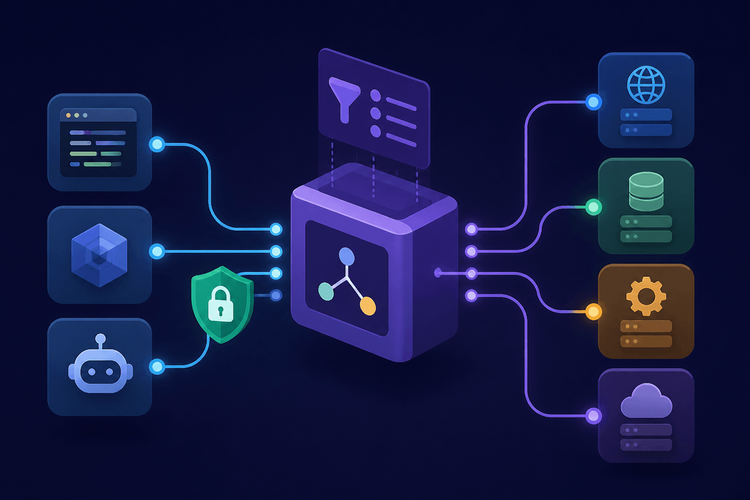
  4. Building Composite Model Context Protocol (MCP) Gateways in TypeScript

    Step‑by‑step tutorial showing how to build a stateless composite Model Context Protocol (MCP) gateway in TypeScript using Hono, Zod, and the MCP SDK. It covers config‑driven upstream registration, namespaced tool discovery, JSON‑RPC routing, per‑tool auth middleware, and a token‑bucket rate limiter, with concrete code snippets and design trade‑offs.

    SitePointsitepoint.com16 min
  5. Fixing Server Component Bundle Leaks in Next.js with AST Linting

    Server‑only code can silently inflate client bundles in Next.js 15+ apps. The article shows how to spot leaks with @next/bundle-analyzer, prevent them by removing shared barrel files or adding the `server-only` guard, and enforce a deny‑list of server modules via a custom ESLint rule that scans the AST of files with a `'use client'` directive. The rule is wired into a CI bundle‑budget check using…

    SitePointsitepoint.com14 min
  6. Textbook review: Is Parallel Programming Hard, And, If So, What Can You Do About It?

    A detailed, personal review of Paul McKenney’s free online textbook on parallel programming. The author, coming from a TLA⁺/distributed‑systems background, finds the early chapters excellent for building intuition about CPU caches, memory ordering, and false‑sharing, but notes gaps (e.g., shallow coverage of C++11 atomics and MESI). The review is concrete, cites specific chapters, and offers prac…

    Lobstersahelwer.ca8 minlobste.rs21
  7. Markdown in /src

    The essay argues that Markdown should be treated as source code and checked into a /src/md directory alongside the implementation it describes. Keeping intent in diffable, reviewable Markdown lets teams generate code and tests from it while preserving locality for both humans and AI agents.

    Lobstershtmx.org6 minlobste.rs10
  8. Cloudflare Introduces the Agent Development Lifecycle to Replace Traditional SDLC

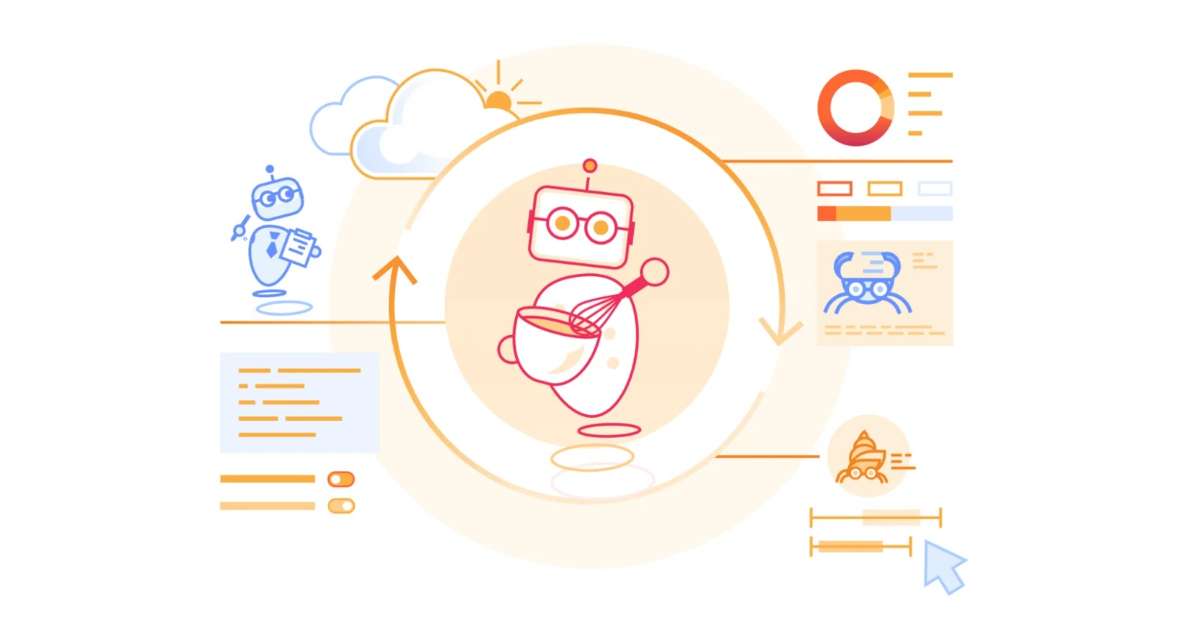
    Cloudflare’s Agent Development Lifecycle (ADLC) replaces the classic SDLC with an autonomous, event‑driven workflow system that lets AI agents handle code generation, testing, deployment, and maintenance. The platform builds on Cloudflare Workflows and the new @cloudflare/ci library to spin up containers, run headless browsers, and chain steps with caching and credential support. Observability is…

    InfoQinfoq.com2 min
  9. M5 Ultra Mac Studio Review

    The M5 Ultra Mac Studio (256 GB RAM) uses a quad‑die M5 Max architecture with an 80‑core GPU and 1.2 TB/s memory bandwidth, delivering ~70 % faster prompt‑to‑first‑token and token‑generation rates than the M3 Ultra. In the author’s tests Qwen3.8‑Flash‑Next hits 100 tokens/s on short prompts and 60‑85 tokens/s with 64‑256 KB context, making local AI agents (Open Minis, Hermes, Codex) feel snappy a…

    Hacker News front pagemacstories.net39 minHN191174
  10. Canonical announces Zephyr 26.04 LTS

    Canonical announced Zephyr 26.04 LTS, an enterprise‑grade RTOS with up to 15 years of security updates and built‑in OTA support via Golioth. It’s delivered through Ubuntu Pro for Devices and includes a containerized development environment to simplify MCU firmware builds.

    Lobsterscanonical.com4 minreleaselobste.rs12
  11. Pruning LLMs Like a Physicist: Block Removal as an Ising Optimization Problem

    The authors cast transformer block removal as a constrained binary optimization problem equivalent to an Ising glass, using a Hessian‑derived energy as a proxy for downstream quality. Solving the resulting QUBO with classical or quantum‑inspired solvers yields up to 23 MMLU points improvement over prior block‑removal baselines at 50 % depth compression.

    Hugging Facehuggingface.co8 min
  12. Python Workers are now generally available

    Python Workers are now GA on Cloudflare Workers. The runtime uses Pyodide‑compiled WebAssembly to run Python, adds first‑class support for Cloudflare bindings (queues, KV, etc.) without manual JS conversion, provides built‑in ASGI/WSGI adapters for FastAPI, Django, Flask, and implements a socket syscall bridge so standard Python DB drivers work via Hyperdrive. The team also pushed PEP 783 to stan…

    Hacker News front pagecloudflare.com9 minreleaseHN17528
  13. Concurrency Control: Your Aggregate Is Single-Threaded. Your Cluster Isn’t.

    This article distinguishes between serialization (preventing concurrent access) and arbitration (permitting access and rejecting losers) in distributed concurrency control. It argues that arbitration should be responsible for correctness, as serialization guarantees are conditional and can fail silently in multi-process environments, leading to data corruption.

    Atomic Objectatomicobject.com14 min
  14. Creating a Blog in Gemini://

    A practical guide to setting up a Gemini‑based blog (gemlog), covering platform choices, folder layout, naming conventions, optional features like favicons, security.txt, and interactive primitives using TLS client certificates.

    Lobstersbrennan.day17 minlobste.rs24
  15. Article: Beyond Relevance: A Governance-First Architecture for Enterprise Personalization

    The article proposes a governance‑first architecture for enterprise personalization, where policy‑driven steps (memory, journey graph, AI routing, scoring, trust checks, outcome simulation) shape the recommendation before it is returned. A reference FastAPI implementation demonstrates the pattern with external YAML policies and optional LLM assistance.

    InfoQinfoq.com19 min
  16. Podcast: Securing AI Agents: Identity, Authorization, and the DPACT Framework

    This podcast discusses the critical challenges of identity, authorization, and security for AI agents. It introduces the DPACT framework (Delegation, Policy, Auditability, Context, Time) as a blueprint for building responsible agentic systems with bounded, delegated authority, moving beyond simple token-based access.

    InfoQinfoq.com29 mintalk
  17. Introducing: Dark mode for Flare

    Flare adds a dark theme. The post outlines the design steps: defining semantic color tokens, adjusting gradients and shadows, and using side‑by‑side screenshots to verify the light theme stays unchanged. Accessibility is mentioned but no code or measurable results are provided.

    Freek Van der Hertenfreek.dev1 min
  18. Building Sentry's Laravel AI Integration

    Sentry added zero‑config Agent Tracing for Laravel AI agents. The integration hooks into Laravel AI events and HTTP request events to create Chat spans for each LLM call, matching requests by provider URL prefix. Updating to sentry‑laravel 4.27 automatically instruments agents without any user code changes.

    Sentrysentry.io4 min
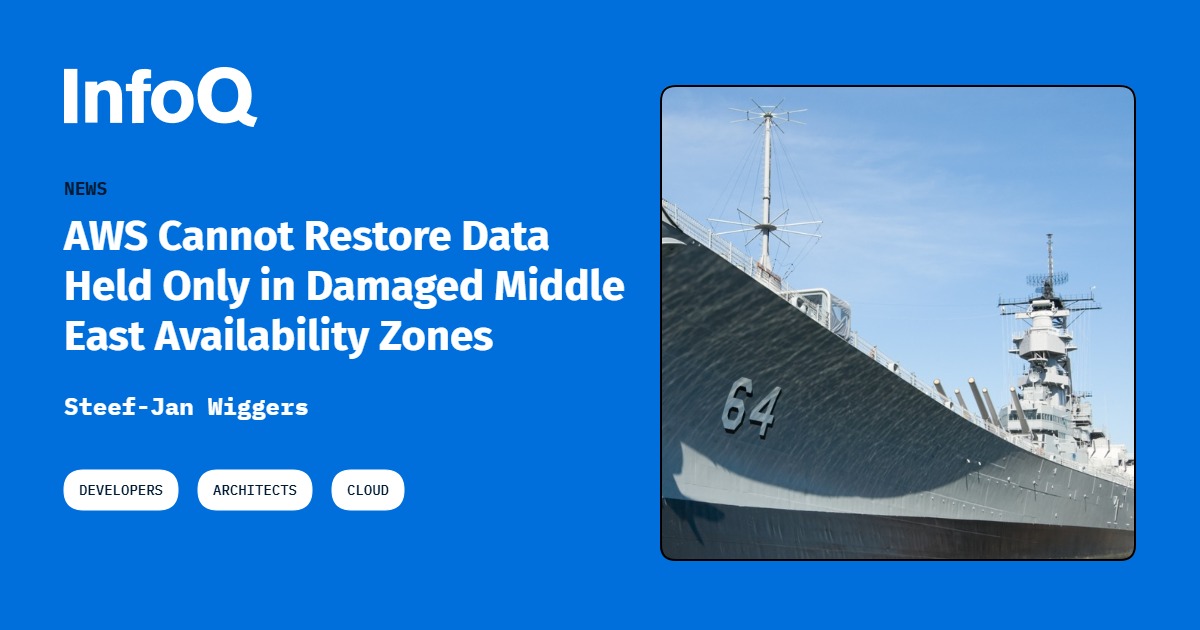
  19. AWS Cannot Restore Data Held Only in Damaged Middle East Availability Zones

    AWS admitted it cannot recover data that was stored only in the damaged Availability Zones of its Middle East (UAE) and Bahrain regions after Iranian drone strikes. The outage highlights that AWS’s multi‑AZ guarantees only protect against localized failures, not regional destruction, and that customers must implement cross‑region replication to meet durability and data‑residency requirements.

    InfoQinfoq.com5 min
  20. What Sun got wrong

    The author reflects on Sun Microsystems, arguing that despite strong technology, Sun failed because it grew bored with the mechanics of running a business—illustrated by a 2005 startup’s experience where Sun’s sales response was slow and mismatched while Dell’s personal rep closed the deal quickly. The story warns engineers and founders that operational discipline is as critical as technical visi…

    Lobstersdtrace.org3 minHN478263lobste.rs86