proomt

Search

Search posts, papers, and topics

Top

  1. 151

    If math is more than proof, we need to better celebrate the rest of it

    The author argues that mathematics should reward “motivated explanations” – narrative, intuition‑driven expositions that clarify why a theorem is interesting and how it fits into broader context – on par with traditional proof‑oriented work. He defines the concept, contrasts it with proofs, cites examples (Princeton Companion, Thurston’s essays, Chow’s exposition paper), and suggests formalizing…

    Hacker News front pagewordpress.com12 minHN423284
  2. 152

    Don't Mask the Environment: Observation Supervision Changes How Agents Explore Under RL

    ActObs is a supervised fine-tuning method that trains agents to predict both actions and environmental observations from trajectories. This joint supervision improves subsequent reinforcement learning performance, leading to better exploration and task completion on benchmarks like Terminal-Bench 2.0 and aider-polyglot.

    Hugging Face Daily Papersarxiv.org1 minpaper
  3. 153

    ScienceIDE: Turning World's Scientific Codebase into Agent Learnable Environments

    ScienceIDE is a framework that turns existing scientific software repositories into programmable environments that agents can use for task generation, execution, and verification. Training on these environments yields LLMs (PhAI‑IDE series) that outperform baselines on scientific code repair and several general code‑reasoning benchmarks.

    Hugging Face Daily Papersarxiv.org2 minpaper
  4. 154

    Show HN: Pizza Bot – An inbox for AI agents that work in the background

    Pizza Bot is an open‑source inbox for long‑running LLM‑based agents. It runs a stateful DeepAgents/LangGraph runtime behind an HTTP/SSE API server, with Electron, web, and CLI front‑ends. The tool supports multiple model providers (Bedrock, Anthropic, Gemini, OpenAI, OpenRouter, Ollama), checkpointed runs, human‑in‑the‑loop approvals, and a plugin/skill system. The repo includes a clear monorepo…

    Hacker News front pagegithub.com4 minreleaseHN5933
  5. 155

    Infinite-Parameter LLMs: Generating and Adapting Weights from Live Data

    The paper presents Infinite-Parameter LLMs, where a compact hypernetwork creates feed‑forward weights from live user data and updates a Bayesian latent code online, keeping the stored model size constant while effectively having infinite parameters. This design aims to improve over standard in‑context learning and retrieval by persisting knowledge in weights and freeing context space.

    Hacker News front pagearxiv.org2 minpaperHN15743
  6. 156

    UTF-8000: Unlimited UTF-8

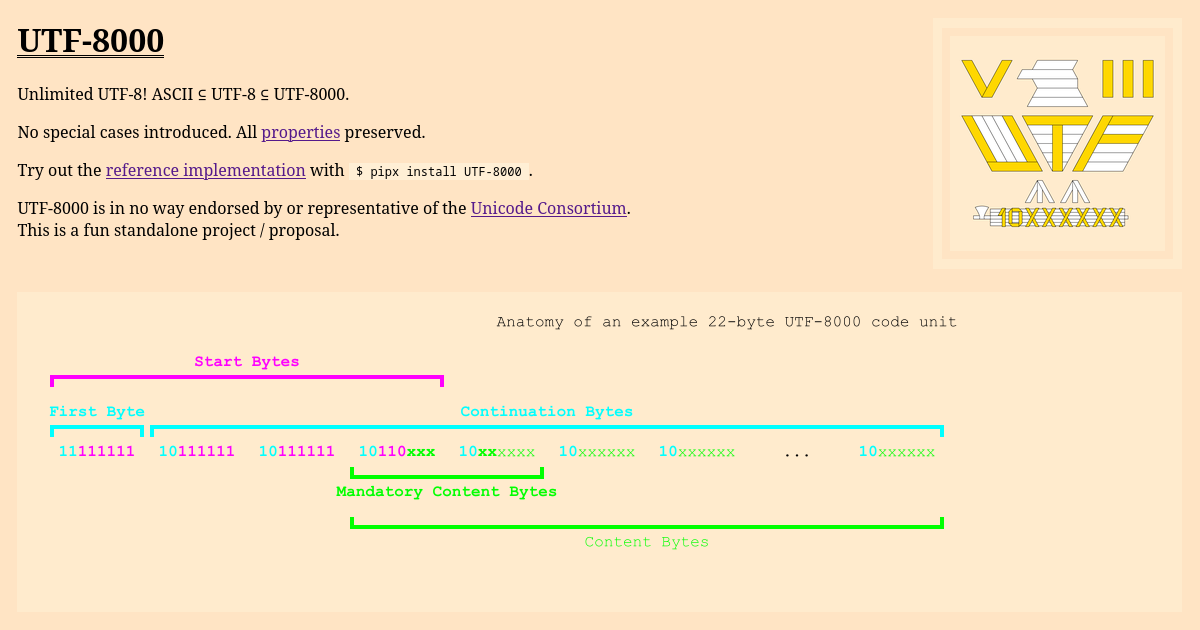
    A speculative proposal for an “UTF‑8000” encoding that extends UTF‑8 to arbitrarily long code units. The post defines a new self‑synchronizing byte format, introduces terminology (first byte, start bits, continuation byte, etc.), and links to a reference implementation installable via pipx. No performance data, real‑world use cases, or rigorous analysis are provided.

    Hacker News front pagejb2170.com90 minHN133118
  7. 157

    Trying the Software Factory Pattern

    The post describes an experiment implementing the software‑factory pattern: an AI‑driven loop that audits a Linear project, syncs goals from Notion, metrics from Datadog/Snowflake, creates and updates issues, and executes non‑blocked tasks. It shows how tying together a unified task tracker, observability data, and an orchestrated agent harness can keep projects aligned without manual state hoard…

    Hacker News front pagelethain.com3 minHN8745
  8. 158

    A custom virtual machine for the Stars! 4X game

    Stars!VM is a 32‑bit Windows executable that embeds a custom 80286 emulator and a Win16‑to‑Win32 bridge to run the 1995 4X game Stars! without any external emulators. The author adds differential fuzzing, hot‑routine patching, I/O buffering and asset compression, achieving about a 2× speedup in turn generation.

    Chris Wellonsnullprogram.com5 minHN8422
  9. 159

    Rethinking Critic Learning in PPO: Understanding and Mitigating Value Flattening

    PPO critics in reinforcement learning for LLMs suffer from "Value Flattening," where predicted state values are too flat compared to actual values. This paper identifies the causes as an implicit variance penalty and redundant updates, and proposes SParse Proximal Policy Optimization (SP3O) to mitigate it by supervising only a few well-separated states.

    Hugging Face Daily Papersarxiv.org1 minpaper
  10. 160

    Can MiniMax-H3 Reason About the Physical World? An Evaluation of Omni-Modal Generative Model

    This paper introduces a novel evaluation framework to assess the physical world reasoning capabilities of omni-modal generative models like MiniMax-H3. It found that MiniMax-H3 achieved an overall success rate of 41.97% across 517 instances, with significant performance variations depending on the input modalities and reasoning tasks.

    Hugging Face Daily Papersarxiv.org2 minpaper
  11. 166

    Anatomy of a Texture

    A practical deep‑dive into modern texture memory layout: block‑compression (BC7), swizzle ordering (Morton/Z‑order), mip‑map hierarchies, and concrete debugging tricks for cross‑platform texture conversion.

    Hacker News front pagegithub.io12 minHN10816
  12. 167

    Can we stop with the uptime percentages?

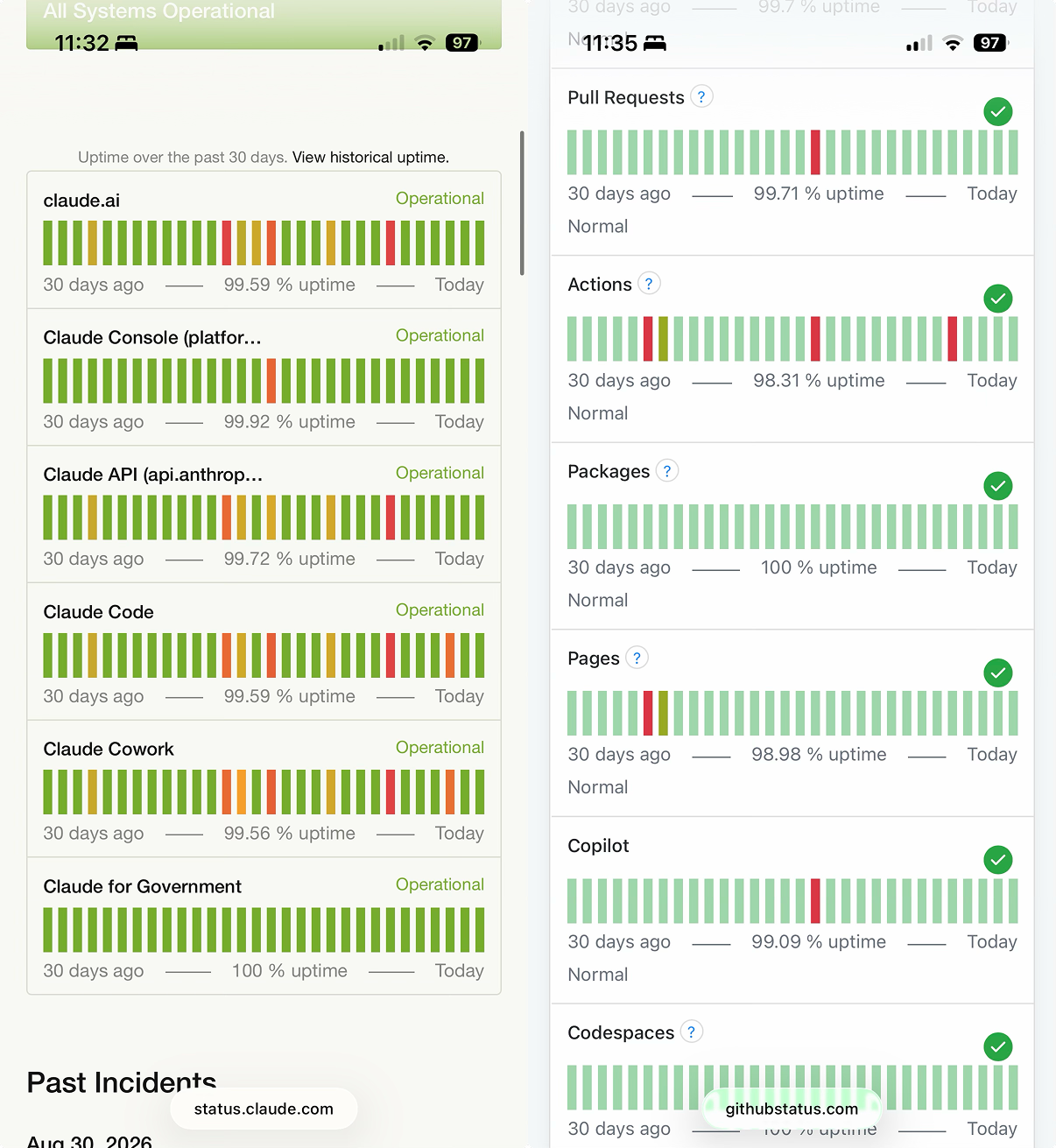
    This article argues that uptime percentages are a poor public interface for communicating service reliability because their non-linear nature is not intuitive to non-infrastructure people. It proposes showing absolute downtime (e.g., hours affected) alongside percentages for better clarity for a general audience.

    Hacker News front pagejim-nielsen.com2 minHN144112
  13. 168

    Rate limits on GitLab.com are changing

    GitLab.com will tie API rate limits to subscription tiers: free users (and unauthenticated IPs) get 60 req/hr, while Premium/Ultimate get higher per‑user and per‑group caps starting Oct 19 2026 (free) and Jan 2027 (paid). Authenticated requests use the plan’s limits; hitting a limit returns 429 with Retry‑After. Preview “brownout” windows on Oct 7 and 14 let you test the new caps. If you need mor…

    Hacker News front pagegitlab.com4 minHN174127
  14. 169

    Designer-RSI: Evolving Procedural Memory from User Traffic for Agentic Graphic Design

    The paper introduces Designer‑RSI, a continual‑adaptation system that couples a frozen design‑software‑controlling LLM with an external procedural memory of natural‑language design skills. Over five adaptation rounds on real user briefs, the memory grows from 76 to 139 procedures and lifts execution success from 72.7% to 99.3%, showing that skill accumulation and selective replay can dramatically…

    Hugging Face Daily Papersarxiv.org1 minpaper
  15. 172

    Wax motor

    Wax motors are linear actuators that turn thermal energy into mechanical motion via wax phase change. They consist of a wax chamber, a plunger, a heat source (electric, solar, combustion, ambient) and a heat sink. Wax expands 5‑20% on melting, delivering forces up to ~4000 N, with a bias spring providing 20‑30% of that force for retraction. Advantages include high force density, smooth actuation,…

    Hacker News front pagewikipedia.org4 minHN519106
  16. 174

    Agora: Git as Shared Memory for Collective AutoResearch

    Agora treats a Git repository as a shared, append‑only memory for autonomous research agents, recording each claim as an immutable commit in a DAG. In a 12‑day run with 13 language‑model workers it generated 1,703 reproducible contributions and closed 62 % of the gap to a trained GPT‑2‑124M, demonstrating that shared research state can accelerate discovery.

    Hugging Face Daily Papersarxiv.org2 minpaper
  17. 175

    Prompts aren’t Real

    The talk argues that prompt engineering is a dead‑end and proposes building large evaluation/optimization pipelines (pass^k testing, adversarial scenario generation, automated prompt optimization) to make LLM agents reliable. It describes a workflow: generate tests, run them with/without a new “skill”, feed results to a genetic optimizer that mutates prompts, validate on hold‑out tests, and itera…

    Hacker News front pageevaluation.club24 mintalkHN11757
  18. 177

    When EOS Tokens Disagree: Understanding Length Inflation in On-Policy Distillation

    On-policy distillation (OPD) can lead to excessively long student responses, a phenomenon called length inflation. This paper identifies "termination-token mismatch" between base students and post-trained teachers as a key source, where models place stopping probability on different EOS tokens. Treating functionally equivalent EOS tokens as a shared semantic stopping action substantially mitigate…

    Hugging Face Daily Papersarxiv.org1 minpaper
  19. 178

    RetireOPD: Self-Retiring On-Policy Distillation for Agentic Reinforcement Learning

    RetireOPD introduces a self‑retiring on‑policy distillation framework for multi‑turn RL agents. A skill‑conditioned teacher is first trained with environment rewards, then a skill‑free student learns jointly via RL and token‑level distillation. The student automatically drops the teacher once its performance gap stops shrinking and it reaches a target success‑rate fraction, after which training c…

    Hugging Face Daily Papersarxiv.org1 minpaper
  20. 180

    Show HN: Radius – A Meetup.com Alternative

    Radius is a new web platform marketed as a free, hyper‑local alternative to Meetup.com, letting users create groups, post events, and discover activities. The post is a product announcement with screenshots and UI copy but contains no technical details, architecture discussion, or implementation insights.

    Hacker News front pageradius.to1 minreleaseHN351152