proomt

Search

Search posts, papers, and topics

All posts

RenderHazal Mestci4 min readintermediate
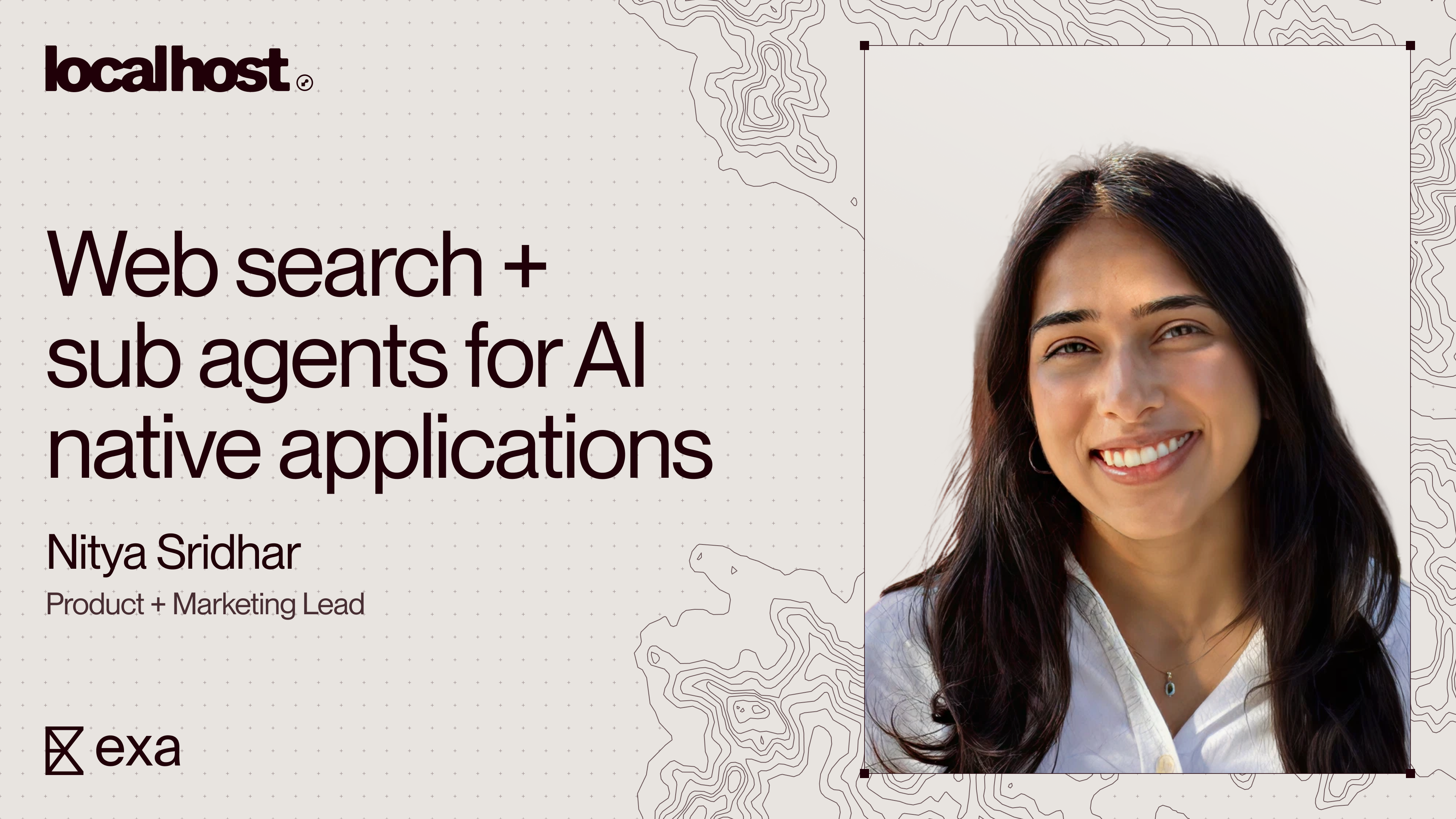
Search for agents splits discovery from proof

Summary

Exa’s Agent splits search for AI agents into a discovery phase (candidate generation) and a verification phase (evidence check). The design uses a powerful model for generation and cheaper models for parallel verification, optimizing latency, token usage, and cost. It treats the web as a structured database rather than a ranked list, and runs the verification sub‑agents as independent, fault‑tole…

  • Agent‑centric search requires low latency (200‑300 ms) and token‑efficient retrieval, unlike human‑focused search.
  • Treating the web as a database means semantic search and structured extraction outweigh simple keyword ranking.
  • Exa’s architecture separates discovery (expensive, high‑capacity model) from verification (cheap, narrow model) to control cost and improve quality.
  • Verification sub‑agents are independent, enabling massive parallelism and easy orchestration via a workflow engine.

As AI agents become the primary consumers of web information, search systems must shift from delivering ranked link lists to providing structured, verified data. Exa’s split‑architecture demonstrates a practical way to meet the latency, cost, and accuracy constraints of agent workloads, and shows h…

6/10
Related reading

  1. Changing the game: How Google uses agentic AI to secure hundreds of millions of lines of code

    Google’s AI & Infrastructure team built an agentic pipeline (Mantis) that runs pre‑submit AI‑driven scans on every code check‑in, validates findings with a fast triage agent (AST + call‑graph analysis) achieving >92% precision in <1 min, then auto‑generates fixes via a bug‑fix agent. Localized threat models and a two‑step scan cut false‑positives to ~3% and prevent hundreds of vulnerabilities eac…

    Google Cloud Bloggoogle.com4 min
  2. Cloudflare Introduces the Agent Development Lifecycle to Replace Traditional SDLC

    Cloudflare’s Agent Development Lifecycle (ADLC) replaces the classic SDLC with an autonomous, event‑driven workflow system that lets AI agents handle code generation, testing, deployment, and maintenance. The platform builds on Cloudflare Workflows and the new @cloudflare/ci library to spin up containers, run headless browsers, and chain steps with caching and credential support. Observability is…

    InfoQinfoq.com2 min
  3. The Web Search Your Agent Inherited Isn't Good Enough

    Omnigent is a unified agent definition layer that lets you write an LLM‑agent once and run it on any harness (Claude Code, Codex, raw API). By plugging Nimble’s specialized web‑search API into the Omnigent web_search builtin, you get consistent, deeper, and cheaper web results – benchmark accuracy jumps from 46 % to 71 % and search cost halves. All model calls go through Databricks Foundation Mod…

    Databricksdatabricks.com7 min
  4. The DevFest Community Workshop Experience: Building Real Agents Together

    Google’s DevFest Community Workshop introduced a “Workbench” format that emphasizes architectural mental models over copy‑paste code, guiding engineers to build long‑running, self‑evolving multi‑agent systems with the Agent Development Kit and Gemini Enterprise platforms. Attendees learned state‑separation, workflow pausing, and self‑patching pipelines, and the series will continue in five more c…

    Google Cloud Bloggoogle.com2 min
  5. CERA-MoA: Co-Evolving Routing Mechanisms with Continually Learning LLM Agents

    CERA-MoA proposes a reinforcement‑learning loop where a router and a set of LLM agents are trained together. A “familiarity” estimator reads mid‑layer hidden states to predict each agent’s competence on a query, letting the router activate only a minimal subset of agents that meet a cumulative confidence threshold. The system also feeds targeted training examples to agents based on their evolving…

    Hugging Face Daily Papersarxiv.org1 minpaper