proomt

Search

Search posts, papers, and topics

All posts

Hacker News front pagevolotat20 min readadvanced

Show HN: Mini-AGI – Dynamic continual learning model trained on 8GB VRAM

Summary

mini-AGI is a byte‑level continual‑learning language model that fits on a single 8 GB GPU by paging expert weight files from disk. It uses two dense prelude blocks followed by a recurrent block applied up to 24 times per character, with adaptive depth (PonderNet halting) and per‑application top‑8 expert routing. The system maintains a RAM cache and a VRAM resident set, swaps experts based on dema…

  • Continual learning without catastrophic forgetting is possible on consumer‑grade hardware by separating a small always‑resident trunk from a large disk‑backed expert pool.
  • Adaptive depth via a halting head (PonderNet) lets easy characters use few compute steps while hard ones use more, keeping average compute per token low (≈8–10 rows).
  • Per‑application expert routing (top‑8) and dynamic growth/pruning allow the model to allocate capacity where needed without a fixed tokenizer or vocabulary.
  • Keeping Adam moments with each expert file and using hysteresis for cache replacement prevents momentum contamination and reduces churn.

If personal LLMs can be trained and continuously updated on a laptop, the barrier to owning a private, data‑specific model drops dramatically. The design shows a path to scalable, on‑device continual learning that avoids the usual trade‑off between model size and hardware limits, and it provides co…

8/10
Related reading

  1. Designer-RSI: Evolving Procedural Memory from User Traffic for Agentic Graphic Design

    The paper introduces Designer‑RSI, a continual‑adaptation system that couples a frozen design‑software‑controlling LLM with an external procedural memory of natural‑language design skills. Over five adaptation rounds on real user briefs, the memory grows from 76 to 139 procedures and lifts execution success from 72.7% to 99.3%, showing that skill accumulation and selective replay can dramatically…

    Hugging Face Daily Papersarxiv.org1 minpaper
  2. Do LLMs Have the Memory of a Goldfish?

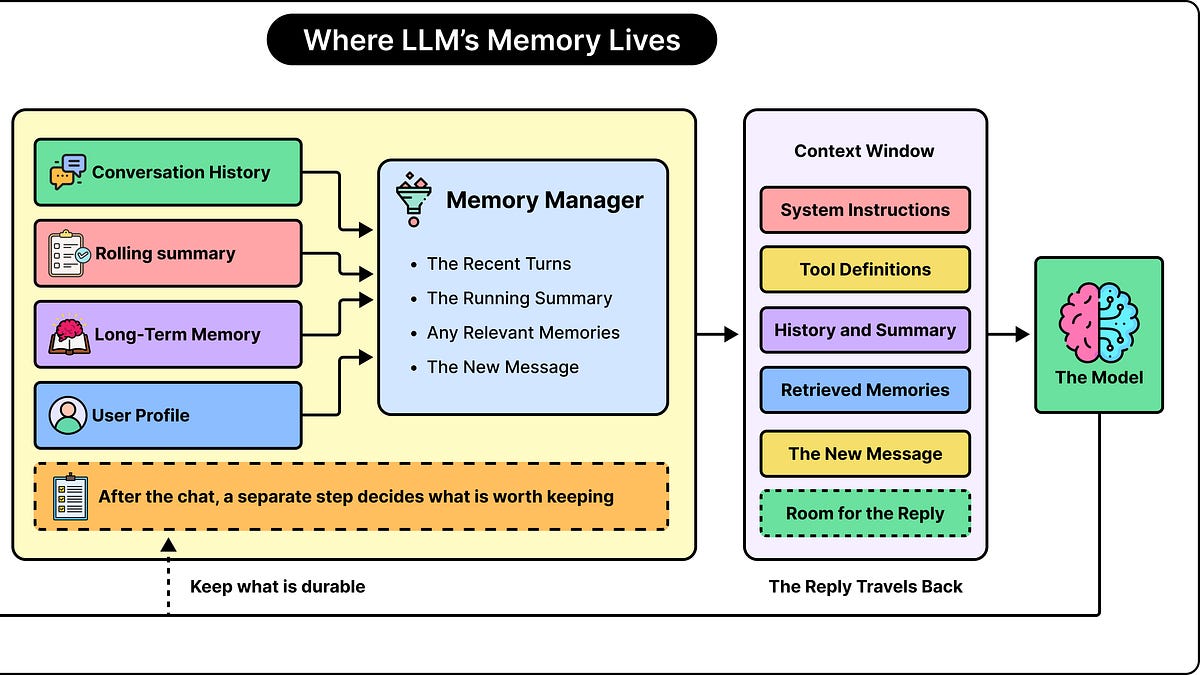
    The article explains that LLMs don’t have persistent personal memory; all “memory” is supplied by the surrounding application via the context window, summaries, or external storage. It outlines the distinction between trained weights, working‑memory (token context), and persistent application memory, shows how to construct API calls to preserve conversation state, and discusses the cost and laten…

    ByteByteGobytebytego.com12 min
  3. From Megawatts to Tokens: How NVIDIA Maximizes AI Factory Production

    NVIDIA’s DSX platform lets AI data‑centers shift workloads in response to grid signals, squeezing ~24% more token throughput (4 M→5 M tps) and ~23% better performance‑per‑watt on a fixed megawatt budget. The first production demo used Emerald AI’s Conductor to drop a 4 MW load to 3 MW in under a minute without interrupting high‑priority jobs. DSX MaxLPS reallocates headroom across HGX B200 server…

    Nvidianvidia.com5 min
  4. The Other Half of the Memory Wall: Serving 35B MoEs from SSD with Trained Routing Prediction

    The paper presents Edge0, a streaming MoE inference engine that predicts the next layer's routing one token ahead, allowing expert weights to be fetched from SSD while compute proceeds. This enables a 35 B‑parameter MoE to run on a single 24 GB machine at ~20 tokens/s using only ~3 GiB of active memory and with near‑teacher accuracy.

    Hugging Face Daily Papersarxiv.org1 minpaper