proomt

Search

Search posts, papers, and topics

All posts

Swizec Tellerhi@swizec.com (Swizec Teller)3 min readintermediate
We now auto-approve and merge 15% of PRs

Summary

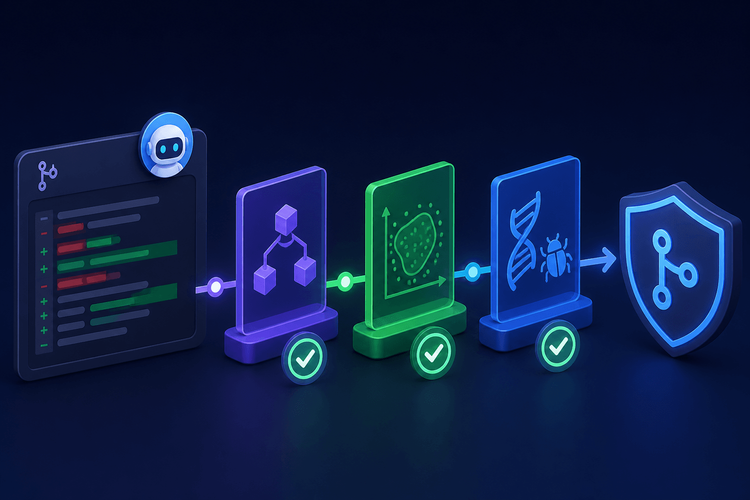
This article describes how a team implemented a bot to auto-approve and merge 15% of low-risk pull requests, aiming to reduce code review bottlenecks and improve development velocity. The system relies on custom deterministic linters, basic end-to-end tests, and a risk scoring mechanism to identify safe changes.

  • Code review can be a significant bottleneck to development velocity, leading to large backlogs.
  • Custom deterministic linters, often hundreds of lines of AST-parsing logic, can automate common code quality checks.
  • Basic end-to-end UI tests for critical user flows are sufficient to catch major regressions without aiming for 100% coverage.
  • Risk scores (low/mid/high) help reviewers prioritize and can be used to automate approvals for low-risk changes.

Engineers and team leads looking to improve development velocity and reduce code review overhead can learn practical strategies for automating parts of their CI/CD pipeline.

6/10
Related reading

  1. Presentation: Teaching Engineers, Trusting AI: How Education Enabled Autonomous Code Review

    Duolingo’s DevEx AI team built a program of AI‑literacy workshops, observability dashboards, office‑hours, and vendor partnerships to get engineers comfortable with LLM‑based tools. With that foundation they launched a PR‑risk‑assessment bot that auto‑approves low‑risk pull requests, cutting review bottlenecks while keeping defect rates flat.

    InfoQinfoq.com24 mintalk
  2. How to Review AI-Generated Python Code Efficiently

    A practical five‑step workflow for reviewing AI‑generated Python code, covering intent clarification, automated quality checks (linters, type checkers, security scanners, tests), risk‑first manual reading, a checklist of common AI mistakes, and fix‑verify loops, plus a ready‑to‑use dev‑environment setup.

    Real Pythonrealpython.com26 min
  3. Changing the game: How Google uses agentic AI to secure hundreds of millions of lines of code

    Google’s AI & Infrastructure team built an agentic pipeline (Mantis) that runs pre‑submit AI‑driven scans on every code check‑in, validates findings with a fast triage agent (AST + call‑graph analysis) achieving >92% precision in <1 min, then auto‑generates fixes via a bug‑fix agent. Localized threat models and a two‑step scan cut false‑positives to ~3% and prevent hundreds of vulnerabilities eac…

    Google Cloud Bloggoogle.com4 min