proomt

Search

Search posts, papers, and topics

New

  1. SNAP3D: Physically Grounded 3D Parts for Assembly from a Single Image

    The paper presents SNAP3D, a physics‑guided pipeline that converts a single image into a set of 3D parts that can be assembled without interpenetration. By using simulation‑driven connector placement and a new physics‑based evaluation, the method yields assemblies that are both geometrically accurate and stable enough for 3D printing.

    Hugging Face Daily Papersarxiv.org1 minpaper
  2. Redesigning a popular robotic arm

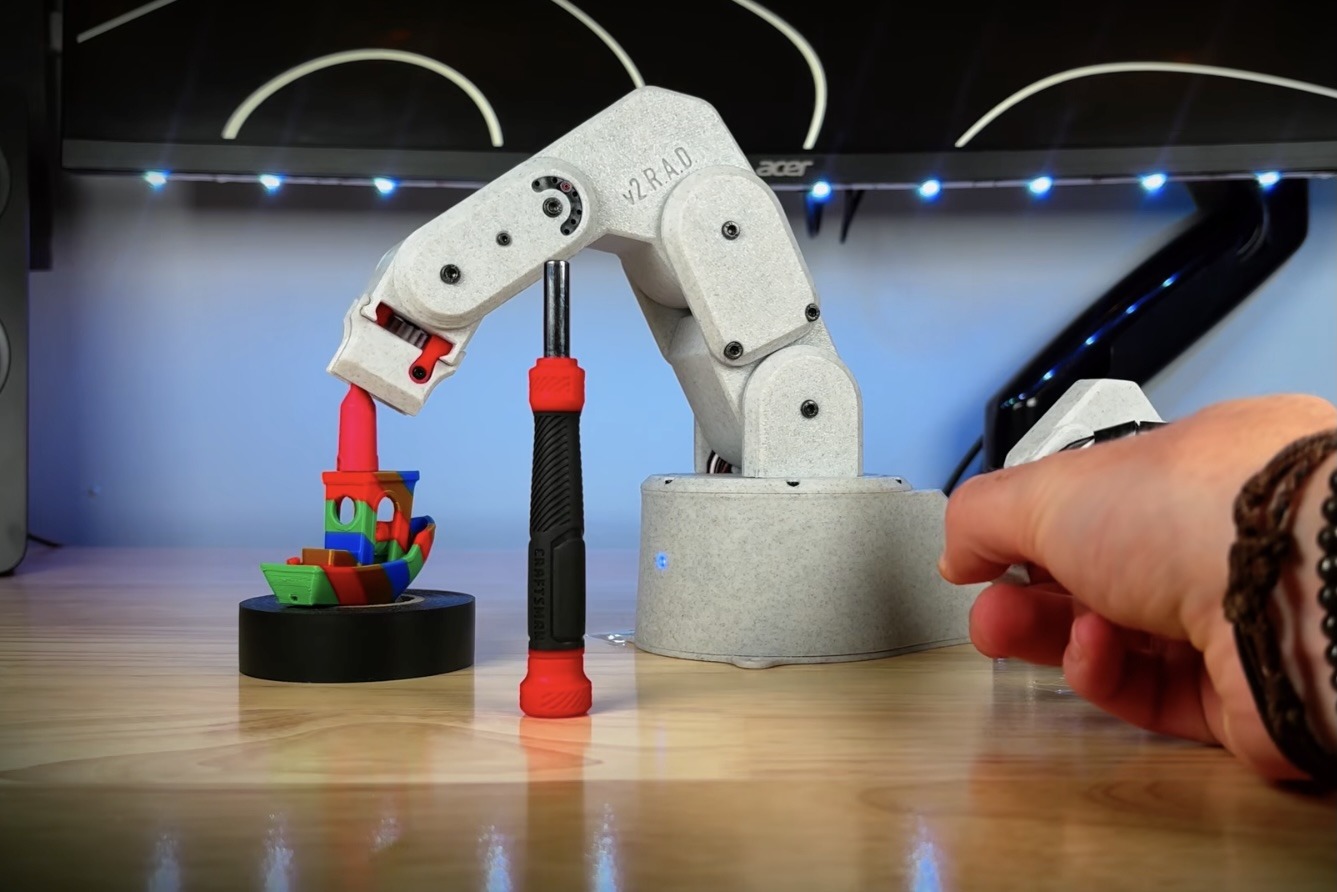
    Arduino’s blog spotlights a community‑built robotic arm that’s been mechanically redesigned for cheaper parts, easier 3‑D printing, and better performance. The arm uses a Nano ESP32 to read potentiometer‑based puppet‑style input and drive servos via a driver board, with belt‑driven wrist and rack‑and‑pinion gripper upgrades.

    Arduino Blogarduino.cc1 min
  3. Announcing Windows 11 Release Preview Builds 26100.9539/26200.9539

    Microsoft released Windows 11 24H2/25H2 Release Preview builds 26100.9539/26200.9539. The update ships via gradual or normal rollout and adds UI tweaks (File Explorer preview pane, Home state, thumbnail reliability), Emoji 17.0 support, a new Tips widget, extensive personalization background fixes, Bluetooth UI/audio stability improvements, accessibility “Open apps maximized”, refreshed Magnifier…

    Microsoft Edgewindows.com6 minrelease
  4. Who Owns AI-Generated Code Failures?

    AI‑generated code breaks the traditional chain of ownership: developers merge PRs they didn’t write, reviewers approve logic they didn’t originate, and QA validates tests chosen by a model. A CloudBees survey shows 81% of firms see more production failures from AI code, and accountability often drifts upward to CTO/VP. The post argues role‑based accountability isn’t enough; you need end‑to‑end tr…

    Codeshipcloudbees.com4 min
  5. Every tool is green. Can you ship?

    A CloudBees blog post argues that existing CI, security, and QA tools don’t give release managers a complete view of AI‑generated code risk. It claims tool consolidation rarely helps and proposes a “control plane” (CloudBees Unify) that aggregates signals from multiple tools and adds AI‑driven test prioritization. The piece is largely promotional, with no concrete implementation details, metrics,…

    Codeshipcloudbees.com4 min
  6. COBRA-Skills: Contextual Bandit-Guided Evolution for Agent Skill Optimization

    COBRA‑Skills uses a contextual‑bandit loop to selectively evaluate and evolve LLM agent skills, achieving better performance with roughly half the evaluation cost of prior methods. The framework works with limited examples and remains robust across different agent setups and even when the target model creates its own skills.

    Hugging Face Daily Papersarxiv.org1 minpaper
  7. The information geometry of large language models is shared, learned, and controllable

    The paper shows that the Fisher‑Rao geometry of next‑token probabilities is largely shared across transformer, state‑space and recurrent LLMs, and that this shared geometry can be used to design low‑disturbance interventions that steer model behavior. Experiments demonstrate that geometry predicts semantic transfer, fact acquisition, and enables reusable control better than Euclidean methods.

    Hugging Face Daily Papersarxiv.org1 minpaper
  8. Workflow or agent? What building QAradar taught us

    Deezer built QAradar, a workflow‑driven Slack‑bot that lets developers discover and run the exact automated tests covering their feature. By pre‑generating a clean test catalog and keeping the LLM in a fixed four‑step workflow, they avoided the complexity and cost of a full‑blown agent while dramatically reducing knowledge silos and friction for QA and developers.

    Deezermedium.com6 min
  9. This Week in Rust 668

    This issue of *This Week in Rust* (Sept 9 2026) aggregates community news, recent Rust releases, notable blog posts, a “crate of the week” (tokio‑rcu), and a long list of merged PRs across the compiler, std, Cargo, rustdoc, rustfmt, Clippy and rust‑analyzer. The most concrete technical highlight is the tokio‑rcu crate, an async‑aware userspace RCU implementation built on Tokio.

    Mozilla Automation Teamthis-week-in-rust.org10 min
  10. Towards a Deterministic Math Solver for Clinical Language Models

    The paper proposes a Program‑Solve interface where LLMs emit Python code that a sandboxed executor runs, making arithmetic deterministic for clinical calculators. Experiments show the approach boosts a 32B model’s accuracy on a verified benchmark, but coverage and upstream extraction remain limiting factors.

    Hugging Face Daily Papersarxiv.org1 minpaper
  11. Pick One Contact Without Asking for the Address Book

    Codename One adds a permission‑free `ContactPicker` API that uses the Android 17 system contact picker and iOS `CNContactPickerViewController` to let apps request only the specific fields (name, phone, etc.) they need. The picker returns a snapshot `Contact` object without granting broad address‑book access, and the API gracefully falls back on older platforms or unsupported cases.

    CodeName Onecodenameone.com3 min
  12. Automated Worker Versioning with GitHub Actions

    The post shows how to wire Temporal's Worker Controller with GitHub Actions to automatically build, version, and roll out worker images via Kubernetes. A demo repo illustrates the full CI pipeline and safe version upgrades.

    Temporaltemporal.io10 min
  13. Helping families and educators support safer experiences and healthier habits on Windows

    Microsoft announced the Windows Age API, a set of platform calls (GetUserAgeRangeAsync, GetAgeVerificationStatusAsync, CheckAgeStatusAsync) that expose age signals from a Microsoft account while preserving privacy. The APIs let Windows apps deliver consistent, age‑appropriate experiences and reuse verified age status, with parental controls now highlighted during device setup.

    Microsoft Edgewindows.com5 min
  14. We Stopped Waiting for Platform Changes to Find Us

    Codename One added a daily automated scan of Apple and Google deprecation notices, linking each notice to concrete builder artifacts before work is created. The system caught the Android 16 back‑gesture change and enabled a permission‑free ContactPicker, turning policy shifts into repeatable, evidence‑backed patches.

    CodeName Onecodenameone.com3 min
  15. Feyospace-v1: How the Cyber Mercury Seven Trained Frontier Cyber Models

    Feyospace‑v1 presents a data‑centric training pipeline for cyber‑security agents, combining five systems (Choulea, SkyReal, Hongzwang, PSBreakup, Kreator) to generate and verify 164 k long‑context trajectories across diverse exploit environments. The resulting checkpoints improve baseline performance by ~24% on CyberGym and achieve a 63% verified success rate, ranking top among similarly‑sized op…

    Hugging Face Daily Papersarxiv.org1 minpaper
  16. Claude watermarks its writing now. Should you worry?

    Anthropic added an invisible, statistical watermark to Claude’s output to satisfy EU AI‑Act transparency rules. The mark only signals that a model was involved; it doesn’t affect Google rankings, but creators should disclose AI use and avoid bulk unreviewed content.

    Hostingerhostinger.com8 min
  17. Fill an SMS Verification Code Without Reading the Inbox

    Codename One adds a one‑time‑code autofill component that leverages iOS, Android, and browser autofill APIs, eliminating the need for SMS‑reading permissions. The new `PhoneVerification` component handles phone entry, code entry, resend timing, and server callbacks, while the UI uses a single hidden editor to back six visual boxes, improving typing, paste, and accessibility. The post explains the…

    CodeName Onecodenameone.com3 min
  18. A Mac App, Not an iOS App on a Mac

    Codename One switched its default Mac build from iOS‑Catalyst to a native AppKit port. The new path creates true NSApplication/NSWindow objects with per‑window CAMetalLayer rendering, native menus, text input, multi‑monitor support and accessibility, eliminating the costly image‑copy pipeline of Catalyst and enabling proper desktop window behavior.

    CodeName Onecodenameone.com3 min
  19. Deep Persona: A Psychologically Grounded Architecture and Evaluation Framework for Role-Playing Agents and Simulations

    Deep Persona is a three‑layer architecture that models LLM personas with hierarchical expression, beliefs, and motivations, and enforces behavior through scripted determinism and bounded agency. The authors also introduce a reference‑free evaluation using psychological instruments, finding that structured personas improve alignment with human dialogue but LLMs still lag in emotion and joint atten…

    Hugging Face Daily Papersarxiv.org1 minpaper
  20. SkillSpec: Intent-Masked Specification Reasoning for Agent Skill Correctness

    SkillSpec introduces a Hoare‑style framework that turns heterogeneous agent skill artifacts into a unified graph and reasons about correctness via intent‑masked specifications. In a study of 515 real‑world skills it flagged 763 confirmed defects with 61.2% precision, especially exposing intent‑implementation mismatches.

    Hugging Face Daily Papersarxiv.org1 minpaper